


Contents
- 1 What Is SHA BLS Certification and Why Does Saudi Arabia Require It?
- 2 Understanding AHA BLS Certification and Its Recognition Status in KSA
- 3 Which Certification Do You Actually Need for SCFHS, DHA, and MOH Licensing?
- 4 Practical Comparison: SHA vs AHA BLS Certification for KSA Healthcare Jobs
- 5 Getting SHA Certification: Your Step by Step Process
- 6 Frequently Asked Questions
- 6.1 Is AHA BLS valid in Saudi Arabia for nurses applying for SCFHS license?
- 6.2 Do I need Saudi Heart Association BLS for SCFHS medical license renewal?
- 6.3 Can I convert AHA to SHA certification in KSA without taking the full course?
- 6.4 What is the best BLS certification for Saudi Arabia hospital jobs?
- 6.5 How long does SHA BLS certification take to receive after completing the course?
- 7 Conclusion
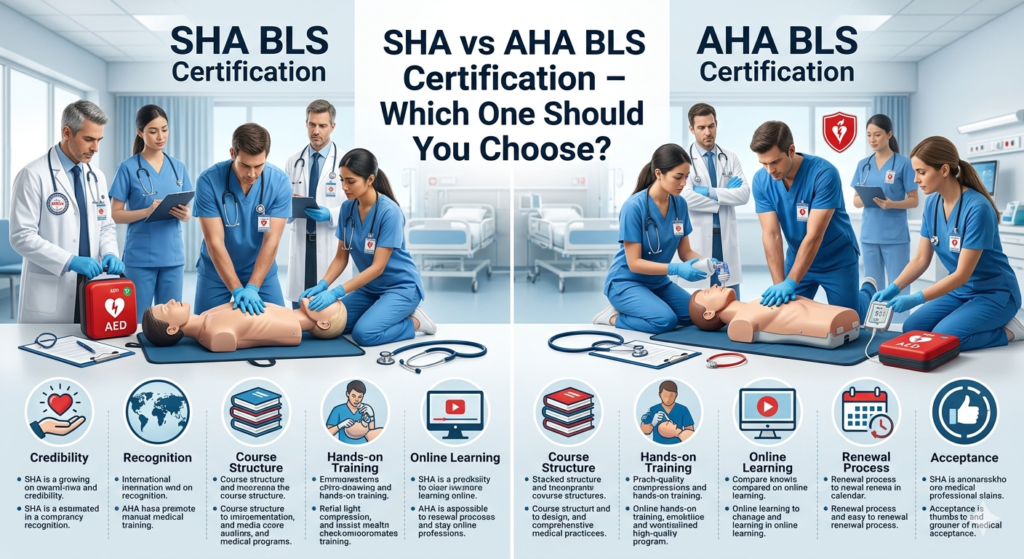
If you’re a healthcare professional planning to work in Saudi Arabia, you’ve probably heard mixed advice about BLS certification. Some colleagues swear by AHA certification while others insist you need SHA. The confusion is real, and getting it wrong can delay your licensure or job application.
Here’s what actually matters. Saudi Arabia officially recognizes certifications from the Saudi Heart Association (SHA) as its national standard. The Saudi Commission for Health Specialties (SCFHS) primarily accepts SHA BLS certification for healthcare professionals applying for licenses in the Kingdom. While AHA certification is internationally recognized and sometimes accepted initially, most healthcare positions eventually require SHA certification for compliance with Saudi regulations. EUTC Global provides both certification pathways, helping healthcare professionals understand which option fits their specific career timeline in KSA.
The choice between these certifications affects your employability, license processing time, and career progression in Saudi hospitals. Let me break down exactly what you need to know.
TL;DR: SHA BLS certification is the official standard required by SCFHS for healthcare licensing in Saudi Arabia. While AHA certification may be accepted for initial applications in some hospitals, SHA remains mandatory for long-term compliance. The Saudi Heart Association hosted the largest cardiac meeting in the Middle East on November 16, 2025, reinforcing its authority in regional cardiac care standards. (Saudi Heart Association, 2025)
What Is SHA BLS Certification and Why Does Saudi Arabia Require It?
SHA BLS for Healthcare Providers specifically targets public safety professionals and healthcare providers. It teaches essential skills for CPR, respiratory arrest, cardiac arrest, and choking response situations. (Academy of Sciences, 2026)
The Saudi Heart Association developed its certification program to align with Saudi Arabia’s specific healthcare protocols and cultural context. SCFHS, the regulatory body overseeing healthcare professionals in KSA, recognizes SHA as the official standard for basic life support training.
SHA courses run throughout the year in major Saudi cities. Scheduled sessions include dates on January 21, February 4, February 18, and March 4, 2026, in Riyadh, with additional offerings in Dammam and other locations. (Academy of Sciences, 2026)
Course duration typically runs from 8 AM until 12 PM, with timing adjustments during Ramadan. Participants must arrive 15 minutes early for registration. (Academy of Sciences, 2026) The training emphasizes practical skills for code team harmony in advanced critical care situations. This team-based approach reflects the collaborative nature of emergency response in Saudi hospitals. (SHA CPR, 2026)
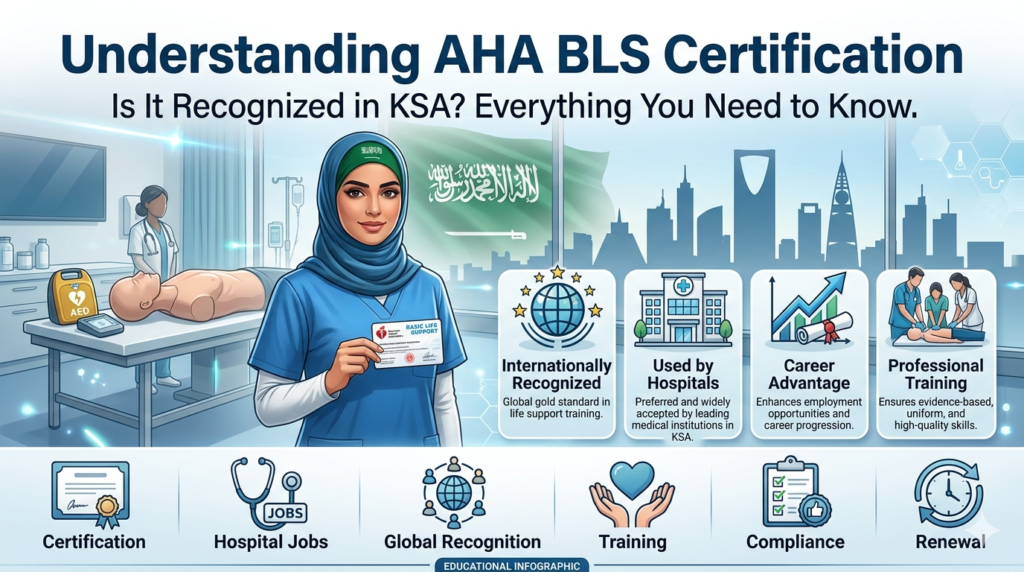
Understanding AHA BLS Certification and Its Recognition Status in KSA
The American Heart Association holds global recognition as a premier cardiac care training organization. Its BLS certification is accepted in over 80 countries and remains the standard in many Western healthcare systems.
Many healthcare professionals arrive in Saudi Arabia already holding valid AHA certification. Hospitals sometimes accept this initially during urgent hiring situations or temporary assignments. International medical staff from the US, UK, Canada, and Australia often possess AHA credentials.
However, acceptance isn’t universal or permanent. Most employment contracts specify that staff must obtain SHA certification within a defined period, typically three to six months from the start date. This requirement ensures compliance with SCFHS regulations.
Private hospitals occasionally show more flexibility with international certifications during initial hiring. Government hospitals and those seeking CBAHI accreditation maintain stricter adherence to SHA requirements.
Our insight: If you already hold AHA certification and plan to work in KSA, don’t assume it’s sufficient. Contact your prospective employer’s HR department before arriving to confirm their specific certification requirements and whether they provide SHA training for new hires.
The curriculum between AHA and SHA programs shares substantial similarities. Both cover chest compressions, airway management, defibrillator use, and team dynamics. The core life-saving skills remain consistent.
Key differences emerge in protocols, documentation formats, and cultural considerations specific to Saudi healthcare settings. SHA training incorporates local emergency response systems, Saudi hospital hierarchies, and communication patterns familiar to the Kingdom’s healthcare environment.
Which Certification Do You Actually Need for SCFHS, DHA, and MOH Licensing?
SCFHS licensing applications for nurses, doctors, and allied health professionals require SHA BLS certification as the standard. (Academy of Sciences, 2026) This applies whether you’re applying for initial licensure or license renewal. Your application checklist will explicitly state “valid SHA BLS certification” among the required documents.
The Dubai Health Authority (DHA) operates independently from Saudi regulations. If you’re considering UAE opportunities, DHA accepts both AHA and other internationally recognized BLS certifications. Don’t confuse DHA requirements with SCFHS.
Ministry of Health (MOH) positions within Saudi Arabia follow SCFHS standards. Whether you’re applying to MOH hospitals in Riyadh, Jeddah, Dammam, or smaller cities, SHA certification remains necessary. Some hospitals conduct their own BLS training courses for incoming staff. Ask about this during your interview process. It can save time and ensure you meet local requirements immediately.
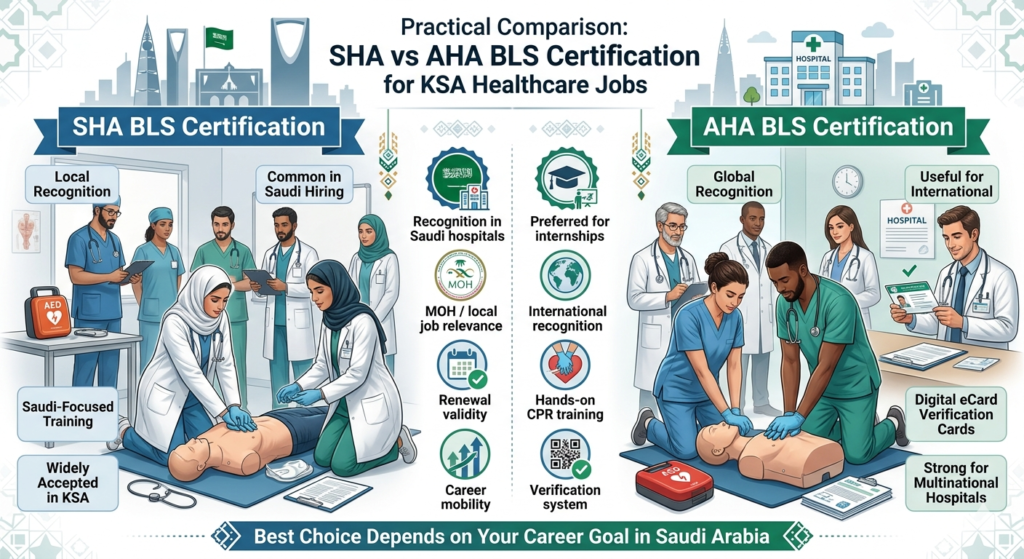
Practical Comparison: SHA vs AHA BLS Certification for KSA Healthcare Jobs
Here’s a straightforward comparison to help you make an informed decision:
| Factor | SHA BLS | AHA BLS |
|---|---|---|
| SCFHS Recognition | Officially required | Not accepted for licensing |
| Course Availability in KSA | Regular sessions in Riyadh, Jeddah, Dammam | Limited, mostly international providers |
| Cost in Saudi Arabia | 800 to 1200 SAR typically | Varies, often 1500+ SAR if available |
| Validity Period | 2 years | 2 years |
| Hospital Acceptance | All Saudi hospitals | Temporary acceptance only in some private facilities |
| Language Options | Arabic and English | Primarily English |
| Course Duration | 4 hours (8 AM to 12 PM) | 4 to 6 hours |
| Certification Timeline | Confirmation within 24 hours, eBook access provided | Varies by provider |
SHA BLS courses provide participant confirmation within 24 hours of enrollment. eBook access and pre-course reminders are also provided. This streamlined process helps healthcare professionals plan their schedules effectively. (Academy of Sciences, 2026)
Payment flexibility exists for SHA courses. This includes options like Tamara installment payments for course fees. (Academy of Sciences, 2026)
For example, a SHA BLS Provider course scheduled from April 8 to April 8, 2026, at the Industrial Technical Training Institute in Dammam runs from 16:00 to 20:00, accommodating healthcare workers’ varying shift schedules. (KSA CPR, 2026)
Our insight: If you’re currently outside Saudi Arabia preparing for a healthcare position in KSA, prioritize getting SHA certification before arrival if possible. It prevents delays in starting work and demonstrates your commitment to meeting Saudi healthcare standards to prospective employers.
Getting SHA Certification: Your Step by Step Process
First, identify an approved SHA training center in your location. Major cities like Riyadh, Jeddah, and Dammam host multiple authorized centers. Check the official SHA CPR website for verified providers.
Register online through the training center’s portal. You’ll need basic personal information, professional credentials, and payment details. Most centers offer online registration with immediate confirmation.
Complete any pre-course requirements. Some programs require reviewing educational materials or completing online modules before attending the hands-on session.
Attend the full course session. SHA BLS typically lasts four hours and includes demonstrations, practice sessions, and skills assessments. Participation in all segments is mandatory.
Pass the skills assessment. Instructors evaluate your technique in chest compressions, rescue breathing, AED use, and team coordination. You must demonstrate competency in each area.
Receive your certification card. Digital certificates often arrive within 24 to 48 hours, while physical cards may take one to two weeks.
For healthcare professionals interested in teaching BLS, SHA offers a one-day BLS Instructor course to train future instructors. (SHA CPR, 2026) [INTERNAL-LINK: First aid training courses → certified first aid and emergency response training] complement BLS certification for comprehensive emergency preparedness in healthcare settings.
Frequently Asked Questions
Is AHA BLS valid in Saudi Arabia for nurses applying for SCFHS license?
No, AHA BLS certification is not accepted by SCFHS for nursing license applications in Saudi Arabia. You must obtain SHA BLS certification to complete your SCFHS registration. Some nurses report initial acceptance during document submission, but the application ultimately requires SHA certification before license approval. Plan to complete SHA training either before arriving in KSA or within your first month.
Do I need Saudi Heart Association BLS for SCFHS medical license renewal?
Yes, SCFHS requires valid SHA BLS certification for medical license renewals. Your BLS certificate must remain current throughout your practice period in Saudi Arabia. Renewal applications submitted with expired BLS certification face processing delays. Most physicians schedule their SHA BLS renewal course three to four months before certificate expiration to ensure continuous coverage and avoid last-minute scheduling conflicts.
Can I convert AHA to SHA certification in KSA without taking the full course?
No direct conversion or bridge program exists between AHA and SHA certifications. Healthcare professionals holding AHA BLS must complete the full SHA BLS Provider course to receive SHA certification. The course duration remains the same regardless of previous certifications. However, your existing BLS knowledge and skills make the SHA course easier to complete, as core concepts overlap substantially between the two programs.
What is the best BLS certification for Saudi Arabia hospital jobs?
SHA BLS certification is the best and only officially recognized option for healthcare jobs in Saudi Arabia. Hospitals hiring staff for government positions, MOH facilities, or SCFHS regulated roles require SHA certification without exception. Private hospitals may temporarily accept AHA during initial hiring but require SHA certification for continued employment. International healthcare professionals should prioritize SHA certification from the beginning to avoid complications with employment verification or license processing.
How long does SHA BLS certification take to receive after completing the course?
Participant confirmation occurs within 24 hours of course completion, and eBook access is provided immediately. (Academy of Sciences, 2026) Digital certificates typically arrive within 24 to 48 hours via email. Physical certification cards take one to two weeks to receive through postal delivery. Most healthcare professionals can begin using their digital certificate for employment verification and license applications immediately after receiving it electronically.
Conclusion
The certification question for Saudi Arabia healthcare professionals has a clear answer: SHA BLS is the required standard. While AHA certification holds value internationally, it won’t satisfy SCFHS licensing requirements or long-term employment needs in the Kingdom.
Here are your key takeaways:
- SHA BLS certification is mandatory for SCFHS licensing for all healthcare professionals including nurses, doctors, paramedics, and allied health staff.
- AHA certification may serve as a temporary credential during initial hiring at some private hospitals but cannot replace SHA for regulatory compliance.
- SHA courses run regularly throughout Saudi Arabia with flexible scheduling, including evening sessions and Ramadan-adjusted timings.
- Course completion takes approximately four hours with digital certification available within 24 to 48 hours.
- Both certifications remain valid for two years, but only SHA meets Saudi regulatory standards.
Don’t delay your certification decision. If you’re planning to work in Saudi Arabia, schedule your SHA BLS training as early as possible in your preparation process. Contact approved training centers, verify course dates, and complete your certification before starting your SCFHS license application.
Your professional credentials matter. Getting the right certification from the start prevents delays, demonstrates cultural awareness, and positions you for success in Saudi Arabia’s growing healthcare sector.