


Contents
- 1 What is Basic Life Support (BLS)?
- 2 The BLS Chain of Survival: Why Each Link Matters
- 3 What Does BLS Training Cover?
- 4 Are BLS and CPR the Same Thing?
- 5 Why Workplace BLS Training Isn’t Optional Anymore
- 6 The Real Cost of Not Having BLS-Trained Staff
- 7 How AED Devices Fit Into BLS Training
- 8 How to Get BLS Certified: What to Expect
- 9 BLS Training Tips for Safety Officers and HR Teams
- 10 Watch: BLS in Action
- 11 Key Takeaways: What You Need to Know About BLS
- 12 Frequently Asked Questions About Basic Life Support
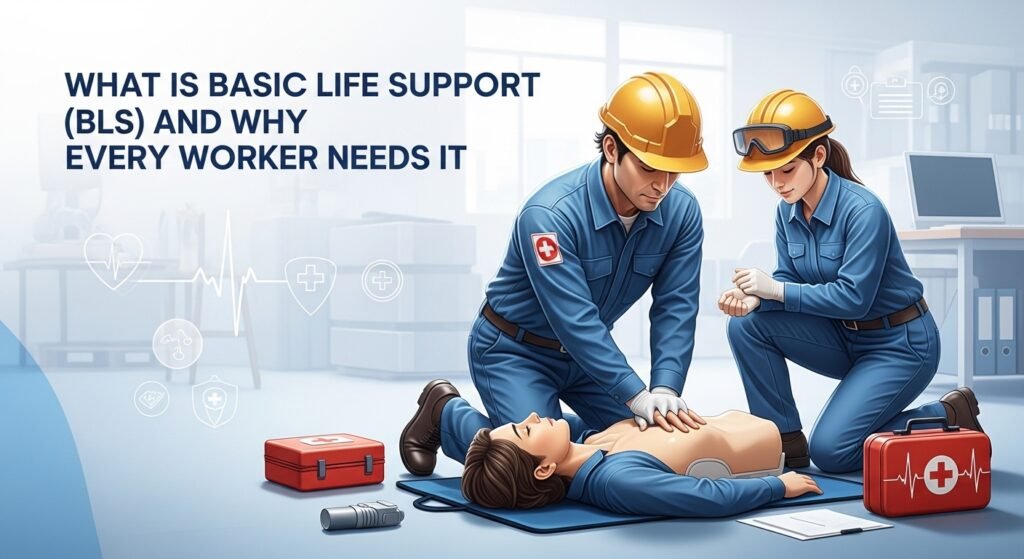
Picture this: a colleague suddenly collapses at their workstation. No warning. No obvious cause. Just a person on the floor, unresponsive, while everyone around them freezes.
This happens more often than most people realize. Cardiac emergencies can strike anyone, anywhere — and the workplace is no exception. The difference between survival and tragedy often comes down to one thing: whether someone nearby knows what to do in those first few minutes.
That’s exactly what Basic Life Support is about.
What is Basic Life Support (BLS)?
Basic Life Support — commonly called BLS — is a set of emergency medical skills designed to keep a person alive when their heart or breathing has stopped. It covers CPR (cardiopulmonary resuscitation), using an AED (automated external defibrillator), and clearing a blocked airway.
BLS isn’t just for doctors or paramedics. It’s designed for anyone willing to learn. The goal is simple: bridge the gap between when an emergency happens and when professional medical help arrives. Those few minutes are critical.
According to the American Heart Association (AHA), bystander CPR can double or even triple a person’s chance of survival after cardiac arrest. Yet in most workplaces, the majority of employees have never received any formal training.
That’s a problem worth solving.
The BLS Chain of Survival: Why Each Link Matters
Emergency medicine professionals use a concept called the Chain of Survival to describe how lives are saved in cardiac emergencies. Think of it as a series of actions that must happen quickly and in order.
The chain includes:
- Recognizing the emergency and calling for help — the faster this happens, the better
- Early CPR — maintaining blood flow to the brain and heart
- Rapid defibrillation — using an AED to restore a normal heart rhythm
- Advanced medical care — paramedics or hospital treatment
- Recovery — post-resuscitation support
If any link breaks, survival chances drop significantly. BLS training focuses on the first three — the steps ordinary people can take before emergency services arrive.
What Does BLS Training Cover?
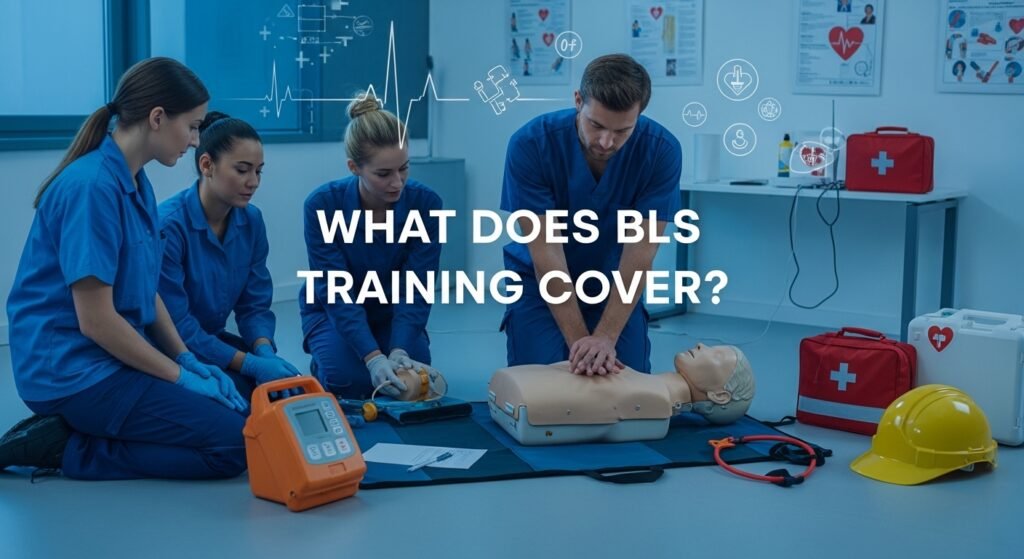
A standard BLS course — particularly the AHA BLS certification — typically runs four to five hours. It’s hands-on, practical, and built around real scenarios.
Here’s what participants usually learn:
- Scene safety and assessment — checking the environment before approaching someone in distress
- Checking responsiveness — tapping, calling out, looking for signs of life
- Calling for emergency help — activating the emergency response system immediately
- High-quality chest compressions — correct hand placement, depth (at least 5 cm), and rate (100–120 per minute)
- Opening the airway — using the head-tilt chin-lift method
- Rescue breathing — delivering effective breaths if trained to do so
- AED operation — turning it on, applying pads, following prompts
- Choking response — abdominal thrusts and back blows for conscious adults
Training uses sensor-equipped manikins that give real-time feedback on compression depth and rate. That kind of immediate correction is what makes the difference between training that sticks and training that fades.
Are BLS and CPR the Same Thing?
This is one of the most common questions people ask — and it’s a fair one.
CPR (cardiopulmonary resuscitation) is actually a component of BLS, not the same thing. BLS is the broader skill set that includes CPR alongside AED use, airway management, and choking relief.
Think of it this way: CPR is one tool in the BLS toolkit. BLS is the full kit.
When someone asks for “BLS certification,” they’re typically asking about the full certification that includes CPR and several related skills. When employers — especially in healthcare — say BLS is required, they mean the whole package.
Why Workplace BLS Training Isn’t Optional Anymore
Some industries have already made BLS training mandatory. Healthcare workers — nurses, surgical technicians, emergency responders — are often required to hold a current BLS certification to maintain their jobs. The AHA lists BLS as one of the top skills for healthcare roles through 2026.
But this isn’t only a healthcare conversation.
Manufacturing plants, construction sites, corporate offices, schools — cardiac events can happen anywhere. A coworker with a heart condition. A client who collapses during a meeting. A sudden choking incident in the break room.
HR managers and safety officers are increasingly recognizing that BLS-trained staff reduce liability, improve emergency response times, and contribute to a healthier workplace culture overall. In many regions, having a minimum number of trained first aiders on-site is a regulatory requirement — not a recommendation.
In Saudi Arabia and the wider KSA region, demand for BLS training is growing fast, particularly as organizations align with international standards and healthcare sector expansion continues under Vision 2030. AHA BLS certification is widely recognized and accepted across healthcare and corporate environments.
The Real Cost of Not Having BLS-Trained Staff
Here’s something HR managers and safety officers should consider carefully.
When a cardiac emergency happens and no one nearby knows what to do, the outcome is often preventable death or serious injury. Beyond the human cost, organizations face potential legal exposure, operational disruption, and lasting damage to workplace culture.
BLS training, by contrast, is relatively affordable and time-efficient. A four-to-five-hour course. Recertification every two years. A skill that once learned, stays with a person for life.
Compare that to the alternative, and the choice becomes straightforward.
How AED Devices Fit Into BLS Training
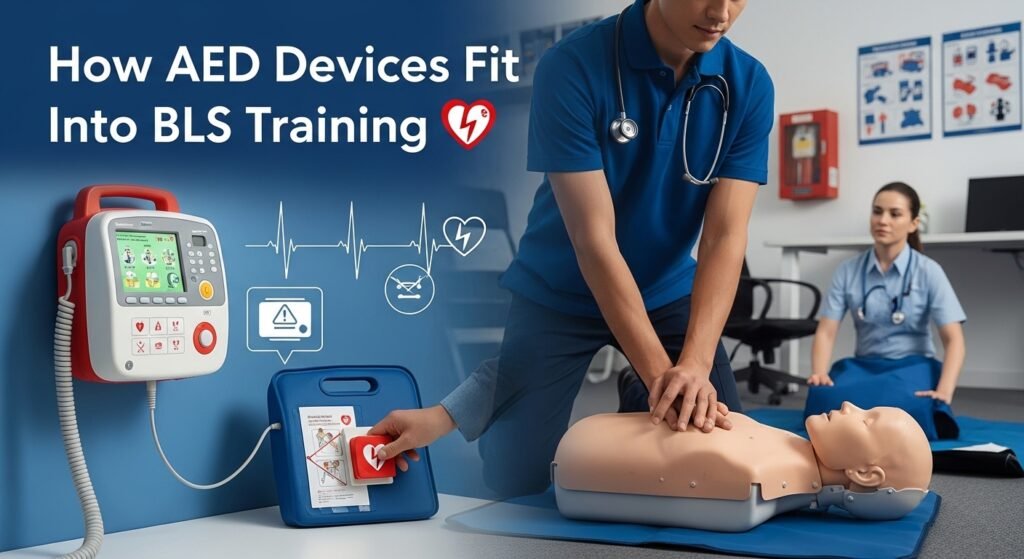
An AED is a portable device that analyzes a person’s heart rhythm and delivers an electric shock if needed to restore normal function. Modern AEDs are designed for non-medical users — they provide audio and visual instructions, so anyone who’s been trained can use one effectively.
Key points about AED use:
- Turn it on and follow the spoken prompts
- Apply pads to bare skin (upper right chest and lower left side)
- Make sure no one is touching the person when the device analyzes or shocks
- Resume CPR immediately after each shock until the person recovers or help arrives
AEDs should be placed in clearly marked, accessible locations across workplaces. Every employee should know where the nearest AED is — even if only trained staff are expected to operate it.
How to Get BLS Certified: What to Expect
BLS certification is available through several routes depending on your location and schedule:
In-person courses offer the most hands-on experience and are ideal for teams. Instructors provide direct feedback during manikin practice.
Blended or hybrid courses combine online learning with a shorter in-person skills session — useful for people with busy schedules.
Online-only courses work for knowledge refreshers but typically don’t count as full certification without a hands-on component.
For those seeking BLS training in Saudi Arabia, AHA-authorized providers offer courses that meet international standards and are recognized by most healthcare employers. Certification is typically valid for two years, after which recertification is required.
If you’re responsible for a team, group training sessions can be arranged on-site — often at reduced cost per participant and with scheduling flexibility.
BLS Training Tips for Safety Officers and HR Teams
If you’re planning to introduce or expand BLS training in your organization, here are a few things worth keeping in mind:
- Start with high-risk roles first — security staff, receptionists, floor supervisors, anyone who’s frequently present in common areas
- Track certification expiry dates — BLS certification lapses every two years, so build a renewal reminder system into your HR processes
- Make AED locations part of onboarding — new employees should know where emergency equipment is on day one
- Don’t rely on one person — if your one trained staff member is on leave when an emergency happens, that’s a problem
One common mistake organizations make is treating BLS training as a one-time checkbox rather than an ongoing program. Emergency response capability needs to be maintained, not just established.
Watch: BLS in Action
Seeing a skill demonstrated makes it far easier to understand and remember. The American Heart Association publishes video demonstrations of BLS techniques — including CPR, AED use, and airway management — on their official YouTube channel. Watching even a short demonstration before attending a course helps participants arrive better prepared and get more from the hands-on practice.
📌 Ready to get certified? Explore our BLS certification course for individuals and teams across Saudi Arabia.
Key Takeaways: What You Need to Know About BLS
BLS training is one of those skills that most people assume someone else has. But in a real emergency, “someone else” isn’t always there.
Here’s a quick summary of the key points:
- BLS covers CPR, AED use, airway management, and choking response — it’s broader than CPR alone
- The Chain of Survival depends on fast, competent action — BLS skills are the foundation of that response
- AHA BLS certification is globally recognized — including in Saudi Arabia and KSA healthcare environments
- Workplaces benefit practically — reduced liability, better compliance, safer culture
- Training is accessible — in-person, blended, or hybrid options are widely available
The next step is simple: identify who in your organization is already certified, who isn’t, and when the next round of training should happen. If you’re an individual looking to get certified, an AHA-authorized provider near you or an accredited online program is a practical starting point.
Emergencies don’t schedule themselves. But preparation can.
Frequently Asked Questions About Basic Life Support
Are BLS and CPR the same thing?
Not exactly. CPR is one component of Basic Life Support, but BLS includes additional skills like AED operation, airway management, and relief of choking. When an employer or institution requires “BLS certification,” they mean the full skill set — not just CPR alone. That said, CPR is arguably the most critical element of BLS in a cardiac emergency.
What are the 4 elements of basic life support?
The four core elements of BLS are: airway management (keeping the airway open), breathing support (rescue breaths when needed), circulation (chest compressions to maintain blood flow), and defibrillation (AED use to restore heart rhythm). Some training programs expand on these, but these four form the clinical foundation of BLS.
How do I get BLS certification through the American Heart Association?
AHA BLS certification is available through authorized training centers worldwide, including in Saudi Arabia and across the KSA region. Courses are offered in-person, as blended learning (online theory + in-person skills), or through HeartCode BLS online programs. Certification is valid for two years. To find an authorized provider near you, visit the AHA’s official training center locator on their website.
Is BLS certification required for non-healthcare workers?
It depends on your industry and location. Healthcare roles — nurses, surgical technicians, emergency responders — typically require current BLS certification as a condition of employment. For non-healthcare workplaces, BLS may not be legally mandated but is strongly recommended. Many safety regulations across different countries require organizations to have trained first aiders available on-site, and BLS training satisfies those requirements while going a step further in emergency preparedness.