


Contents
- 1 Primary Roles That Require Scaffolding Training
- 2 Specialized Training for ARAMCO and High-Risk Projects
- 3 Regulatory Requirements and Height Thresholds
- 4 Frequently Asked Questions
- 4.1 Do office staff visiting construction sites need scaffolding training?
- 4.2 How often must scaffolding certifications be renewed in Saudi Arabia?
- 4.3 Can experienced scaffolders from other countries work in KSA without local training?
- 4.4 What happens if untrained workers are found on scaffolds above 1.8m?
- 4.5 Do warehouse and logistics workers need scaffolding training?
- 5 Conclusion
If you’re responsible for HSE compliance or workforce development in Saudi Arabia’s construction sector, you’ve likely wondered which roles actually require scaffolding training. The answer isn’t straightforward. Requirements vary based on job responsibilities, project types, and specific regulatory standards.
Saudi Arabia’s construction safety regulations mandate scaffolding training for anyone working at or above 1.8 meters. However, the specific type and level of training depends on whether your team members are erecting, inspecting, supervising, or simply working near scaffolds. Understanding these distinctions helps you allocate training budgets effectively. It also helps maintain compliance without over-training workers who don’t need certification.
TL;DR: Site supervisors, scaffold erectors, inspectors, engineers, project foremen, contractors, and maintenance managers working at height all require STI scaffolding training to meet Saudi safety compliance standards (Arbrit KSA, 2026). Workers must be certified for scaffolds above 1.8m height.
Primary Roles That Require Scaffolding Training
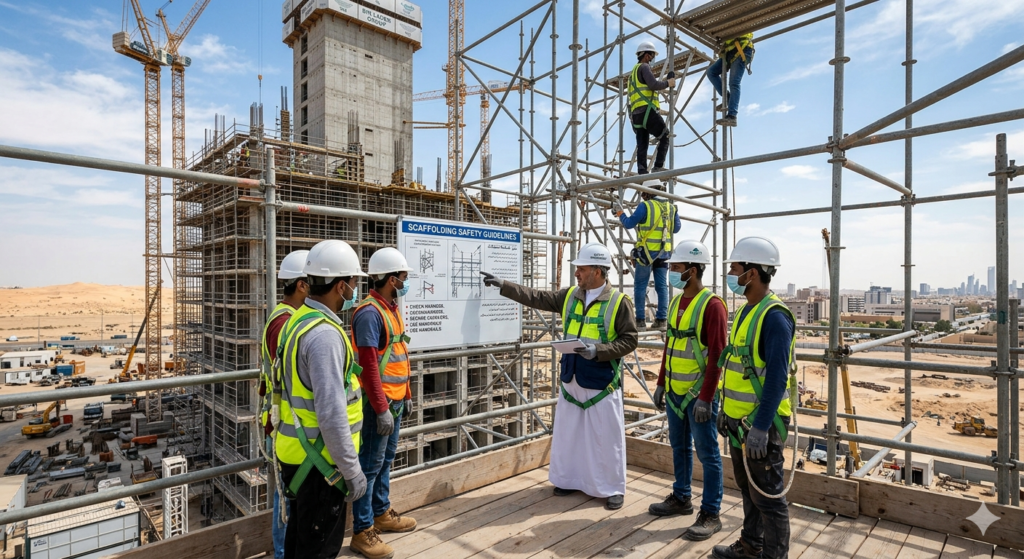
Site and safety supervisors, scaffold erectors and inspectors, engineers and project foremen, and contractors and maintenance managers working at height require STI scaffolding training. This is necessary to meet Saudi safety compliance (Arbrit KSA, 2026). These are not just guidelines; they are mandatory requirements for anyone directly involved in scaffold operations. The training covers erection, dismantling, load classification, and both national and international regulations that govern scaffold safety in the Kingdom.
Your HR department needs to prioritize these roles. Untrained workers cannot legally operate scaffolds in Saudi Arabia. Safety officers and HSE managers also need scaffolding inspector training. This ensures compliance with OSHA, BS EN 12811, and TG20 standards (SaveFast Training Academy, 2026). Site engineers, civil supervisors, experienced scaffolders promoted to inspection roles, and QA/QC inspectors round out the list of essential personnel requiring certification.
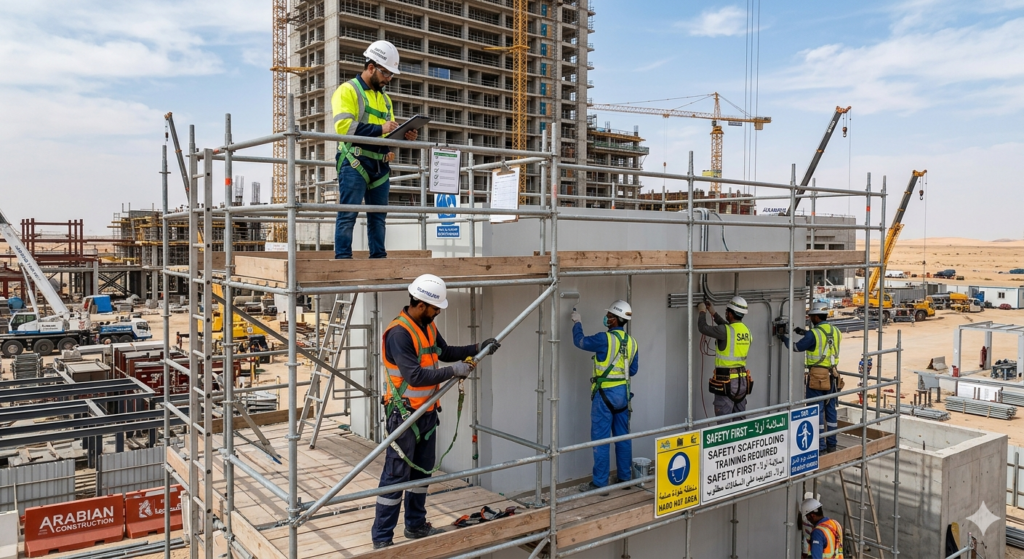
Our insight: Many HR managers assume only hands-on erectors need training, but inspectors and supervisors carry equal legal liability. We’ve seen companies face project shutdowns because they trained their workers but neglected to certify the supervisors who approved the scaffold installations.
Construction and industrial project managers also qualify for scaffolding training. This is especially true when they oversee teams working at significant elevations. These professionals need training on fall prevention, correct assembly for taller configurations, emergency procedures, and height-critical inspections (Affix KSA, 2026). Don’t forget maintenance personnel—crews performing routine upkeep often work on scaffolds and need the same baseline competencies as construction workers.
Specialized Training for ARAMCO and High-Risk Projects
Scaffolding erectors at the advanced level, construction foremen, supervisors, safety officers, safety managers, and operation and maintenance personnel qualify for ARAMCO Preparatory Scaffolding Supervisor/Inspector courses on GI 8.001 standards (ITC, 2026). If your company works on ARAMCO projects or other oil and gas facilities, standard scaffolding training won’t be enough. These specialized environments demand specific knowledge of industry-specific protocols that go beyond general construction requirements.
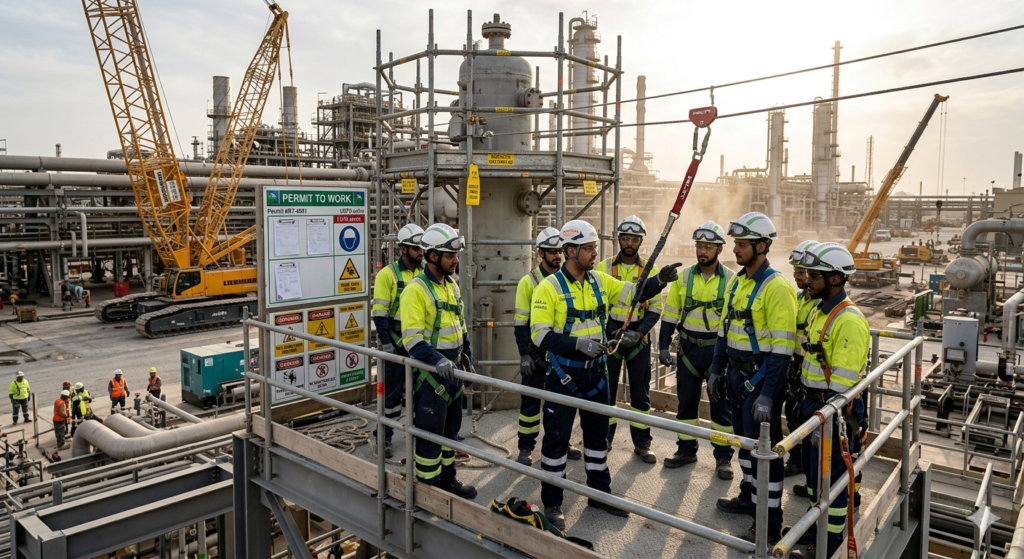
The training requirements become more demanding when dealing with rigging and lifting operations. Individuals required to perform or supervise scaffolding, rigging, and lifting need specialized training for safe handling, operation, and supervision (Pathways International, 2026). This applies particularly to industrial maintenance teams in petrochemical facilities, power plants, and manufacturing complexes where scaffolds serve as platforms for heavy equipment operations.
Site managers and foremen overseeing complex projects must attend comprehensive training. This includes scaffolding and working at height, covering erection, dismantling, load classification, and compliance with national and international regulations (ACTrain, 2026). These individuals bridge the gap between hands-on workers and upper management, making their competency essential for an effective site-wide safety culture.
Regulatory Requirements and Height Thresholds
Working above 1.8 meters requires safety harnesses, lifelines, certified scaffolders, and safe access. Saudi regulations explicitly prohibit untrained workers on scaffolds at this height (Scaffolding Safety Q&A Saudi Arabia, 2026). This threshold is not arbitrary; it represents the point where falls typically result in serious injuries or fatalities. Your L&D planning must account for this hard cutoff, as there’s no grace period or temporary exemption for workers operating above this height.
All scaffolds must be inspected regularly by trained personnel. This is in accordance with Saudi Arabia’s safety regulations, including requirements for certified scaffolders above 1.8m height (Scaffolding Safety Q&A Saudi Arabia, 2026). This means you cannot simply train erectors and consider the job done. You need a separate group of certified inspectors who can validate scaffold integrity before each shift. Many companies assign this dual responsibility to supervisors, but that requires them to complete both erection and inspection training modules.
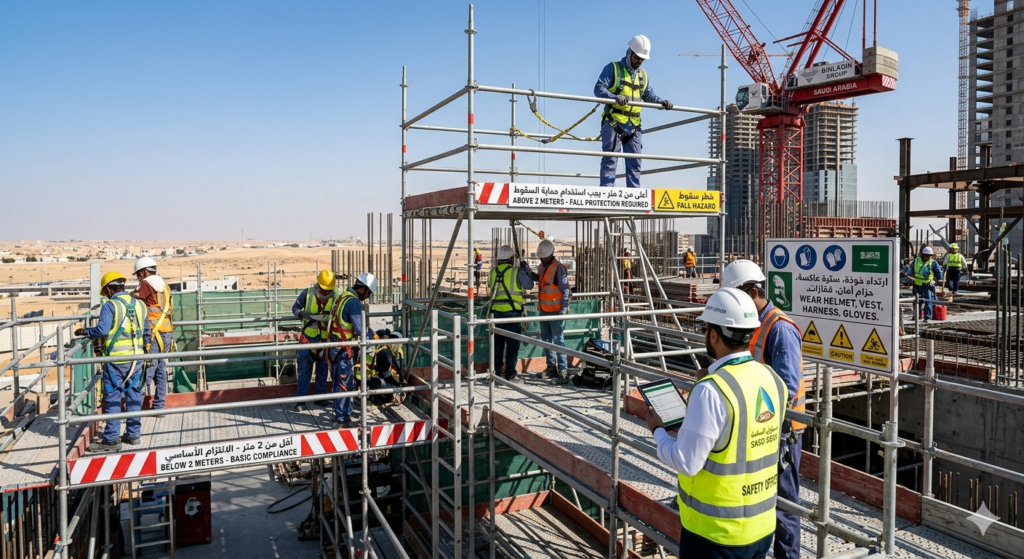
Our insight: The 1.8-meter threshold catches many companies off guard, particularly those transitioning from less regulated markets. We’ve observed that facilities with multiple elevation levels often have untrained workers performing tasks just above this limit, thinking “it’s not that high.” Regulatory enforcement has intensified, and inspectors specifically check for certification at these borderline heights.
The maximum mobile scaffold height without tying is 4 meters. This requires trained inspectors and erectors as per Saudi standards to prevent failures from untrained workers (Scaffolding Safety Saudi Arabia, 2026). Mobile scaffolds present unique risks because they combine height hazards with stability concerns. Training for mobile scaffold operations should be distinct from fixed scaffold training, covering wheel locking, base width calculations, and movement protocols.
Frequently Asked Questions
Do office staff visiting construction sites need scaffolding training?
No, office staff making brief site visits do not need full scaffolding certification. However, they must receive site-specific safety inductions and should never access scaffolds without escort. If project managers or engineers routinely inspect scaffolds as part of their duties, they need inspector-level certification regardless of their primary office location.
How often must scaffolding certifications be renewed in Saudi Arabia?
Most scaffolding certifications require renewal every 2-3 years. ARAMCO and specialized industry certifications may have annual refresher requirements. The specific renewal schedule depends on the training provider and the standards framework (STI, OSHA, BS EN 12811) your certification follows. Check with your training provider for exact timelines.
Can experienced scaffolders from other countries work in KSA without local training?
International experience is valued, but workers still need Saudi-specific certification covering local regulations and standards. Many training providers offer accelerated courses for experienced scaffolders that focus on Kingdom-specific requirements rather than basic skills. The 1.8-meter height rule and inspection protocols differ from other markets, making local training non-negotiable.
What happens if untrained workers are found on scaffolds above 1.8m?
Regulatory violations result in immediate work stoppages, substantial fines, and potential criminal liability for supervisors and employers. Beyond penalties, insurance claims may be denied if accidents involve untrained personnel. Saudi labor authorities have increased enforcement, with random inspections becoming more common across construction sites and industrial facilities.
Do warehouse and logistics workers need scaffolding training?
Yes, if they access scaffolds for inventory management, maintenance, or loading operations above 1.8 meters. Warehouse operations often use permanent or semi-permanent scaffold structures that require the same training as construction sites. Forklift operators who work near scaffolds should also receive awareness training on scaffold stability and exclusion zones.
Conclusion
Scaffolding training requirements in Saudi Arabia extend far beyond the workers physically assembling structures. Your training matrix should include supervisors, inspectors, safety managers, engineers, and specialized personnel working on ARAMCO or industrial projects. The 1.8-meter threshold triggers mandatory certification for anyone accessing scaffolds. Inspection duties require separate training even for experienced erectors.
Key takeaways for HR and HSE managers:
- Erectors, inspectors, supervisors, engineers, and safety officers all need role-specific scaffolding certification to comply with Saudi regulations.
- The 1.8-meter height threshold is a strict legal requirement with no exemptions for brief tasks or experienced workers.
- ARAMCO and petrochemical projects require specialized GI 8.001 standard training in addition to general construction certification.
- Regular recertification (typically every 2-3 years) is mandatory to maintain compliance and competency.
- Mobile scaffolds and rigging operations require additional specialized training distinct from fixed scaffold certification.
Don’t wait for a regulatory inspection to discover gaps in your training records. Build a comprehensive training plan that accounts for all roles with scaffold exposure. Furthermore, maintain detailed certification documentation for every worker operating above ground level.