


Contents
Falls from scaffolding remain one of the leading causes of fatal injuries on Saudi construction sites — estimated at roughly 30% of all construction fatalities. With Vision 2030 driving an unprecedented infrastructure boom, thousands of new scaffold structures go up across KSA every week, many under intense schedule pressure that cuts corners on systematic checks. This article delivers a practical, lifecycle scaffolding checklist covering erection, daily inspection, and dismantling — built around SASO 2826:2017 and Saudi Aramco GI 7.028, with regional adaptations for KSA’s unique soil and wind conditions.
Checkout: Scaffolding Erection & Dismantling Training KSA
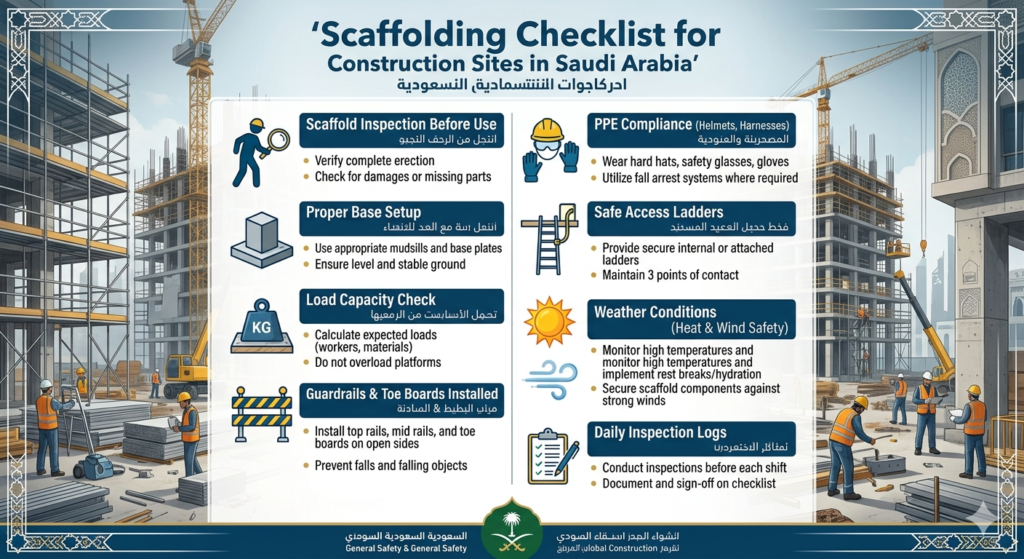
What to verify before a single tube goes up
The pre-erection phase is where most KSA scaffolding failures are born — not during the collapse itself. SASO 2826:2017 requires a documented ground condition assessment before any scaffold base is set, yet site visits consistently show this step skipped under schedule pressure. A structured erection checklist eliminates that gap before it becomes a GOSI fine.
Pre-erection
Before any frame work begins, ground bearing capacity must be assessed and documented — this is especially critical on sandy eastern KSA soils where settlement occurs rapidly. Base plates and sole boards must be sized correctly per load calculations, and scaffold design drawings reviewed and approved by a competent engineer. Erector certifications must be verified against originals, not photocopies, using CISRS cards or equivalent KSA-recognised credentials. Exclusion zones must be marked with physical barriers before work begins.
During erection
Standards must be plumb and level at every lift. Ledgers and transoms must be secured with properly rated couplers — no mixed-grade fittings. Tie-ins to the permanent structure are required at specified intervals, typically every 4 m vertically and 6 m horizontally per SASO guidance. The bracing pattern must match the approved drawing. Toe boards and guardrails must be installed as each lift is completed — not as a finishing step.
Regional note: Most erection checklists miss the tie-in schedule entirely. In high-wind zones of eastern Saudi Arabia, an under-tied scaffold can sway laterally even within spec. The checklist must include a wind exposure category check tied to the site’s geographic location.
What does a daily scaffolding inspection checklist cover?
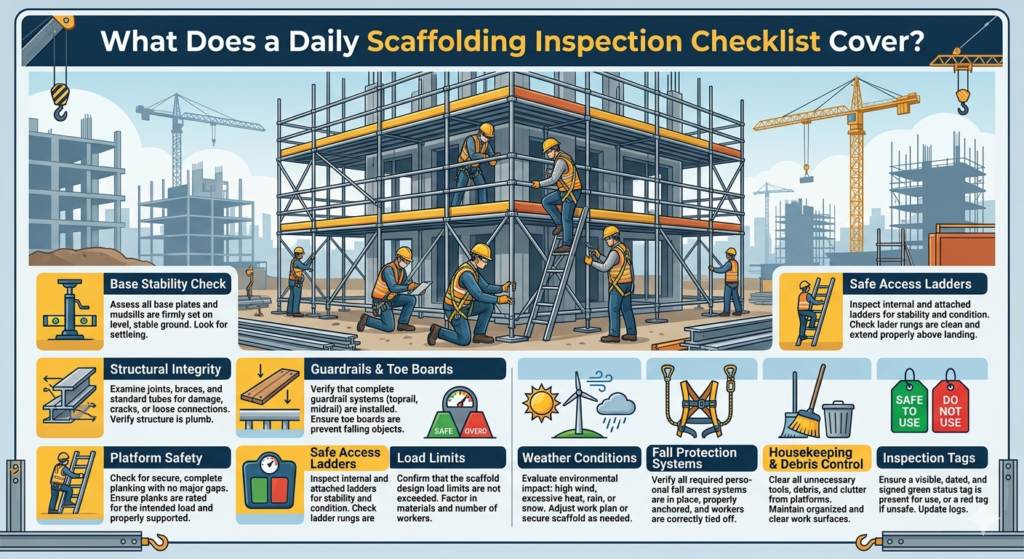
Daily inspection is the most skipped step on multi-contractor KSA sites, and the most consequential. A scaffold that passed erection inspection on Monday can be compromised by Tuesday morning — through overnight wind, adjacent excavation, or unauthorised modifications by other trades. The inspection checklist must be shift-specific, not a once-weekly formality.
Daily pre-shift checks
Each shift begins by confirming the scaffold tag is green and dated within its valid period, and that no components have been removed or modified since the last shift. All access ladders must be secured and properly angled. Guardrails must be intact at all working platforms — minimum 950 mm height per SASO. Platforms must be fully boarded with no gaps exceeding 25 mm, toe boards present and undamaged, and base plates not displaced or undermined. No materials should be stacked beyond the platform’s load rating.
Site observation: The most common non-conformance on active KSA sites is not missing guardrails — it’s removed toe boards. Other trades pull them off for material access and don’t replace them. A checklist that explicitly names toe board verification catches this before an inspector does.
The scaffold tag system
The tag system used on Saudi Aramco and major KSA contractors follows three colours: green (safe to use), yellow (restricted use with conditions), and red (do not use). Each tag must display the inspector’s name, inspection date, and next inspection due date — making the tag itself a compliance document, not just a visual signal.
The sequence that prevents incidents
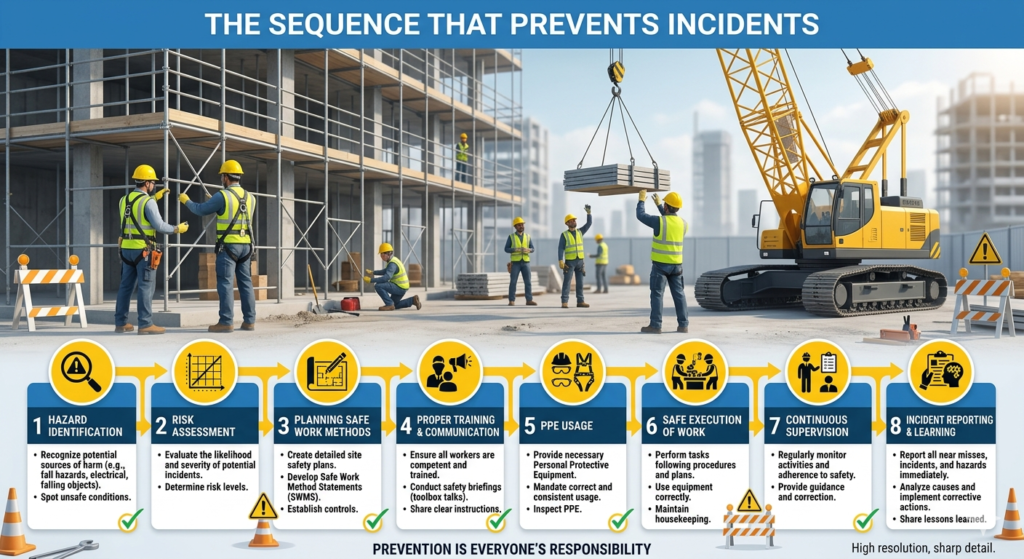
Dismantling is statistically the highest-risk phase of the scaffold lifecycle — not erection. Rushing teardown to meet handover deadlines is a pattern across KSA projects, and it is when braces fall on workers below and adjacent trades get struck by falling tubes.
Dismantling sequence
An exclusion zone must be re-established below and around the scaffold before dismantling begins. All materials and tools must be removed from platforms before decking is struck. Dismantling must proceed strictly top-down — taking components from the middle of a structure is never acceptable. Guardrails and toe boards must be removed last at each lift, not first. Couplers and tubes must be lowered by hand or mechanical means, never dropped. Each component should be inspected for damage as it is removed. The ground crew must be briefed on falling object hazards, and a dismantling supervisor must be present throughout — this cannot be delegated to unsupervised labour.
Cost impact: Delays caused by unsafe dismantling sequences can add two to five working days of downtime per incident, directly inflating project costs and pushing completion past contract milestones.
Which regulations apply?
Two frameworks govern scaffolding compliance for most KSA construction sites. SASO 2826:2017 is the national standard — it applies to all scaffold work across Saudi Arabia. Aramco GI 7.028 applies specifically to Saudi Aramco projects and is stricter in several areas, including tie-in frequency and inspector qualification requirements.
GOSI enforces workplace safety through site inspections under the Labour Law. MoLSD mandates that all scaffold erectors and supervisors hold recognised competency credentials. The most efficient approach for HSE teams working across multiple clients is to build one checklist template that defaults to the stricter Aramco requirement — it satisfies both frameworks automatically.
GOSI fines exceeding SAR 100,000 apply for documented non-compliance. Supervisors who cannot produce a signed, dated inspection record on request face immediate stop-work action. GOSI enforcement inspections have intensified since 2023, with scaffolding-related violations among the most cited categories during site audits.
Frequently asked questions
What is the basic scaffold inspection checklist for KSA sites?
It must cover base plate stability, standard plumb and level, guardrail and toe board integrity, platform boarding continuity, tie-in points, and scaffold tag currency. SASO 2826:2017 requires inspection before first use, after any modification, and after any wind event or ground disturbance.
What are the 5 core requirements for scaffolding under SASO standards?
SASO 2826:2017 requires: (1) design by a competent person, (2) pre-use inspection and documentation, (3) guardrails at minimum 950 mm height, (4) toe boards on all working platforms, and (5) tie-ins to the permanent structure at specified intervals. Each must be evidenced in writing during a GOSI inspection.
What is the 3-to-1 rule, and does it apply in Saudi Arabia?
The 3-to-1 rule states that a scaffold’s height must not exceed three times its minimum base width without additional stabilisation — typically tie-ins or outriggers. It applies under SASO 2826:2017 on all KSA sites and is one of the most common violations cited during GOSI audits.
What questions do scaffolding inspectors face in KSA job interviews?
Common questions test knowledge of SASO 2826:2017, scaffold tag systems, tie-in interval calculations, load rating principles, and dismantling sequences. Candidates are typically asked to walk through an inspection scenario step by step.
Key takeaways
- Erection checklists must include tie-in schedules and wind exposure categories — not just frame assembly verification.
- Daily inspection is non-negotiable — a green tag from Monday does not cover Tuesday’s unauthorised modifications.
- Dismantling must be supervised, top-down, and documented — this is where the highest-risk incidents occur.
- SASO 2826:2017 is your baseline — Aramco GI 7.028 applies on Aramco sites and sets the stricter standard.
- Know all three inspection triggers: before first use, after alteration, and after any wind event or ground disturbance.