


Contents
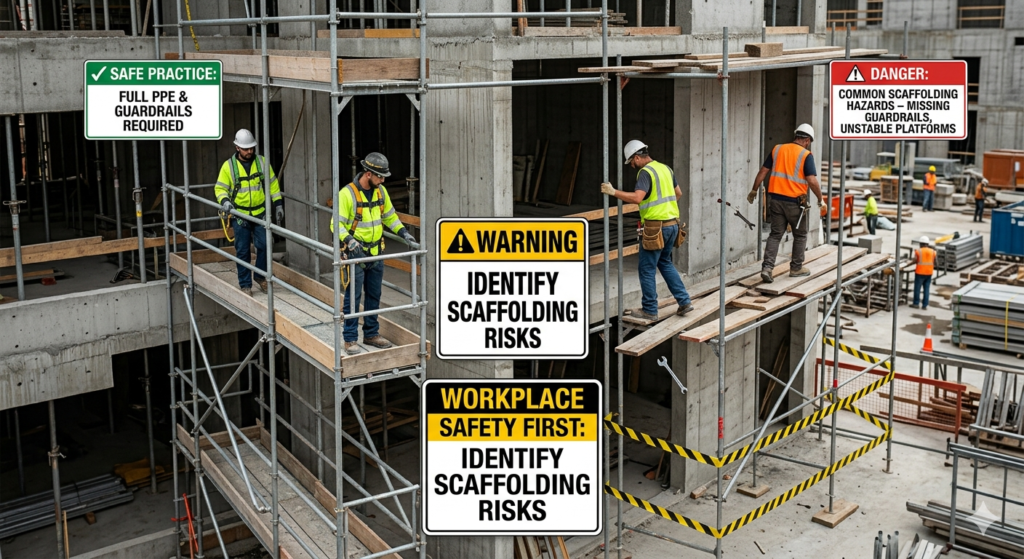
Falls from scaffolding kill more construction workers globally than almost any other single cause. The International Labour Organisation attributes 36% of all construction fatalities to falls from height. On Saudi Arabia’s Vision 2030 megaprojects, where thousands of workers share scaffolding systems across multi-contractor sites, that exposure is multiplied significantly.
This article identifies the five scaffolding hazards most likely to trigger injuries, fatalities, and stop-work orders on KSA construction sites, along with practical controls HSE managers, safety officers, and site supervisors can apply immediately.
Summary
The top 5 scaffolding hazards in Saudi Arabia are falls from height, scaffold collapse, unsafe access routes, falling objects, and heat-related worker instability. Falls account for 36% of global construction deaths (ILO). KSA sites operating under Aramco and NEOM standards must address all five to pass HSE audits and protect workers on Vision 2030 projects.
What Makes Scaffolding Hazards in Saudi Arabia Different From Other Markets?
KSA construction sites operate under a regulatory hybrid that catches many HSE managers off guard. Saudi Arabia’s General Construction Safety Law, last significantly updated in 2020, mandates licensed erectors and pre-use inspections. Vision 2030 megaprojects, particularly Aramco and NEOM developments, layer in OSHA-influenced and BS EN 12811 standards on top, creating compliance uncertainty across multi-contractor environments.
A common problem on Eastern Province sites is tag system mismatches. One contractor uses a green/yellow/red tagging protocol adapted from OSHA while another uses a vendor-specific system. During client audits, these inconsistencies become immediate findings.
The real risk often is not the scaffold itself. It is the assumption that standards are aligned across subcontractors when they are not. On a large NEOM or Aramco turnaround site, a scaffolding inspection checklist that satisfies one client HSE team may fail another, because no single federal decree has unified tagging requirements as of 2025.
OSHA does not legally govern KSA sites. It is used as a reference framework, not a binding standard. Understanding that distinction is essential when building a site HSE scaffolding plan — and it is one reason Scaffolding Supervisor Training in Saudi Arabia increasingly covers regulatory alignment across client standards, not just technical erection skills.
1: Falls From Height
Why Falls Remain the Deadliest Risk on Saudi Construction Sites
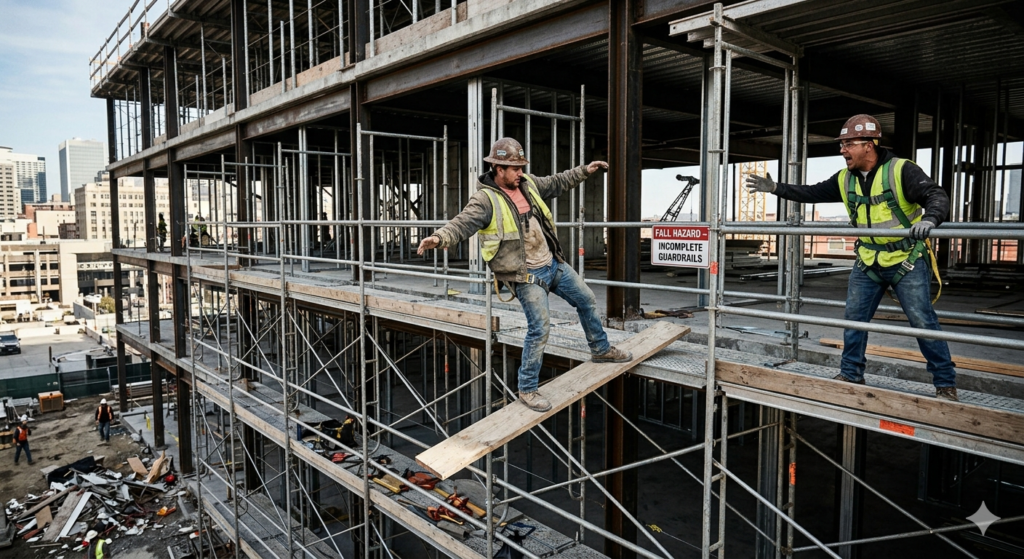
Falls from scaffolding platforms remain the single most deadly hazard in KSA construction. Globally, the ILO reports that falls from height account for 36% of construction sector fatalities, and there is no credible reason to believe KSA’s rate is lower given the scale of active megaprojects running simultaneously.
The causes are predictable: missing guardrails, unsecured platforms, and workers bypassing fall arrest systems during quick tasks. In desert environments, wind loads can be significant, and guardrails that pass inspection on a calm morning may flex dangerously by afternoon.
The Transition Point Problem
The most overlooked fall risk is often not the open edge. It is the transition point, where a worker moves from a scaffold platform to a ladder or between scaffold bays. These handover points frequently have no guardrail at all, because neither the scaffold erector nor the trade contractor takes clear ownership of them.
This is a gap that competent scaffolding supervisors are specifically trained to identify and close. On sites where supervisors have completed formal Scaffolding Supervisor Training in Saudi Arabia, transition point ownership is typically assigned and documented before any work at height begins.
Controls That Work
Install double guardrails with the top rail at 950 to 1150mm and mid-rail at 500mm per BS EN 12811 specifications. Enforce full-body harness use with double lanyard for any platform above 2 metres. Conduct pre-shift inspections specifically at transition points, not just platform surfaces.
According to the ILO’s 2024 global construction safety data, fall protection systems reduce fall-related fatalities by up to 70% when consistently enforced. A written fall protection plan, not a verbal policy, is a non-negotiable site document.
2: Scaffold Collapse
Why Collapse Incidents Are Almost Always Preventable
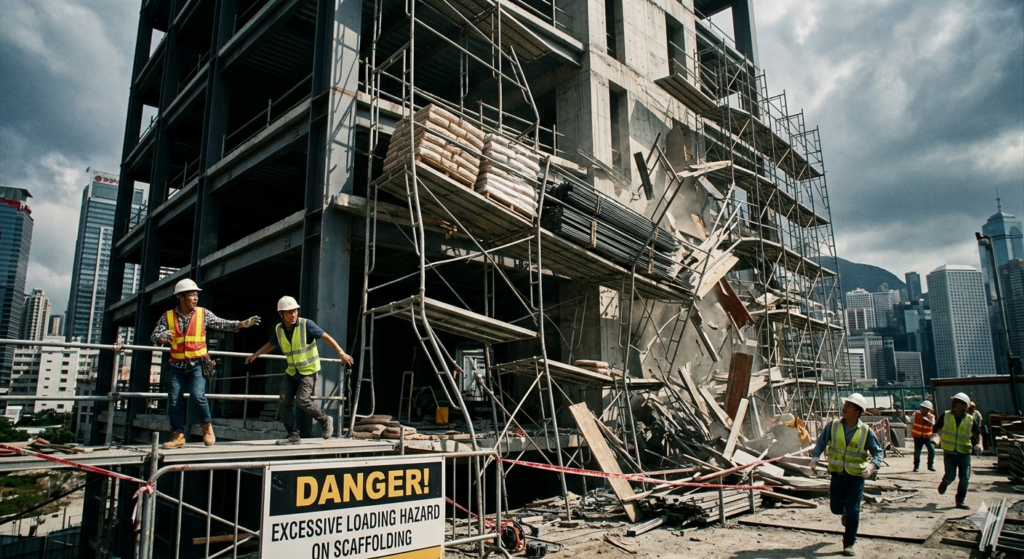
Scaffold collapse is less frequent than falls, but the consequences are catastrophic. A single collapse can injure multiple workers simultaneously and triggers automatic stop-work orders from client HSE teams, costing days or weeks of lost productivity.
The root causes almost always trace back to erection quality and load management. Scaffolds erected without approved load charts, or with base plates sitting on soft or uncompacted ground, are structurally compromised from day one.
The Two Failure Points Behind Most Collapses
Analysis of audit findings from HSE managers on Vision 2030 sites in the Eastern Province shows that collapses are disproportionately linked to two failure points: base plate sizing errors and unauthorized modifications made mid-project by non-certified workers. Neither failure is caught by visual inspection alone. They require documented load calculations reviewed before erection begins.
Controls That Work
Require signed-off load charts from a competent engineer before any scaffold is erected. Enforce a tagged erection system where no green tag means no access. Never permit modifications to a standing scaffold without re-inspection and re-tagging.
3: Unsafe Access Routes
How Improvised Access Creates Serious Risk
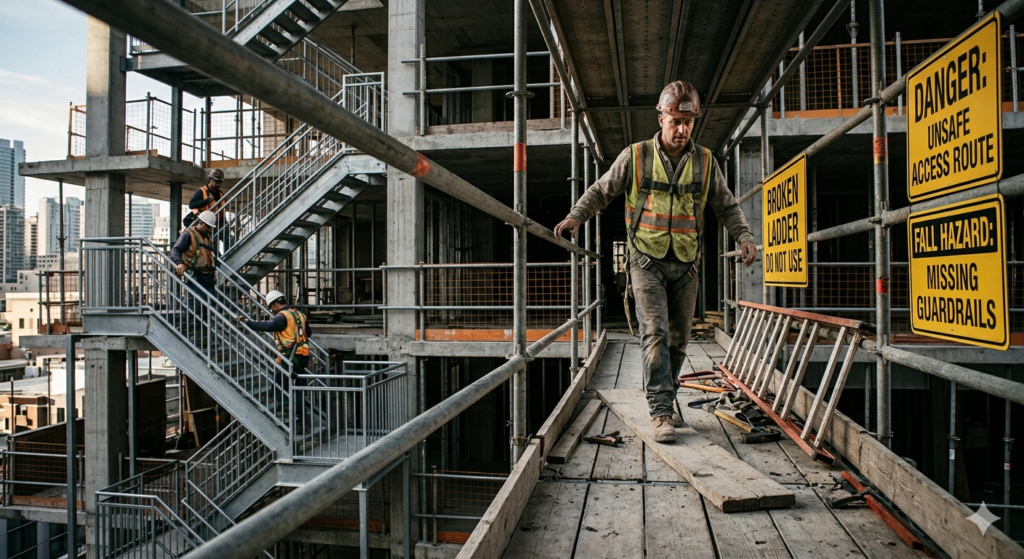
Workers improvising access routes by climbing cross-bracing or using stacked materials as makeshift steps is one of the most persistent hazards on busy construction sites, especially when site tempo increases near project milestones.
The 3-to-1 rule in scaffolding states that a scaffold’s height should not exceed three times its minimum base dimension without additional stability measures. Many site teams do not apply this calculation when using internal ladder access towers, creating structures that are out of compliance from the moment they are built.
Controls That Work
Install dedicated stair towers on any scaffold structure used for extended work periods. Mark all improvised access routes as prohibited zones using physical barriers. Include access route inspection as a standalone item on the daily scaffolding inspection checklist.
4: Extreme Heat and Worker Instability
A KSA-Specific Hazard Most Safety Guides Miss
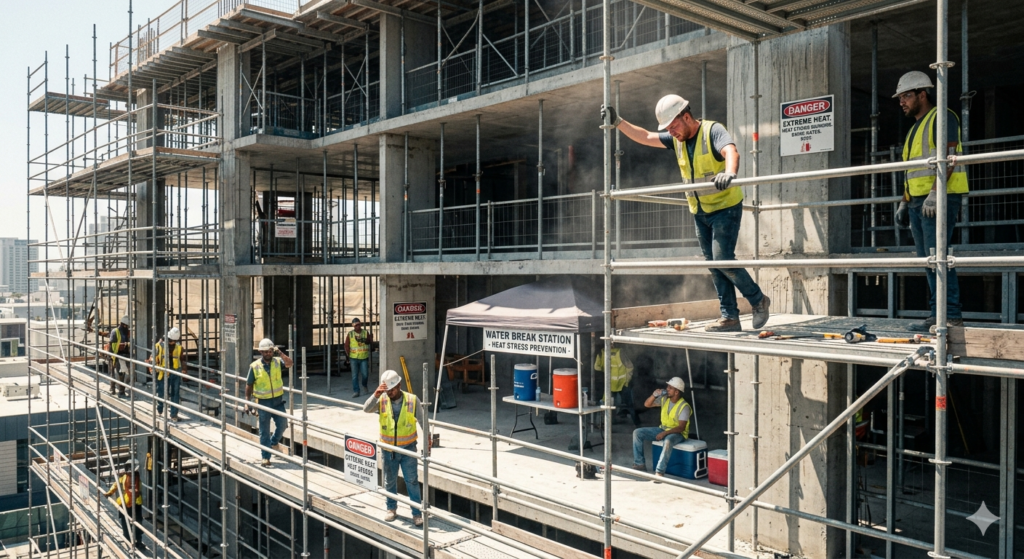
Heat is a scaffolding hazard specific to KSA and Gulf environments that most generic safety guides overlook entirely. Surface temperatures on metal scaffolding components can exceed 70 degrees Celsius in direct summer sun, enough to cause burns on contact and accelerate worker fatigue to the point where balance and coordination are compromised.
Worker instability on elevated platforms due to heat exhaustion is an underreported cause of near-misses and falls. It is frequently recorded as a fall incident rather than a heat-related event, which means it does not get addressed through the correct control pathway.
Why Misclassification Makes It Worse
If incident data shows falls but not the heat-fatigue trigger behind them, corrective actions will target guardrails and harnesses when the real intervention needed is a revised work/rest rotation schedule and shaded rest areas adjacent to scaffold access points.
This is exactly the kind of site-specific risk recognition that quality Scaffolding Supervisor Training in Saudi Arabia addresses directly. A trained supervisor understands that heat instability and fall risk are connected, and responds to both through a single coordinated control plan rather than treating them as separate issues.
Controls That Work
Schedule high-elevation scaffold work before 10am and after 4pm during summer months. Require insulated gloves for scaffold work when ambient temperature exceeds 40 degrees Celsius. Include heat fatigue recognition in scaffolding safety training, not just standalone heat stress modules.
OSHA’s Heat Illness Prevention guidelines, adapted by many KSA client HSE standards, require workers acclimatising to extreme heat environments to complete a minimum 7 to 14 day graduated exposure period before working at height.
5: Falling Objects
The Hazard Inspectors Consistently Miss
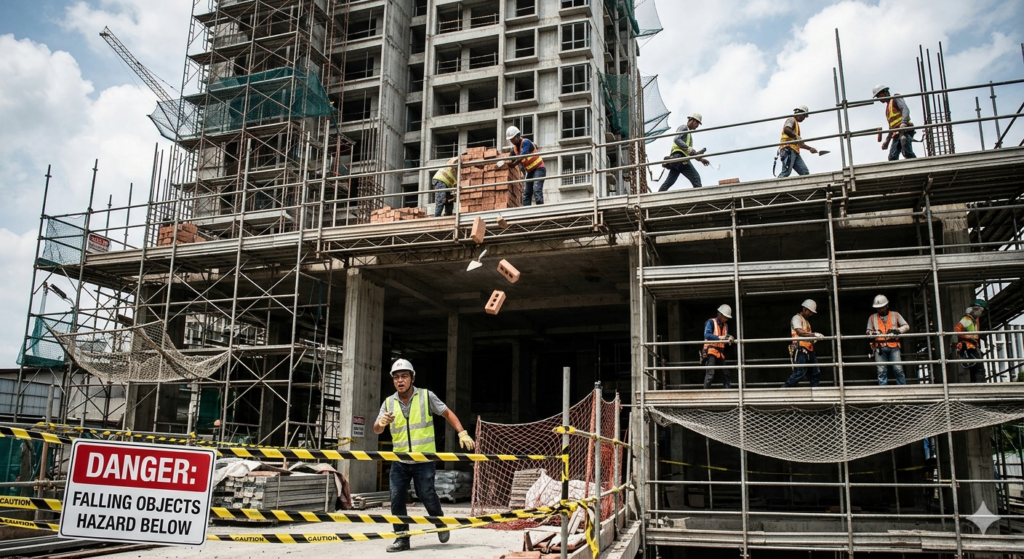
Falling tools, materials, and debris from scaffolding platforms put workers at ground level at serious risk. This hazard is frequently undercontrolled because scaffold inspections focus upward to platforms and guardrails rather than downward to toeboards and exclusion zones.
OSHA’s scaffolding standards, used as a reference on many KSA sites, require toeboards of at least 150mm on all open platform edges. In practice, toeboards are one of the most commonly missing items on scaffold inspection checklists.
Controls That Work
Install 150mm toeboards on all platform edges as a mandatory erection requirement. Establish clearly marked and enforced exclusion zones below active scaffold work. Require tool lanyards for all hand tools used above 3 metres.
A site-wide falling object protection plan, reviewed and signed off before scaffold erection begins, is a standard requirement during Aramco and NEOM HSE pre-mobilisation audits.
Frequently Asked Questions
Is OSHA accepted in Saudi Arabia?
OSHA is not a legally binding standard in Saudi Arabia. It is widely used as a reference framework on major projects, particularly those under Aramco, NEOM, and international contractor standards. Saudi sites are governed by the General Construction Safety Law (2020) and client-specific HSE requirements, which often align with OSHA principles without formally adopting them.
What are the most common hazards associated with scaffolding?
The five most common scaffolding hazards are falls from height, scaffold collapse, unsafe access routes, falling objects, and heat-related worker instability on elevated platforms. Falls from height account for 36% of global construction fatalities (ILO, 2024), making them the highest-priority risk to control on any site.
What does a yellow tag mean on a scaffold in KSA?
A yellow tag indicates a scaffold is erected but has restrictions on use, typically requiring additional safety measures such as harness use before access is permitted. Green tags mean the scaffold is safe for unrestricted use. Red tags mean access is prohibited. Tag meanings vary by contractor, which is a known compliance gap on multi-contractor sites.