


Fire Warden vs Fire Watcher vs Fire Marshal What’s the Difference in KSA?
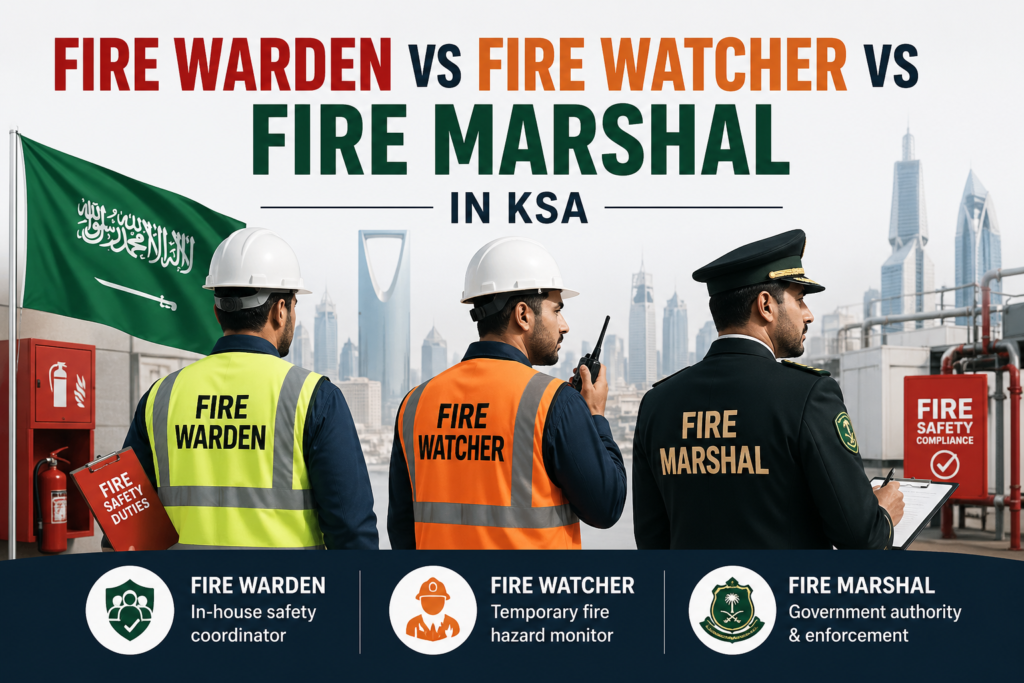
You’re about to approve a hot work permit on your Jubail construction site. Your supervisor asks: “Do we need a fire watcher or a fire warden for this welding job?” Then your HSE officer mentions a fire marshal for the evacuation drill tomorrow. Wait—aren’t these all the same person? If you’ve ever been puzzled about which fire safety role applies to which situation on your Saudi Aramco contractor project, NEOM site, or SAFCO facility, you’re not alone. These three titles are often used interchangeably. However, they are distinct roles with different responsibilities under Saudi Civil Defence regulations and international standards like NFPA and OSHA. What makes it even more confusing is that on smaller KSA sites, one person might fulfill all three roles. Even in such cases, they still need separate training and certification for each role. Incorrect assignment of responsibilities can lead to work stoppages, Civil Defence violations, or, more seriously, preventable incidents.TL;DR: Fire watchers monitor active hot work and stay on-site 60 minutes post-job (NFPA 51B requirement). Fire wardens handle daily prevention and assist with evacuations. Fire marshals take command during emergencies. In Saudi Arabia, industrial sites typically need all three roles certified separately, with TUV-approved training preferred on Aramco-approved projects. (NFPA, 2023) What Does a Fire Watcher Do in KSA Industrial Sites? According to OSHA 29 CFR 1910.252, fire watchers are required whenever welding, cutting, or other hot work operations create ignition risks. This covers about 90% of maintenance and construction activities on Saudi industrial sites. (OSHA, 2023) A fire watcher’s job is focused: they monitor a specific hot work location before, during, and after the operation. They are not to roam the facility checking fire extinguishers. They are not to lead evacuations. They are stationed at that one welding station, cutting torch, or grinding area, making sure sparks do not ignite nearby combustibles. Here’s what that looks like in practice on a SABIC facility or KEMYA plant: Before hot work begins: During hot work: After hot work ends (this is where most sites make errors): Fire watchers must be trained specifically in NFPA 51B standards, which covers fire prevention during welding, cutting, and hot work. On Aramco contractor projects, TUV-approved fire watcher certification is frequently a requirement. Get certified as a Fire Watcher. Our insight: On multi-level construction sites (common in NEOM and Red Sea projects), you might need fire watchers on BOTH the level where hot work occurs AND the level directly below. Sparks and slag can fall through floor openings and ignite materials several meters away. What’s a Fire Warden’s Role in Saudi Arabia Workplaces? Fire wardens operate at the prevention level. Saudi Civil Defence regulations mandate that commercial and industrial facilities designate trained fire wardens for each floor, building section, or work area. This typically means one warden per 50-75 occupants, depending on facility type. (Saudi Civil Defence, 2023) Consider fire wardens your primary defense before any fire starts. They are proactive, not reactive. On a typical HADEED steel plant or SAFCO petrochemical facility, fire wardens manage: Daily/weekly prevention tasks: Education and awareness: During evacuation (but NOT as incident commander): Fire wardens do not fight fires; they prevent them and help people exit safely when prevention fails. This distinction is important because their training focuses on hazard recognition, inspection protocols, and evacuation assistance rather than emergency command. Train your site team as Fire Wardens Most GCC-based industrial projects require fire warden training that covers NFPA 1 (Fire Code), local Saudi regulations, and facility-specific emergency procedures. The certification often takes one day and should be renewed annually. Fire Marshal Saudi Arabia: Who Takes Command During Emergencies? When the alarm sounds on your Aramco facility, someone needs to take charge—that person is your fire marshal. According to NFPA standards, fire marshals serve as the on-site emergency coordinator until professional firefighters (Saudi Civil Defence) arrive and assume command. (NFPA, 2023) This role commands significant authority and responsibility. Fire marshals do not merely assist with evacuation; they manage the entire process. On a typical incident at a KEMYA chemical plant or large construction site, the fire marshal performs these duties: Immediate response: Evacuation management: Accountability and communication: Post-incident: Fire marshals require more advanced training than fire wardens. This is because they make real-time decisions under pressure. They must understand fire behavior, hazardous materials protocols, emergency communication systems, and how to interact with Saudi Civil Defence responders. On major Saudi industrial sites, you will often find a Chief Fire Marshal (site-wide authority) and Area Fire Marshals (building or zone-specific). The training usually lasts 2-3 days and covers incident command basics, evacuation strategy, and coordination with emergency services. Our insight: During Aramco shutdown projects, contractors often need to supply all three roles from their own workforce. The main contractor usually appoints the Chief Fire Marshal, while subcontractors provide area-specific wardens and watchers for their scope of work. Ensure your mobilization plan accounts for the training lead time—TUV-approved certification takes time. Can One Person Be a Fire Warden, Watcher, AND Marshal in Saudi Arabia? Yes, but with significant considerations. Small KSA facilities (under 50 occupants) often designate one HSE officer or supervisor to fulfill all three roles. However, Saudi Civil Defence and major clients like Aramco expect separate training and certification for each function. Here’s why simply calling someone “the fire guy” is insufficient: Different competencies: Different legal requirements: Different timing: What works in practice: On smaller sites, structure it this way: On larger facilities like SAFCO Jubail or HADEED Yanbu, you will need multiple people in each role. A 200-person plant might require: The training investment yields benefits. According to HSE contractors operating in KSA’s industrial zones, sites with properly trained and certified personnel in all three roles experience 60% fewer fire-related incidents and near-misses compared to sites that rely on generic “fire safety awareness” training. (Industrial Safety Review, 2023) Why TUV-Approved Fire Safety Training Matters on KSA Projects You’ve likely seen “TUV-approved” or “TUV-certified” listed as requirements on Aramco, SABIC, or Ma’aden contractor pre-qualification documents. What does
OSHA 30 vs IOSH Managing Safely: Which is Right for Saudi Arabia?
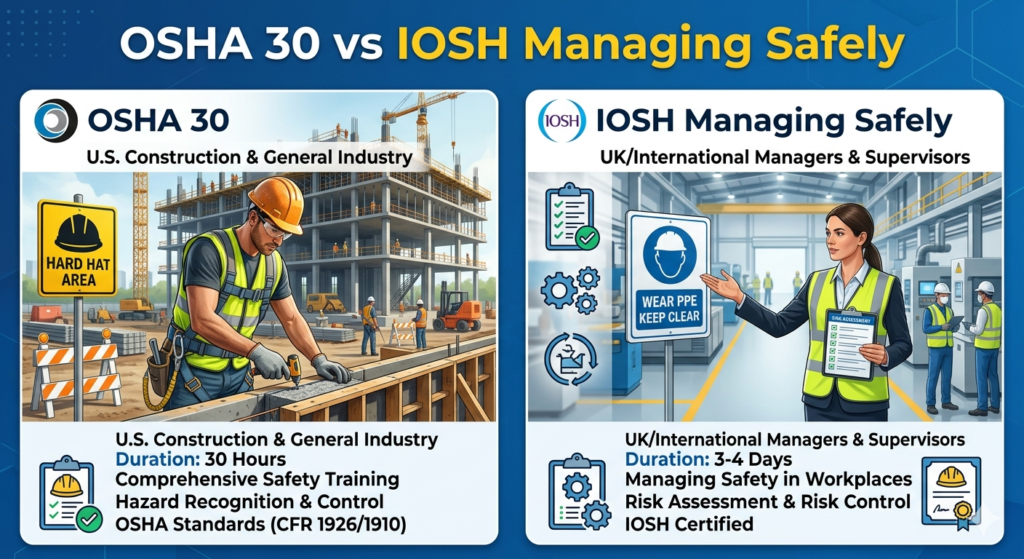
If you’re working in construction, oil and gas, or any high-risk industry in Saudi Arabia, you’ve probably heard about OSHA 30 and IOSH Managing Safely. Both are internationally recognized safety certifications, but they serve different purposes and appeal to different sectors. As Saudi Arabia continues its Vision 2030 transformation with massive infrastructure projects and industrial expansion, choosing the right HSE certification isn’t just about personal development-it’s about career relevance and compliance. This guide explores OSHA 30 and IOSH Managing Safely specifically for the Saudi market. We’ll cover recognition by major contractors like Aramco, industry preferences, costs, exam formats, and which certification matches your role. Whether you’re an HSE manager in Al Khobar, a site supervisor in Riyadh, or an HR professional evaluating training programs, this comparison gives you the facts you need. TL;DR: OSHA 30 is preferred for construction and heavy industries in KSA, while IOSH Managing Safely suits facilities management and administrative teams. Oil and gas contractors often require both depending on client specifications. EUTC Global in Al Khobar offers both certifications with practical, Saudi-focused training – [enquire about upcoming batches → HSE Training Saudi Arabia]. Understanding OSHA 30 and IOSH Managing Safely: What Are They? OSHA 30 is a 30-hour safety training program developed by the U.S. Occupational Safety and Health Administration. It covers workplace hazards, worker rights, employer responsibilities, and accident prevention standards. The course was originally designed for supervisors and workers in high-risk environments in the United States – but it has gained strong acceptance in Saudi Arabia, particularly in construction and oil and gas sectors where American contractors and project standards are common. IOSH Managing Safely is a UK-based safety management course created by the Institution of Occupational Safety and Health (IOSH) – the world’s largest health and safety membership body with over 150,000 members globally. It’s designed for managers and supervisors across all industries who need practical knowledge to manage health and safety within their teams. The course focuses on risk assessment, legal responsibilities, and building a workplace safety culture. Both certifications add real weight to your CV in Saudi Arabia – but their applications vary significantly depending on your sector and employer. Frequently Asked Questions Conclusion: Get Certified with the Right Training Partner in KSA The choice between OSHA 30 and IOSH Managing Safely comes down to your industry and role: Both certifications are recognized by Aramco and major Saudi contractors. Both meet Vision 2030 compliance requirements. And both significantly improve your employability in Saudi Arabia’s growing industrial landscape. EUTC Global in Al Khobar specializes in HSE training for Saudi Arabia’s industrial environment. Their OSHA 30 and IOSH Managing Safely programs are delivered by instructors with hands-on experience from Aramco projects, SABIC facilities, and major construction sites across the Kingdom. Whether you need individual enrollment or corporate group training, EUTC Global offers flexible scheduling and Saudi-specific course content. Contact EUTC Global today to check upcoming course dates, discuss your certification requirements, and enroll in the program that fits your career goals.
Does OSHA 30 Certification Expire? Renewal Guide for KSA Professionals
If you’re a safety professional in Saudi Arabia, you’ve probably heard mixed information about OSHA 30 certification expiry. Some say it lasts forever, while others claim you need to renew it regularly. The confusion is real, especially when your job prospects depend on having valid safety credentials. The truth about OSHA 30 validity matters more in Saudi Arabia than most places. Construction sites, oil and gas facilities, and industrial projects across the Kingdom require workers to maintain current safety certifications. Understanding when your card expires—and how to renew it—can make the difference between landing that job or watching opportunities pass by. This guide clarifies the confusion around OSHA 30 expiry dates, explains renewal requirements specific to the Saudi job market, and shows you exactly what steps to take to keep your certification current. TL;DR: OSHA 30 cards don’t technically expire, but employers in Saudi Arabia often require recent training (within 3-5 years). The oil and gas sector employs over 700,000 workers in the Gulf region, with most major companies requiring updated safety certifications for hiring and contract renewal (Middle East Economic Survey, 2023). Does Your OSHA 30 Card Actually Expire? According to OSHA’s official policy, your OSHA 30 completion card doesn’t have a formal expiration date printed on it. The certification itself remains valid indefinitely from a regulatory standpoint (OSHA Training Institute, 2024). However, here’s what catches many professionals off guard: while OSHA doesn’t mandate renewal, employers in Saudi Arabia set their own requirements. Most construction companies, oil refineries, and industrial facilities in the Kingdom prefer certifications obtained within the last three to five years. Why the discrepancy? Safety standards change. New equipment arrives on sites. Regulations get updated. A certificate from 2015 shows you completed the training, but it doesn’t prove you’re current with today’s safety practices. Major Saudi employers like Saudi Aramco, SABIC, and Ma’aden have internal policies requiring recent safety training. If your card shows a completion date older than their threshold, you’ll need to retake the course. Our insight: We’ve seen qualified safety officers lose job opportunities simply because their OSHA 30 card was six years old, even though they had extensive field experience. In KSA’s competitive job market, a recent certificate often matters more than technical validity. The construction sector in Saudi Arabia is particularly strict. With Vision 2030 projects creating significant building demands, companies cannot risk safety incidents. Recent OSHA training isn’t just preferred—it’s often a requirement in bid specifications. Who Needs to Renew Their OSHA 30 Certification in Saudi Arabia? Approximately 45% of workplace accidents occur due to outdated safety knowledge or failure to follow current protocols (National Safety Council, 2023). That’s why specific groups in Saudi Arabia face stronger pressure to maintain recent certification. Construction supervisors and site managers top the list. Whether you’re working on NEOM, the Red Sea Project, or Riyadh Metro expansions, general contractors require supervisors to show proof of current safety training. Many specify certifications dated within three years. Oil and gas workers face similar requirements. Facilities in the Eastern Province, offshore platforms, and petrochemical plants maintain rigorous safety protocols. Your OSHA 30 card serves as baseline proof of competency, but refineries often want to see you’ve updated your knowledge recently. HSE professionals need the freshest credentials. As a safety officer, you’re responsible for implementing current standards. Companies hiring HSE managers in KSA typically screen for certification dates, seeking proof you’re up-to-date with the latest OSHA guidelines. Job seekers planning to enter the Saudi market should consider timing. If you’re applying from abroad, taking an OSHA 30 course six months before your job search gives you a competitive edge. Recruiters view fresh certification as proof of commitment. Here’s a breakdown of renewal considerations by industry: How to Get Your OSHA 30 Certification Current Saudi Arabia’s training market serves over 12 million expatriate workers, with safety certification being among the top five requested courses (Saudi Ministry of Human Resources, 2023). Here’s how to get your certificate updated. Step 1: Understand you’re not renewing—you’re retaking This is important: OSHA doesn’t offer a “renewal” course. You need to complete the full 30-hour training program again. There’s no shortcut or refresher option that gives you a new card. Step 2: Choose an authorized training provider In Saudi Arabia, you have two options. You can take the course through an OSHA Authorized Training Center located in the Kingdom, or complete it online through an approved provider. Both result in the same official OSHA 30 card. Online courses offer flexibility, especially if you’re currently employed. You can complete modules during off-hours and finish at your own pace (though you must complete it within six months of starting). Step 3: Complete the 30-hour curriculum The training covers the same content as your original certification: Construction and General Industry versions differ slightly in specific topics, so choose the one matching your work in Saudi Arabia. Step 4: Pass the final assessment You’ll need to pass module quizzes and a final exam. Most providers allow retakes if needed, but you must demonstrate competency to receive your certificate. Step 5: Receive your new card After successful completion, OSHA mails your official card within 4-6 weeks. Many providers give you a temporary certificate immediately, which most Saudi employers accept while you wait for the physical card. Our insight: Many professionals in KSA wait until their current card becomes an issue with employers. Smart planning means starting your re-certification when your card reaches the 4-year mark, giving you time to complete training before it impacts job applications. Costs and timeframes: Why Keeping Current Certification Matters in the Saudi Job Market Workers with current safety certifications earn 15-20% more on average compared to those with outdated or no credentials in Gulf construction markets (Gulf Construction, 2023). Beyond salary, there are practical reasons to maintain fresh OSHA 30 certification. Job mobility increases significantly. When you apply for positions across Saudi Arabia—whether in Jeddah, Riyadh, or Dammam—a recent OSHA 30 card opens doors. Recruiters can submit your profile to more clients, and
Saudi Aramco First Aid Requirements for Vendors
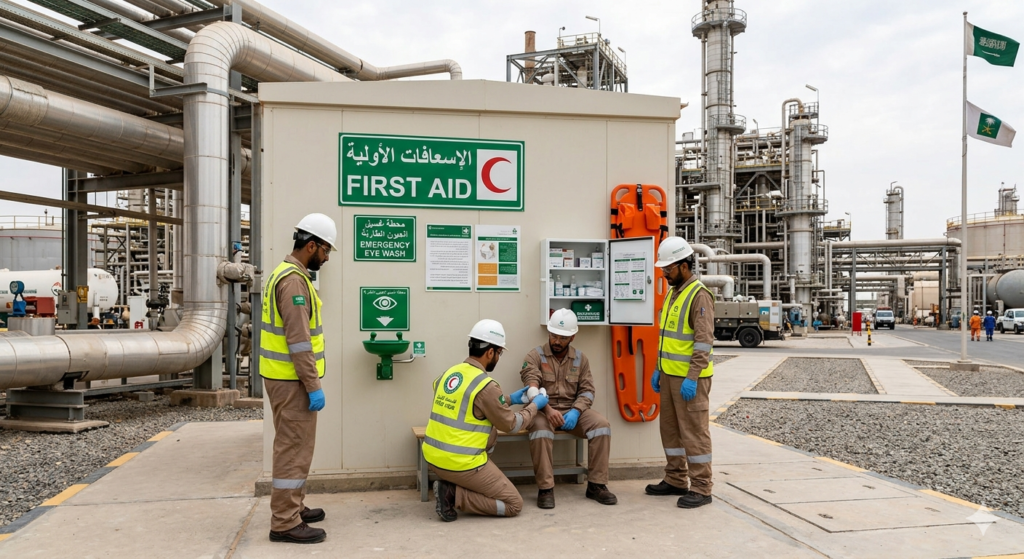
Working as a vendor or contractor for Saudi Aramco means adhering to some of the strictest safety standards in the oil and gas industry. First aid readiness isn’t optional. It’s a mandatory part of your HSE compliance package. Whether you’re managing a construction crew, supervising industrial operations, or providing support services, understanding these requirements protects your workers and keeps your contract active. The consequences of non-compliance can be severe. You risk project shutdowns, financial penalties, and potential contract termination. More importantly, inadequate first aid preparedness puts lives at risk in environments where accidents can happen quickly. Saudi Aramco’s comprehensive safety framework exists because the stakes are genuinely high in industrial settings. Getting compliant starts with knowing exactly what Aramco expects from you. This guide breaks down the specific first aid requirements, certification standards, equipment needs, and practical steps to maintain compliance across your operations. TL;DR: Aramco vendors must provide certified first aiders, maintain properly stocked first aid kits (10 units for sites under 50 workers, 36 units for larger sites), and ensure medical personnel hold valid BLS and first aid certifications. All requirements stem from Saudi Aramco GI 150.002 and government regulations (Saudi Aramco GI 150.002, 2024). What First Aid Certifications Do Aramco Vendors Need? Saudi Aramco requires specific certifications that meet international standards and local regulations. Your personnel must hold valid, recognized credentials that prove they can respond effectively in medical emergencies. The two primary certifications are Standard First Aid (SFA) and Basic Life Support (BLS). Organizations like EUTC Global deliver Aramco-compliant training programs designed specifically for industrial environments in Saudi Arabia. These courses cover everything from basic wound care to cardiac emergencies, giving your team the skills needed for real-world situations. According to Aramco LPD Safety and Medical Standards, male nurses working in contractor clinics must hold both BLS certification and First Aid certification (Aramco LPD Safety and Medical Standards document, 2024). This dual requirement ensures medical staff can handle both basic injuries and serious cardiac events. The same standards apply to ambulance drivers operating on Aramco sites. They must maintain current BLS certification and First Aid certification (Aramco LPD Safety and Medical Standards document, 2024). This makes sense when you consider that ambulance drivers often serve as first responders before patients reach medical facilities. Saudi Aramco’s Health Education Unit provides SFA/BLS Heartsaver CPR training through qualified instructors (Saudi Aramco GI 150.002, 2024). However, vendors often use approved external training providers to certify their workforce before entering Aramco facilities. Certifications typically remain valid for two years. You need to track expiration dates carefully and schedule renewal training well before certificates lapse. Expired certifications mean non-compliant personnel, which can halt work immediately. BLS certification courses are essential for medical personnel and recommended for supervisors who oversee high-risk operations. The training focuses on CPR techniques, automated external defibrillator (AED) usage, and managing choking emergencies. How Many First Aiders Must Be Present on Aramco Work Sites? The number of certified first aiders required depends on your workforce size, shift patterns, and risk assessment. While Aramco doesn’t publish a universal ratio that applies to every situation, best practice suggests having at least one certified first aider per 50 workers during active operations. For smaller teams, you still need at least one qualified first aider present during all working hours. This becomes more complicated when running multiple shifts. Each shift requires its own first aid coverage, meaning you can’t rely on a single certified person to cover 24-hour operations. High-risk activities demand additional first aid presence. If you’re conducting hot work, working at heights, or operating heavy machinery in confined spaces, consider increasing your first aider ratio. The goal is ensuring someone can respond within minutes, not waiting for help to arrive from another location. Site supervisors should also pursue first aid training even if they’re not designated as primary responders. This creates redundancy and ensures leadership can act immediately during emergencies. It’s a practical investment that pays off when seconds matter. Our insight: Companies that exceed minimum requirements often report better safety culture and faster incident response times. Having more trained personnel creates a safety-first mindset that reduces accidents before they happen. Documentation matters just as much as having trained personnel. You must maintain current records of all certified first aiders, including their certification dates, expiration dates, and training provider details. Aramco auditors will request these documents during compliance checks. Create a visible system that identifies first aiders on site. This might include badges, vest markings, or posted lists near work areas. Workers need to know who to find during emergencies without wasting time. What First Aid Equipment Standards Must Vendors Meet? Saudi Aramco mandates specific first aid kit requirements based on worksite size and government regulations. These aren’t suggestions. They’re binding requirements that get verified during safety inspections and audits. For work sites with fewer than 50 workers, you must provide a First Aid Kit containing 10 units (Saudi Aramco GI 150.002, 2024). The term “units” refers to specific medical supplies outlined in Saudi government standards, including bandages, antiseptics, gauze, scissors, gloves, and basic medications. Sites with 50 or more workers require a significantly larger First Aid Kit of 36 units (Saudi Aramco GI 150.002, 2024). This expanded kit includes additional supplies needed to handle multiple casualties or more serious injuries until professional medical help arrives. The requirement for first aid kits at all Aramco work sites stems from Saudi Government Decision No. 404 (Saudi Aramco GI 150.002, 2024). This government mandate ensures consistent safety standards across all industrial operations in the Kingdom. First aid kits must be easily accessible, clearly marked, and protected from environmental damage. Heat, dust, and humidity can degrade medical supplies quickly in Saudi Arabia’s climate. Store kits in temperature-controlled areas when possible and inspect them regularly. Supplier safety checklists explicitly include first aid equipment and supplies compliance as a verification point (Saudi Aramco Material Supplier Guide, 2020). This means your procurement and logistics teams need to understand these requirements just as thoroughly as your safety
Top 5 Benefits of Fire Safety Training for Your Company
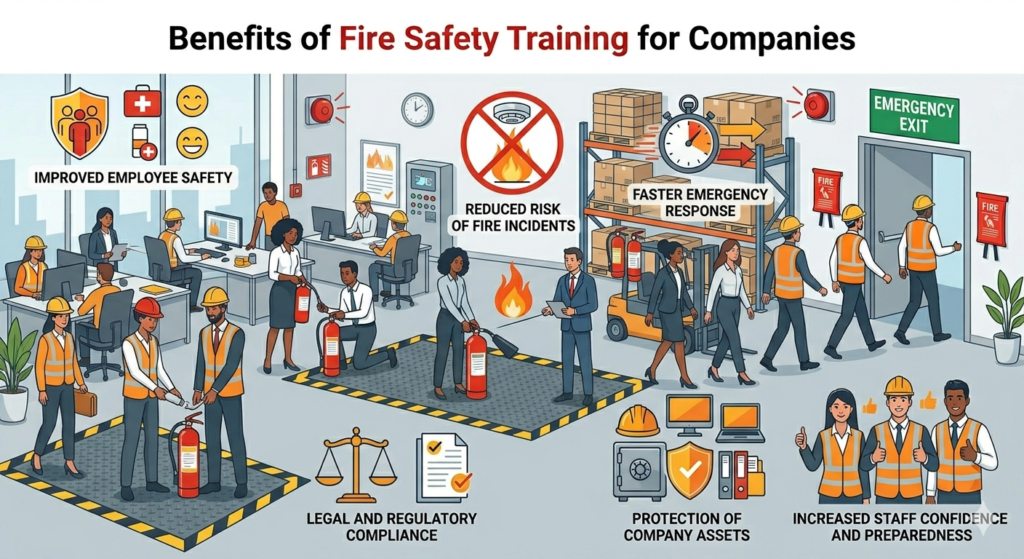
A single industrial fire can cost businesses an average of $4.5 million in damages, downtime, and repairs—excluding legal liabilities and reputational harm. Despite this, many organizations still treat fire safety training as a compliance checkbox rather than a strategic investment. In reality, it delivers measurable financial, operational, and human benefits. Here are the five most impactful advantages of implementing structured fire safety training in your company. 1. Significant Reduction in Workplace Injuries Fire safety training dramatically lowers the risk of employee injuries. Workplaces with structured programs report up to 82% fewer fire-related injuries. This happens because trained employees: Beyond safety, faster evacuations also reduce operational downtime—making this both a human and financial benefit. 2. Strong Return on Investment (ROI) Fire safety training delivers an average 4:1 ROI, meaning every dollar invested saves four dollars in avoided losses. Savings come from In high-risk industries, lack of compliance can even result in lost contracts—turning training into a direct revenue protection strategy. 3. Protection from Regulatory Fines Regulatory compliance is becoming stricter, especially in high-risk sectors. Companies that fail to meet fire safety requirements risk: Common compliance failures include: Regular, certified training ensures your company remains audit-ready and legally protected. 4. Lower Insurance Costs and Liability Exposure Fire safety training has a direct impact on insurance performance. Organizations with proper training programs benefit from: Documented training records demonstrate due diligence, which can significantly reduce liability in legal or insurance disputes. 5. Improved Employee Confidence and Retention Workplace safety directly influences employee morale and retention—especially in high-risk industries. Fire safety training: Employees who feel safe are 20–30% less likely to leave, reducing recruitment and onboarding costs. Key Takeaways Fire safety training is not just a compliance requirement—it’s a high-impact business investment. Core benefits include: What to Do Next To maximize these benefits: A well-implemented fire safety program protects your people, your operations, and your bottom line.
Authorized Gas Tester Training
Have you ever considered how workers detect gas and other gas-related issues on a construction site or any work site? An authorized gas tester steps onto an oil rig or construction site, knowing exactly how to identify invisible threats in the air. That’s the power of authorized gas tester training. It’s a vital skill that saves lives every day. At Eastern United Training Centre, we teach you essential skills, such as how to use a portable gas sniffer. We prepare you to face real-world risks like combustible gas leaks, toxic gases, and low oxygen levels with confidence. Why does this all matter? Picture this: cloudy skies over a refinery, workers in PPE, and a faint visual alarm blinking. In this situation, if you aren’t trained, even a small natural gas leak could become catastrophic. At our training centre in Saudi Arabia, our course blends theory with hands-on practice. We cover everything from gas detection basics to advanced tools like the Max XT II detector. Our certification is recognized across the industry. It is valid for three years and allows you to work everywhere. It is globally recognized because we follow all the standards. Whether you’re an expert or a novice, our collaborative learning ensures we study topics like safe systems of work, risk assessment, and even nitrogen purging techniques. Are you ready to join us? Contact us today to get certified! Who is an Authorized Gas Tester? Well, you can think of him as a guardian of safety in high-risk zones. As an authorized gas tester, you will be trained to identify hazards like methane, propane, or low oxygen levels in confined spaces. These gases can be very dangerous in the construction industry. A gas tester is the first line of defence against disasters. You have to use a gas detector and sharp instincts. Did you even know? Even a tiny spark in a flammable environment can cause chaos. Gas testers are in a very important position, and they are the heroes of the workplace. We have to ensure that every permit to work meets strict safety standards. Authorized Gas Tester Course Outline at Eastern United Training Center This course will teach you everything that is required to become an expert gas tester. After this training, you can work as an authorized gas tester anywhere in the world. Here is what we teach: Why Choose EUTC Global Authorized Gas Tester Training KSA? Well, here are some of the benefits: Validity of Certificate Your EUTC Global gas tester course certification is valid for 3 years. It is globally recognized and trusted for oxygen level monitoring. Course Duration We provide 3 days of immersive training: you will learn theory, like gas testing procedures, and practical skills, like confined space drills. Minimum Qualification Basic safety skills (e.g., risk assessment) are enough. You don’t need prior experience. Just a drive to stop hazards. In Summary In the end, I will say that Authorized Gas Tester Training can be a lifesaver for you. It shows how serious you are when it comes to protecting yourself and your team. At Eastern United Training Center in Saudi Arabia, we blend soft skills with technical challenges that will prepare you for the unexpected. We take authorized gas tester responsibility for the workers. So, if you are facing cloudy skies on a rig or a propane leak in a plant, you will learn to stay calm, act fast, and save lives. So, are you ready to join us? Enroll today!
Emergency Response Leader Training
Emergency Response Training is specially made to train students on how to act in a workplace emergency as a leader. At Eastern United Training Center, we teach the Basic Emergency Response Team Leader course. This course is ideal for team leaders, especially if you have the additional responsibility of managing emergencies. Whether you want to master the role of an Emergency Response Team Leader or want to learn the responsibilities of an Emergency Response Leader, this course has everything. Our program spans two days with an approximate training ratio of 10% theory to 90% practical. From the Emergency Response Leadership Course to Online Emergency Team Leader Training, we offer a lot of options. You’ll learn the skills to assess situations, use resources, and lead your team confidently during crises. This training is perfect for professionals, community leaders, and workers. Our course has a lot of features like the Crisis Management Leadership Course and Incident Commander Training. After this training, you’ll achieve globally accepted certifications that show your skills. If you live in Saudi Arabia or anywhere else, our program will teach you to handle emergencies effectively. Ready to step up as a leader? Enroll in our basic training emergency response team leader program today and become the leader your team or community needs in times of crisis. Emergency Response Team Training We all know that when some emergencies happen, they bring chaos. But it doesn’t have to, right? Well, it is possible if you could be the person who steps up, takes everything in charge, and leads others to safety. This is exactly what Emergency Response Training will train you to do. This training is planned to teach the students basic safety skills and knowledge about workplace emergencies. By learning, they will be able to effectively respond to any workplace emergency. This training will ensure that you’re ready to manage anything from natural disasters to industrial accidents. If you’re a team leader with a lot of responsibilities for emergency management, then you should definitely do this training. At Eastern United Training Center, our training spans two days with an approximate ratio of 10% theory to 90% practical. After that, you will know the responsibilities of the emergency response team leader training and master crisis communication. Ready to be a leader and lead others to safety. Emergency Response Leader Training is for you. What is Emergency Response Leader Training KSA? Well, have you ever imagined being the person everyone comes to during a crisis? Emergency Response Training trains you for this. It’s a very detailed program that will teach all the participants how they manage emergencies. This emergency can be anything from natural disasters to industrial accidents. In this training, you will be trained to assess this kind of situation and make important decisions. You have to lead your team under pressure. However, it’s not just about theory. Our training often includes real-life simulations, leader role-playing, and hands-on exercises. This will ensure that you’re ready for anything. Key Features of Emergency Response Leader Training So, what makes our Emergency Response Leader Training different from others? Well, these are some standout features: Crisis Management Leadership Course You will learn how to handle high-stress situations with confidence. Many people failed to act properly and didn’t know how to manage these situations. Just because of this, many people die every year in these industries. In this training, we make sure that you will know about every situation you might face if you have an emergency. In this way, you will already know how to lead. Incident Commander Training You will be a commander and know how you save others. It’s not just some duty. It’s a proper responsibility. Your team might be at risk, and you have to save them. You should only be able to do that if you master the art of taking charge and coordinating resources effectively. Disaster Response Leadership Certification If you achieve this certificate, people will know how important you are. They will trust you and remember that they should come to you if something happens. When you gain this recognized credential, it will show your expertise. It adds value to your personality and your career. Emergency Preparedness Leadership Workshop You will learn how you can take action if there is an emergency. In almost all accidents, you can save lives if you can do things quickly and properly. The emergency preparedness training will teach skills of emergency team leadership development and develop strategies to prepare for and prevent emergencies. Emergency Action Plan Leadership Training In this course, we will teach how you can build and lead teams that can respond swiftly and efficiently. Your plan is also very important in these situations. You should create actionable plans that are specific to the emergency learning scenarios. These features ensure that you’re not just learning concepts but also applying them in practical life. Who Should Take Emergency Response Training? You might be wondering if I should take this training or not. Well, if you’re someone who wants help during emergencies by saving lives, then this training is definitely for you: In our courses, your background is not an issue. This training can help you to become the leader of your team. Wrapping Up We all must know that emergencies don’t wait for the perfect moment. You can save lives if you act properly. That’s where Emergency Response Training comes in. This program not only teaches you how to respond; it transforms you into a leader. Your team will rely on you during an emergency. The EUTC Global course has hands-on practice and real-world simulations. We will give you expert guidance, and you’ll achieve the confidence and skills to protect your team in crisis. This training will make a great difference. After this training, you will be more responsible, and you can protect your workplace, community, and loved ones. Don’t wait for the next emergency to come.
Emergency Preparedness & Response Training
Imagine a day at your workplace. Machines are humming, teams are collaborating, operations are running smoothly, and you are doing your usual job. Suddenly, an alarm blares, indicating a chemical spill. In this situation, panic will occur. So, do your employees know how to react? Well, at Eastern United Training Center, we have a special course called Emergency Preparedness and Response Training. It is not just a course; it will teach you many life-saving skills. You will study how you can navigate hazardous materials, natural disasters, and public health emergencies with precision and care. Why does this even matter? Well, emergencies occur without any warning. Any small negligence can result in fire, flood, or calamity. If we didn’t know how to handle this, then it could escalate risks. In this training program, you will learn to handle potential hazards like man-made disasters or catastrophes. In our program, we give practical knowledge to participants. You will practice real-life scenarios like guiding your colleagues to evacuation routes or containing a mock chemical spill. Our training courses are tailored to Saudi Arabia’s oil and gas industry. We empower everyone, from firefighters to office staff, with first aid, risk management, and emergency planning skills. Join our courses today so that you don’t have to wait for a disaster to strike before learning emergency response. So, join us today to get certified! What is Emergency Preparedness and Response Training KSA? Well, emergency response and preparedness training is very crucial. It prepares you to handle everything from a small worksite injury to a major natural disaster like a sandstorm or flood. You can divide it into two parts: For example, during a public health emergency like a pandemic, this training teaches you how you can properly react to these kinds of situations. You should learn how you can enforce social distancing, sanitize workspaces, and communicate calmly. Many people think disaster preparedness is only for emergency managers. But here at our training center, we teach teachers, engineers, and people from different professions. Benefits of Emergency Preparedness and Response Training at Eastern United Training Center Why train with us? Well, there are many reasons why you should choose us over others. There are many training centres in Al Khobar, but here is what makes us different: Why Choose EUTC Global Over Competitors? When you Google emergency preparedness training, you’ll find countless options. Here’s why we stand out: Well, if you are still unsure? Then ask our student! Ahmed, a safety officer at Aramco, says, “Your emergency response training PPT helped me lead my team during a real gas leak. We evacuated in 3 minutes flat! Course Outline of Preparedness and Response Training We will teach you many things in our training program. This will make you an expert. You will learn things like: We will also teach you many case studies, like how poor emergency planning worsened the 2020 Beirut explosion. Validity of the Certificate Your EUTC Global certification isn’t just a piece of paper. It is proof of your skills and expertise. This three-year certificate aligns with global standards like OSHA and Saudi Arabia’s Civil Defense protocols. As emergency management evolves, many new risks emerge. That’s why we offer refresher courses on hazardous scenarios, chemical spills, disaster planning, emergency response, and risk management. Course Duration Time is precious, so we’ve designed our course for two days. In these two days, we will teach you about potential emergencies, man-made disasters, public health emergencies, emergency plans, mapping, evacuation routes, and emergency situations. Course Certification & Minimum Qualification Well, almost everyone can join this training. The only requirements are: Your globally recognized certificate opens doors in industries like construction, healthcare, and oil and gas. Who Can Enroll in Emergency Preparedness & Response Training? Well, our training is not just for firefighters or emergency managers. Here’s who can benefit: Oil & Gas Workers That’s Literally everyone. You should know about them. After all, 60% of emergencies happen off the clock! Wrapping it Up In the end, I just want to say that Emergency Preparedness and Response Training isn’t just normal training, it’s confidence in a certificate. At Eastern United Training Centre, we don’t just teach what to do. We teach the participants advanced emergency preparedness kit skills. At our training centre, you can learn many important and life-saving skills like dodging chemical spills or calming colleagues during a crisis. So, are you ready to join our next batch and get certified today?
Rig/Rig less Operation Orientation
Do you want to get a Rig/Rigless operation training course in Saudi Arabia? Then you are at the perfect spot here Eastern United Training Center is providing Rig and Rigless operation and all other essential training on oil and gas safety. In the oil and gas industry, wells need to be drilled, preserved, and sometimes fixed to keep production going. This is where rig and rig-less operations arrive in space. Rig/Rigless Operation Training is developed to help professionals and newcomers in the oil and gas industry enhance their knowledge of how wells are drilled, supported, and repaired using rig/rig-less techniques. This training covers everything from the basics of drilling with a full-sized rig to functioning well interventions. The rig-less operation section focuses on faster, cost-effective methods used for well-maintenance and minor repairs. Both rig and rig-less are very important for doing work safely in the oil and gas industry. There are further Rigger 1 2 3 levels EUTC Global offers in which you can enhance more knowledge. Every employee in that kind of organization should have Rig/Rigless Operation training and certifications. That is why you should choose a productive training center to get professional knowledge. The Rig and Rigless Training Course The rig and ringless training course is designed to give participants a complete understanding of how these operations can work in the oil and gas industry. To enhance knowledge and expertise this course is very productive for both experienced professionals and newcomers in the organizations. In this valuable and productive course, we did add all fundamental concepts and techniques that how to use equipment in both rig and ringless operations. Our experienced specialist in this operation will properly guide them during the course and learners will receive a detailed over of these operations. In need of any query, they will assist you and perform all the sessions practically for you. Rig/Rig less Operation Orientation Program Key Highlights 1. Introduction to Rig Operation Rigs play a very essential role in the oil and gas industry because these are used for drilling and maintaining wells. A rig consists of several important features, such as the mud pumps, and drill string, all operating jointly to drill safely. Rigs are different kinds of such as land-based, offshore, and submersible rigs. These all have specific features and are designed for specific environments. 2. Rig Based Operations Rig-based operations concentrate on managing well integrity and drilling wells. It includes multiple techniques, including horizontal drilling, directional drilling, and rotary to extract oil and gas efficiently. It plays an important part in wells, as it controls blowouts utilizing safety measures like blowout preventers (BOPs). 3. Rig-less Operations Without using the full-sized rig and making it more cost-effective, Rig-less operations permit well interventions. For tasks including cleaning and maintaining the well, slackline, coiled tubing, and wireline equipment are used rather than a rig. Rig less operations involve well logging, which assesses the well’s condition, and perforating, which makes pathways for oil and gas to follow. Plug and defection methods are carried out to close it safely when a well comes to the end of its life. Health, Safety, and Environmental Considerations The most essential is safety in both rigging and rigless operations. In this topic, we are providing the knowledge of each step, such as how to identify risky hazards. Employees ar workers of the oil & gas industries must use PPE (Personal Protective Equipment), including gloves and helmets, during work to protect themselves. Strict safety protocols, including emergency response plans, are obeyed at all times. We train about the use of equipment safely as well as about protecting yourself from harmful chemicals. Operational Management and Planning To perform successfully rig and rig less operations, management and planning in a good way is very essential. We will train in this topic about how to set up necessary equipment and ensure that security or security standards are in place. In this session, you will learn effective coordination among engineers and supervisors to smooth operations. Also, study project management and resource allocation to keep operations on track. Practicals and Case Studies At the end of all topics, you will learn about case studies and do everything practically under the guidelines of the experts. Through a case study, you will be able to understand challenges and answer them effectively. Participants can enhance their skills by doing practical work and can solve problems effectively. Why Choose Us Eastern United Training Center also prioritizes safety and environmental awareness. We are training the participants with important risk management skills to work efficiently. Also, the course includes interactive case studies, real-world systems, and hands-on exercises, ensuring that participants leave with not just theoretical knowledge but also practical expertise. Our professional experts are always available to assist with queries related to the course as well as which course is best according to your needs in Saudi Arabia. Global Recognized Certificates KSA At Eastern United Training Center you will get a certificate after completing the course. This diploma will be OSHA-approved and globally recognized. You can use this anywhere in the world. Whether you are new to the field or looking to enhance your expertise, we will provide the best platform to build your talents and advance in the oil and gas industry.
Respiratory Protection Training
Are you searching for the best Respiratory Protection Training (RPT)? Here, Eastern United Training Center is providing the world’s most suitable and productive respiratory protection training. This course will teach people how to operate, maintain, and select respiratory protective equipment (RPE). This training is important to control the inhalation of hazardous airborne pollutants. In our sessions, we will provide personnel with an introduction to different types of respiratory protection and describe their use in the workplace. Why Choose Us We are providing internationally recognized certificates after completing your course and passing the exam. We will give you grades according to your reputation during the course. All professional and simple people always choose EUTC Global because of our convenient time classes and audio-video lectures. You can learn these according to your opportunity and suitable time. Our Basic Respiratory Protection Training Sessions At Eastern United Training Centers KSA, you will get the following awareness and knowledge: Why is there a need for disposable respirators? In any company or industry where hazardous chemicals are present, disposable respirators are essential to safety employees from all kinds of risks and hazards. Inhalation of harmful, dangerous airborne pollutants can lead to infections such as occupational asthma, industrial cancer, or infections like COVID-19. To ensure workplace safety. So the use of high-quality respiratory protection is very important for the reputation and to meet the industry standards. Respirator Protection Levels Respiratory Muscle Training is divided into multiple levels according to their capabilities, which means how effectively they protect the wearer. Some consist of low capability, and some consist of good quality and provide high protection. The basic levels of masks are the following: FFP3 masks offer the highest level of protection and are suggested for high-risk circumstances, such as medical settings where aerosol-generating procedures (AGPs) are completed. How are Respirators Working? The texture area and layers of filter media in an FFP mask play a crucial role in trapping toxic particles. The filter media is electrostatically set, which enhances the mask’s ability to catch even the smallest airborne impurities. However, it is essential to note that disposable respirators should not be used in oxygen-deficient surroundings or where toxic gases are available. Proper Fitting and Use A respirator’s effectiveness depends on a proper fit. All tight-fitting respiratory protecting equipment (RPE) needs a fit test to confirm there are no leaks around the mask’s seal. Should always Use a taste or smell test to determine if the mask is properly sealed, and use technical equipment to measure the exact leakage near the mask. Employees with facial hair should avoid tight-fitting respirators, as even small gaps can reduce protection levels greatly. Workplace Risk Estimate And Hazards Various workplace activities can generate airborne impurities, such as dust, and fumes. These particles can pose severe health hazards if inhaled. A proper and excellent risk assessment should be conducted following the control of substances hazardous to health regulations. Workers must also consider workplace exposure limits and the assigned protection factor of different respirators.