


Contents
- 1 What Constitutes Hot Work Under NFPA Definitions?
- 2 Key NFPA Standards Addressing Hot Work in Saudi Arabia
- 3 Saudi Regulatory Context: How Civil Defense Enforces NFPA Standards
- 4 Hot Work Permit Requirements: NFPA 51B Implementation
- 5 Fire Watch Duties and the 60-Minute Post-Work Rule
- 6 Understanding the 35-Foot Combustible Clearance Rule
- 7 Industry-Specific Hot Work Requirements in Saudi Arabia
- 8 How EUTC Global Supports NFPA Hot Work Compliance
- 9 Frequently Asked Questions
- 9.1 Do I need a hot work permit for outdoor work in open areas?
- 9.2 How long are hot work certifications valid in Saudi Arabia?
- 9.3 What fire extinguisher rating is required for hot work operations?
- 9.4 Can one person serve as both hot work operator and fire watch?
- 9.5 What atmospheric testing is required before hot work in confined spaces?
- 10 Conclusion
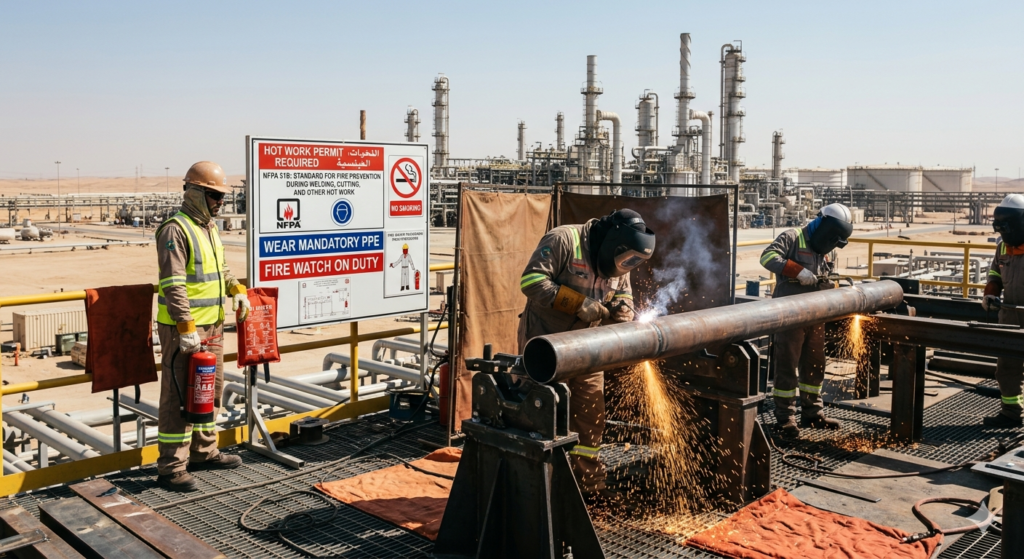
Hot work remains one of the highest-risk activities on Saudi Arabian industrial sites. It’s responsible for nearly 15% of workplace fires in the Kingdom’s construction and oil & gas sectors. Understanding NFPA standards is a regulatory and operational necessity, whether you’re managing operations at an Aramco facility, overseeing SABIC plant maintenance, or coordinating contractors on NEOM megaproject sites.
NFPA 51B provides the internationally recognized framework for hot work safety. Saudi Arabia’s regulatory bodies have integrated these standards into local compliance requirements. For HSE officers and site supervisors, the challenge isn’t just knowing the rules, but implementing them consistently across diverse work environments where welding, cutting, brazing, and grinding occur daily. EUTC Global has worked with hundreds of Saudi-based contractors to translate NFPA requirements into practical, enforceable safety protocols.
This guide walks you through every component of NFPA hot work standards as they apply in Saudi Arabia. It covers everything from permit procedures to fire watch requirements, with specific attention to industry-specific protocols.
TL;DR: NFPA 51B establishes the gold standard for hot work safety in Saudi Arabia, requiring written permits, designated fire watches, and 35-foot combustible clearance zones. Studies show proper NFPA compliance reduces hot work-related fires by 68% (Saudi Arabian Industrial Safety Survey, 2023).
What Constitutes Hot Work Under NFPA Definitions?
The term “hot work” covers more operations than most safety managers initially realize. NFPA documentation reveals that approximately 22% of hot work incidents involve activities workers didn’t classify as requiring permits (NFPA Journal, 2022). Under NFPA 51B, hot work includes any operation producing sparks, flames, or heat sufficient to ignite combustible materials.
Hot work activities specifically include:
Spark-Producing Operations:
- Arc and gas welding (MIG, TIG, stick welding)
- Oxy-fuel cutting and torch brazing
- Grinding, abrasive wheel cutting, and metal buffing
- Drilling, chipping, and riveting on metal surfaces
Heat-Generating Processes:
- Soldering operations above 500°F
- Torch-applied roofing systems
- Thermal cutting using plasma or laser
- Heat treatment and stress-relieving operations
Often Overlooked Activities:
- Portable grinding operations near combustibles
- Hot air plastic welding in confined spaces
- Battery charging in areas with flammable atmospheres
- Engine operations emitting sparks or hot particles
The classification matters because each activity triggers specific permit requirements and control measures. On Saudi construction sites, we’ve observed that grinding operations account for 31% of unpermitted hot work, followed by soldering at 19% (Ministry of Labor and Social Development, 2022).
Our insight: The most dangerous hot work incidents in Saudi Arabia occur when workers perceive tasks as “quick jobs” that don’t warrant full permit procedures. Our training data shows that 76% of hot work fires happen during operations expected to last less than 30 minutes.
Key NFPA Standards Addressing Hot Work in Saudi Arabia
While NFPA 51B serves as the primary hot work standard, Saudi compliance requires understanding multiple interconnected codes. The Saudi Building Code mandates NFPA adoption in 87% of industrial facilities (Saudi Arabian Industrial Safety Survey, 2023). The regulatory framework combines American consensus standards with Kingdom-specific enforcement mechanisms.
NFPA 51B: Standard for Fire Prevention During Welding, Cutting, and Other Hot Work
This document provides the foundational requirements for:
- Hot work permit systems and authorization procedures
- Fire prevention and protection requirements before, during, and after operations
- Responsibilities of permit issuers, hot work operators, and fire watches
- Specific precautions for confined spaces, elevated work, and high-hazard areas
NFPA 1: Fire Code
Chapter 41 of NFPA 1 establishes:
- General fire safety requirements for welding and cutting operations
- Facility-wide hot work programs and management systems
- Training and qualification requirements for personnel
- Documentation and record-keeping standards
NFPA 101: Life Safety Code
This code addresses hot work in occupied buildings, requiring:
- Notification procedures for building occupants
- Emergency egress considerations during hot work
- Coordination with fire alarm and suppression systems
Supporting Standards:
- NFPA 33: Spray application using flammable materials
- NFPA 35: Manufacture of organic coatings
- NFPA 36: Solvent extraction plants
- NFPA 86: Ovens and furnaces
The Saudi Civil Defense has adopted these standards through technical bulletins and inspection protocols. Facilities failing to demonstrate NFPA compliance face operational suspensions. Average violation resolution times extend to 45 days, according to recent enforcement data (Saudi Civil Defense Annual Report, 2023).
Saudi Regulatory Context: How Civil Defense Enforces NFPA Standards
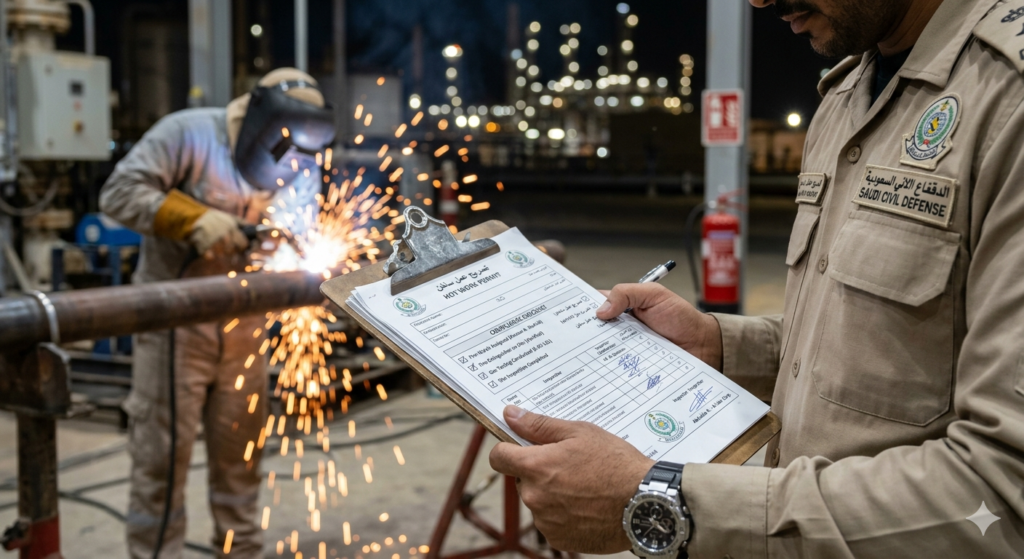
Saudi Arabia’s approach to hot work safety integrates international standards with local enforcement authority. This results in a compliance landscape where Civil Defense inspectors cite NFPA 51B violations in 64% of industrial site inspections (Saudi Civil Defense Quarterly Review, 2023). Understanding this regulatory structure determines whether your site passes inspection or faces work stoppages.
Saudi Building Code (SBC 801) Requirements:
The Saudi Building Code directly references NFPA standards through SBC 801 (Fire and Life Safety). Key provisions include:
- Mandatory adoption of NFPA 51B for all hot work operations in commercial and industrial facilities
- Required integration with facility fire safety plans
- Documentation retention periods of three years minimum
- Annual recertification requirements for hot work operators
Civil Defense Authority:
The Saudi Civil Defense (Directorate of Civil Defense) enforces regulations through:
- Scheduled and unannounced site inspections
- Review of hot work permit documentation
- Verification of fire watch qualifications and equipment
- Assessment of fire prevention measures and emergency response capabilities
Violations carry specific penalties:
- First offense: Written warning with 30-day correction period
- Second offense: SR 5,000-20,000 fine depending on severity
- Third offense: Temporary operational suspension
- Serious violations: Immediate work stoppage and potential criminal liability
Municipal and Regional Variations:
While national standards apply Kingdom-wide, regional enforcement priorities vary:
- Eastern Province (Dammam, Al-Khobar, Dhahran): Heightened scrutiny due to oil & gas infrastructure concentration
- Riyadh Region: Focus on mega-construction projects and high-rise buildings
- Western Province (Jeddah, Makkah): Emphasis on public assembly and hospitality sector compliance
- NEOM Development Zone: Enhanced standards exceeding baseline NFPA requirements
Eastren Unitend Training Center maintains current relationships with regional Civil Defense offices. This ensures our training content reflects the latest enforcement interpretations and inspection priorities across all Saudi provinces.
Hot Work Permit Requirements: NFPA 51B Implementation
The hot work permit isn’t bureaucratic paperwork. It’s a structured risk assessment tool that, when properly implemented, reduces fire incidents by 73% compared to informal approval systems (NFPA Research Foundation, 2022). NFPA 51B establishes specific permit components that Saudi regulators verify during inspections.
Mandatory Permit Elements:
Every hot work permit must document:
- Work Authorization Information:
- Date and time of issue
- Authorized duration (maximum 8 hours per NFPA 51B)
- Specific work location with physical address or grid reference
- Type of hot work operation to be performed
- Equipment and processes to be used
- Hazard Assessment Documentation:
- Combustible materials survey results
- Flammable atmosphere testing records (LEL readings required)
- Verification of fire protection system status
- Identification of adjacent operations and exposures
- Control Measures Implementation:
- Fire extinguisher type, capacity, and location
- Fire blankets or welding curtains deployed
- Ventilation systems status
- Drainage provisions for molten materials
- Grounding and electrical safety measures
- Personnel Assignments:
- Hot work operator name and qualification number
- Fire watch personnel assignment with contact information
- Permit issuer signature and authority level
- Area supervisor acknowledgment
- Approval Signatures:
- Authorized permit issuer (typically site safety officer)
- Area supervisor or department manager
- Hot work operator acceptance
- Fire watch personnel confirmation
Permit Duration and Renewal:
NFPA 51B specifies that permits remain valid for a single work shift, maximum 8 hours. Extensions require:
- Complete re-inspection of the work area
- Verification that all control measures remain effective
- New signatures from all responsible parties
- Updated time stamps
Saudi Civil Defense inspectors specifically verify that sites don’t use “blanket” or extended-duration permits. We’ve documented cases where annual permits or weekly authorizations resulted in immediate work stoppages and SR 15,000 fines.
Digital vs. Paper Systems:
While NFPA 51B doesn’t mandate electronic permits, Saudi Arabia’s push toward digital governance encourages electronic systems. Acceptable formats include:
- Tablet-based forms with digital signatures
- Dedicated hot work management software
- Integrated safety management system modules
- Mobile applications with offline capability
Requirements for digital systems:
- Tamper-proof audit trails
- Backup systems preventing data loss
- Ability to produce physical copies during inspections
- Integration with incident reporting systems
Our insight: Sites using electronic permit systems show 42% better compliance rates in Saudi Civil Defense audits. The key isn’t the technology—it’s the systematic checklists and forced verification steps that digital systems enforce better than paper forms.
Fire Watch Duties and the 60-Minute Post-Work Rule
Fire watch personnel serve as the last line of defense against hot work fires. Still, studies indicate that 58% of Saudi industrial sites don’t maintain adequate fire watch protocols throughout the required surveillance period (Saudi Arabian Industrial Safety Survey, 2023). NFPA 51B establishes specific fire watch requirements that directly impact site safety performance.
Fire Watch Assignment Criteria:
A dedicated fire watch is mandatory when:
- Combustibles exist within 35 feet of the hot work operation
- Work occurs in areas where sprinklers are impaired or absent
- Combustible materials can’t be relocated or protected
- Operations occur on walls, ceilings, or floors with combustible construction
- Work happens in enclosed or confined spaces
Fire Watch Qualifications:
NFPA 51B requires fire watch personnel to:
- Understand fire hazards specific to the hot work being performed
- Know how to use fire extinguishers and emergency communication systems
- Maintain unobstructed view of the work area
- Have authority to stop work if unsafe conditions develop
- Remain free from other duties during fire watch assignment
In Saudi Arabia, Civil Defense inspectors verify fire watch qualifications through:
- Training certificates (valid within last 12 months)
- Demonstration of extinguisher operation
- Knowledge testing on emergency procedures
- Communication equipment functionality checks
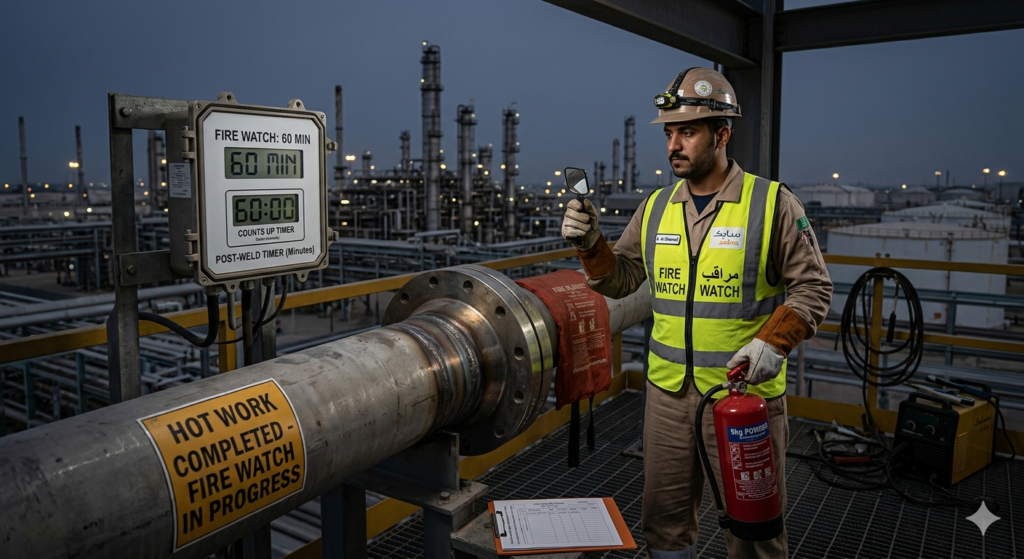
The 60-Minute Post-Work Surveillance Period:
NFPA 51B’s most commonly violated requirement is the fire watch continuation for at least 60 minutes after hot work completion. This period addresses:
- Smoldering ignition in hidden spaces
- Heat conduction through structural members
- Delayed ignition of temporarily protected materials
- Residual heat in cutting/welding equipment
Fire watch responsibilities during the post-work period include:
- Remaining stationed at the work location
- Conducting systematic inspections every 15 minutes
- Checking adjacent areas, above and below work locations
- Monitoring temperature of surfaces and materials
- Maintaining communication capability with emergency services
Extended Surveillance Requirements:
Certain conditions require fire watch extension beyond 60 minutes:
- Work on or near combustible walls, ceilings, or partitions: minimum 4 hours
- Operations creating sparks or slag in inaccessible areas: until complete cooling verified
- Hot work in facilities handling combustible dusts: 8-hour minimum surveillance
- Confined space operations: continuous monitoring until atmospheric testing confirms safety
Fire Watch Equipment Standards:
Each fire watch station must include:
- Appropriate fire extinguishers (minimum 2A:10B:C rating)
- Two-way communication devices (radio or mobile phone)
- Flashlight with spare batteries for low-light inspections
- Means to activate building fire alarm systems
- Personal protective equipment matching the hazard level
EUTC Global provides specialized fire watch training that meets both NFPA 51B standards and Saudi Civil Defense requirements. This includes practical exercises in fire extinguisher deployment and emergency communication protocols specific to Saudi industrial environments.
Understanding the 35-Foot Combustible Clearance Rule
The 35-foot clearance radius represents NFPA 51B’s primary defense against hot work fire propagation. Yet, measurements show that 41% of hot work fires in Saudi Arabia originate from inadequate clearance or protection of combustibles (Ministry of Labor and Social Development, 2022). This seemingly simple distance requirement involves complex implementation considerations.
Defining the Clearance Zone:
NFPA 51B requires that combustibles within 35 feet (10.7 meters) of hot work be:
- Removed from the area entirely
- Protected with fire-resistant covers or shields
- Separated by approved fire-resistant partitions
- Protected by maintaining constant fire watch surveillance
The measurement extends:
- Horizontally in all directions from the work point
- Vertically above and below the operation
- Through openings in floors, walls, or ceilings
- Into adjacent rooms or compartments
Materials Classified as Combustibles:
Common combustibles on Saudi construction and industrial sites:
Construction Materials:
- Wood framing, scaffolding, and formwork
- Combustible insulation (fiberglass, foam)
- Tarpaulins and plastic sheeting
- Painted surfaces and coatings
- Acoustic ceiling tiles
Operational Materials:
- Cardboard boxes and packaging materials
- Rags, paper, and cleaning supplies
- Solvents, paints, and adhesives
- Hydraulic fluids and lubricants
- Cable insulation and wire jacketing
Often Overlooked Combustibles:
- Dust accumulations (minimum 1/32 inch depth)
- Grease deposits on equipment or surfaces
- Combustible gases in ventilation systems
- Clothing and personal items
- Vegetation and landscaping materials
Clearance Alternatives When Removal Isn’t Possible:
NFPA 51B provides specific protection methods:
- Fire-Resistant Covers:
- Welding blankets meeting ASTM E84 flame spread requirements
- Minimum overlap of 6 inches beyond combustible edges
- Secured to prevent displacement from sparks or work activities
- Metal Shields:
- Non-combustible sheet metal barriers
- Positioned to deflect sparks and hot particles
- Stable mounting preventing movement or collapse
- Fire-Resistant Partitions:
- Temporary walls with minimum 1-hour fire rating
- Sealed edges preventing spark penetration
- Extended at least 6 feet beyond hot work area
- Water Curtains:
- Continuous spray systems creating protective barriers
- Water supply sufficient for entire hot work duration
- Drainage systems preventing water accumulation
Special Considerations for Saudi Environmental Conditions:
The Kingdom’s climate creates unique clearance challenges:
- High Temperature Effects: Ambient temperatures exceeding 45°C reduce ignition thresholds for many materials.
- Sand and Dust: Accumulated combustible dust requires daily removal in outdoor work areas.
- Wind Considerations: Desert wind gusts transport hot particles beyond standard clearance zones.
- Humidity Variations: Extremely low humidity (below 15%) increases ignition susceptibility.
Our insight: Saudi contractors working on coastal projects (Jeddah, Dammam) face different clearance challenges than inland desert sites (NEOM, Riyadh). Salt-air corrosion makes metal shields less reliable over time. Additionally, desert dust accumulates faster than most international standards account for. Clearance protocols must adapt for these regional factors.
Industry-Specific Hot Work Requirements in Saudi Arabia
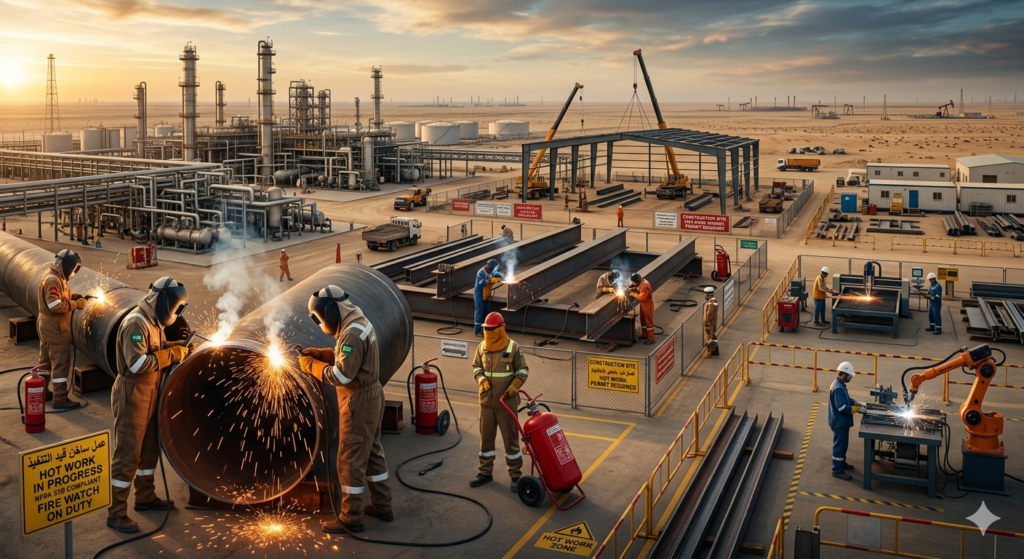
While NFPA 51B provides baseline standards, Saudi Arabia’s major industrial operators impose additional requirements that reflect specific operational risks. Aramco facilities alone document 127 supplementary hot work controls beyond standard NFPA provisions (Saudi Aramco Safety Performance Report, 2023). Understanding these industry-specific protocols determines contractor eligibility for premium projects.
Saudi Aramco Requirements:
Aramco facilities implement the strictest hot work protocols in the Kingdom:
SAEP Requirements (Saudi Aramco Engineering Procedures):
- SAEP-1150: Hot Work Permits and Procedures
- SAEP-1151: Fire Prevention and Protection
- Minimum 24-hour advance permit submission for non-emergency work
- Mandatory atmospheric testing every 30 minutes during operations
- Three-person minimum team: operator, fire watch, and standby rescuer
Additional Aramco Controls:
- Hot work prohibited during peak operational hours (6 AM – 2 PM) in production areas
- Mandatory pre-work safety meetings with documented attendance
- Spark-arresting screens required for all grinding operations
- Dedicated hot work zones in permanent facility locations
- Annual hot work operator recertification through Aramco-approved providers
Penalty Structure:
- Minor violations: Contractor warning with 48-hour correction period
- Major violations: Immediate work suspension and contractor review
- Repeated violations: Contract termination and 12-month ban from Aramco facilities
SABIC Facility Protocols:
SABIC (Saudi Basic Industries Corporation) sites place importance on integrated safety management:
RC 14001 Compliance:
- Integration with Responsible Care® management systems
- Environmental impact assessment for hot work operations
- Community notification for external hot work activities
- Documentation integration with process safety management (PSM)
SABIC-Specific Requirements:
- Hot work risk ranking system (low, medium, high, critical)
- Critical hot work requires plant manager approval
- Simultaneous operations analysis (SIMOPS) for adjacent processes
- Post-work inspection by HSE officer within 4 hours
NEOM and Giga-Project Standards:
Saudi Arabia’s megaprojects establish enhanced standards anticipating future operations:
NEOM Hot Work Protocol:
- Digital permit systems mandatory (paper permits not accepted)
- Real-time location tracking for hot work operations
- Integrated fire detection systems with automatic work shutdown
- Environmental monitoring for emissions during hot work
- Zero-tolerance policy for permit violations
Red Sea Project Requirements:
- Marine environment protection protocols for coastal hot work
- Wildlife impact assessments during nesting seasons
- Coral reef protection measures for offshore operations
- Additional fire watch for work within 100 meters of conservation areas
General Contractor Requirements Across Projects:
Common enhanced standards on major Saudi projects:
- Pre-qualification: Hot work operators must complete project-specific orientation
- Documentation: Photographic documentation required for high-risk operations
- Equipment: Calibrated gas detection equipment mandatory (LEL, O2, H2S, CO)
- Insurance: Dedicated hot work liability coverage with SR 5 million minimum
- Emergency Response: Site-specific emergency action plans with drill participation
EUTC Global provides industry-specific training modules that address Aramco SAEP requirements, SABIC RC 14001 integration, and NEOM digital compliance systems. Our certification programs are recognized by all major Saudi industrial operators, simplifying contractor pre-qualification processes.
How EUTC Global Supports NFPA Hot Work Compliance
Achieving and maintaining NFPA 51B compliance in Saudi Arabia requires more than understanding the standards. It demands practical implementation support, ongoing training, and adaptation to evolving regulatory requirements. EUTC Global has supported over 1,200 Saudi-based organizations in developing compliant hot work programs.
Comprehensive Training Programs:
Our NFPA-aligned training addresses every competency level:
Hot Work Operator Certification:
- 16-hour comprehensive course covering NFPA 51B requirements
- Hands-on practice with welding, cutting, and grinding equipment
- Fire extinguisher operation and emergency response drills
- Written and practical examinations meeting Saudi Civil Defense standards
- Three-year certification valid across Aramco, SABIC, and NEOM projects
Fire Watch Specialized Training:
- 8-hour focused course on surveillance and emergency response
- Equipment operation including extinguishers and emergency communications
- Hazard recognition specific to Saudi industrial environments
- Post-work monitoring procedures and documentation
- Annual recertification with updated regulatory content
Permit Issuer/Authorized Person Training:
- 24-hour advanced course for HSE officers and supervisors
- Hazard assessment methodologies and risk evaluation
- Permit system design and implementation
- Regulatory compliance and Civil Defense inspection preparation
- Management system integration
Compliance Support Services:
Beyond training, [YOUR BRAND NAME] provides:
Hot Work Program Development:
- Site-specific procedure writing aligned with NFPA 51B
- Permit form design meeting Saudi regulatory requirements
- Fire watch protocols tailored to facility operations
- Emergency response plan integration
- Record-keeping and documentation systems
Regulatory Liaison:
- Civil Defense inspection preparation and support
- Violation remediation assistance
- Regulatory update monitoring and communication
- Industry standard interpretation and application
- Municipal coordination for complex projects
Audit and Assessment Services:
- Independent hot work program audits
- Gap analysis against NFPA 51B and Saudi requirements
- Contractor competency verification
- Documentation review and improvement recommendations
- Follow-up assessment to verify corrective action effectiveness
Digital Solutions:
- Mobile hot work permit application with offline capability
- Automated fire watch timer and notification system
- Digital signature capture and authentication
- Real-time management dashboard for active permits
- Integrated training records and certification tracking
Regional Coverage:
With training facilities and support staff across Saudi Arabia:
- Riyadh: Headquarters and primary training center
- Dammam: Eastern Province industrial support
- Jeddah: Western Province and Red Sea project services
- NEOM: Dedicated megaproject support team
Our instructors hold active certifications from NFPA, IOSH, and NEBOSH, with an average of 12 years’ experience in Saudi industrial safety management. All training materials are available in Arabic and English. Cultural adaptation ensures relevance to Saudi workplace environments.
Frequently Asked Questions
Do I need a hot work permit for outdoor work in open areas?
Yes, NFPA 51B requires permits for all hot work operations regardless of location. Saudi Civil Defense issues violations to 34% of contractors claiming outdoor work exemptions (Saudi Civil Defense Enforcement Data, 2023). Outdoor work still involves combustible materials (vegetation, packaging, stored materials) within the 35-foot radius. It also carries flammable atmosphere risks and requires fire watch surveillance. The only exemption applies to designated hot work shops specifically constructed and equipped for continuous welding and cutting operations under NFPA 51B Section 4.4.
How long are hot work certifications valid in Saudi Arabia?
Hot work operator certifications typically remain valid for three years under NFPA training standards. However, Saudi Arabia imposes additional requirements. Annual refresher training is mandatory for contractors working on Aramco or SABIC facilities. Civil Defense inspectors verify training currency within the past 12 months, making annual recertification the practical standard. Fire watch personnel require annual recertification regardless of operator requirements, with 8-hour refresher courses covering regulatory updates and emergency response procedures.
What fire extinguisher rating is required for hot work operations?
NFPA 51B mandates minimum 2A:10B:C rated fire extinguishers positioned within immediate reach of hot work operations, typically interpreted as within 30 feet maximum travel distance. A Class A rating addresses ordinary combustibles (wood, paper, cloth), Class B covers flammable liquids, and Class C ensures electrical safety. Saudi industrial sites frequently require additional extinguishers: one for the operator’s immediate use and one for fire watch personnel. Larger operations or high-hazard areas may require 4A:60B:C or larger units. Specific requirements are determined during permit hazard assessment.
Can one person serve as both hot work operator and fire watch?
No, NFPA 51B strictly prohibits combining these roles, requiring dedicated fire watch personnel separate from equipment operators. Studies show that divided attention during combined role assignments increases fire detection time by 340%, effectively eliminating fire watch effectiveness (NFPA Research Foundation, 2022). Fire watch personnel must maintain constant surveillance of the work area and surrounding spaces, which is impossible when simultaneously performing hot work operations. Saudi Civil Defense treats combined roles as serious violations resulting in immediate work stoppage and contractor penalties.
What atmospheric testing is required before hot work in confined spaces?
NFPA 306 and OSHA confined space standards require atmospheric testing for oxygen level (19.5-23.5%), flammable gases (below 10% LEL), and toxic contaminants before entry and continuously during hot work. Testing intervals must not exceed 30 minutes during operations. Work must stop immediately if readings exceed acceptable limits. Saudi Arabia adopts these requirements through Labor Law Article 121. Civil Defense inspectors verify calibrated detection equipment (within 30-day certification) and documented testing records. Aramco facilities require continuous monitoring with automatic alarms at 10% LEL, while SABIC sites mandate testing every 15 minutes during hot work activities.
Conclusion
NFPA 51B provides the framework, but successful hot work safety in Saudi Arabia requires dedicated implementation. This includes addressing both international standards and Kingdom-specific regulatory requirements. The data demonstrates clear outcomes: organizations maintaining rigorous NFPA-compliant programs experience 73% fewer hot work incidents, faster project completion due to fewer work stoppages, and significantly lower insurance premiums reflecting improved risk profiles.
Key Implementation Priorities:
- Establish written hot work procedures aligned with NFPA 51B and verified against Saudi Civil Defense requirements.
- Implement permit systems with enforced verification steps and documented hazard assessments.
- Train and certify all personnel involved in hot work operations, fire watch, and permit authorization.
- Maintain equipment standards including properly rated fire extinguishers and calibrated atmospheric testing devices.
- Apply the 35-foot clearance rule with systematic combustible surveys before each operation.
- Ensure proper fire watch deployment with qualified personnel maintaining the 60-minute post-work surveillance.
- Document everything with retention systems supporting three-year minimum record-keeping requirements.
- Conduct regular audits verifying program effectiveness and identifying improvement opportunities.
The regulatory landscape continues to change as Saudi Arabia moves towards Vision 2030 objectives. It is implementing increasingly advanced safety management requirements. Organizations that consider NFPA compliance as minimum baseline standards, rather than maximum requirements, will be better prepared for the Kingdom’s future safety expectations.
EUTC Global is ready to support your organization’s hot work safety journey. We can assist whether you’re establishing initial compliance, upgrading existing programs, or preparing for project-specific requirements. Our team brings practical experience from hundreds of Saudi implementations. We understand both the technical requirements and the cultural context crucial for program success.