


Contents
- 1 Daily Site Inspections: The Foundation of Safety
- 2 Toolbox Talks and Safety Training
- 3 Hazard Identification and Risk Assessment
- 4 PPE Enforcement and Compliance Management
- 5 Accident Investigation and Prevention
- 6 The Human Side of Construction Safety
- 7 Career Pathways and Qualifications
- 8 Why This Matters in Saudi Arabia
- 9 Frequently Asked Questions
- 9.1 What qualifications do you need to become a construction safety officer in Saudi Arabia?
- 9.2 How much does a safety officer earn on construction sites?
- 9.3 What’s the difference between a safety officer and an HSE officer?
- 9.4 Can construction workers transition into safety officer roles?
- 9.5 What are the biggest challenges facing construction safety officers?
- 10 Conclusion: More Than Just a Job Title
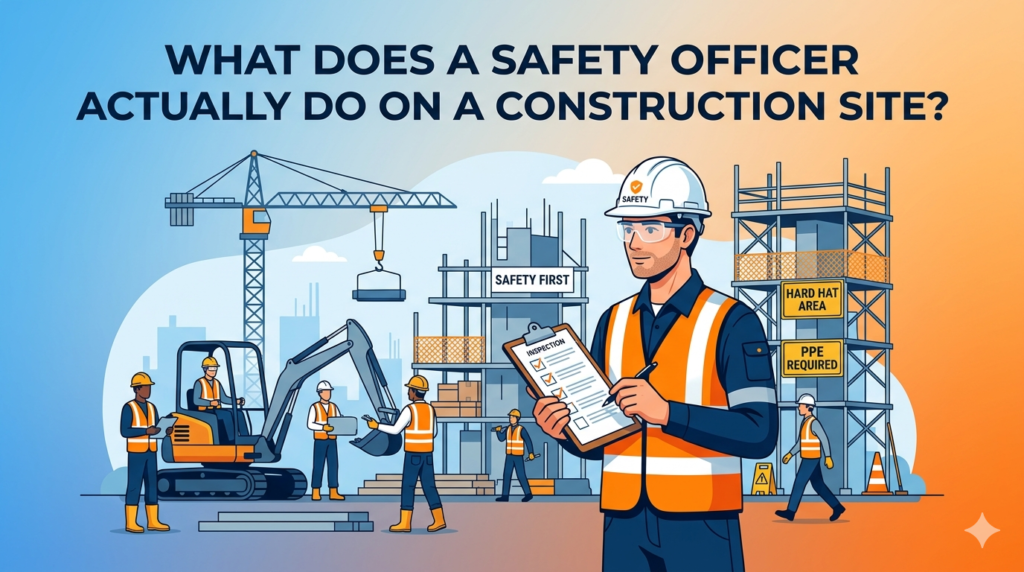
If you’ve ever walked past a construction site and wondered who keeps everyone safe, you’re thinking about the safety officer. This role isn’t just about checking boxes or wearing a hard hat. Safety officers are the frontline defenders against accidents, injuries, and fatalities that plague the construction industry.
Construction accounts for 20% of all deaths among US workers (Procore, 2023), making it one of the most dangerous industries. In places like Saudi Arabia, where massive construction and oil & gas projects dominate the economy, the role becomes even more significant. But what exactly does a safety officer do all day? Let’s break it down in practical terms.
TL;DR: Safety officers conduct daily site inspections, lead toolbox talks, identify hazards, ensure PPE compliance, investigate accidents, and maintain safety documentation. With construction accounting for 20% of all worker deaths (Procore, 2023), their role in accident prevention is vital for both worker wellbeing and project success.
Daily Site Inspections: The Foundation of Safety
Over 99% of all construction accidents are preventable (OSHA Practice, 2026). That’s where daily inspections come in. A safety officer starts most days by walking the entire site, looking for hazards before they become incidents. This isn’t a casual stroll—it’s a methodical examination of everything happening on site.
During inspections, safety officers check scaffolding for proper assembly and secure platforms. They look at excavations to ensure proper shoring and fall protection. They verify that electrical equipment has ground fault circuit interrupters. They examine ladders for damage and proper positioning.
Real example: A safety officer spots a ladder leaning at the wrong angle near the third floor. The angle makes it unstable, and there’s no one holding it steady at the base. This is a fall hazard waiting to happen. The officer stops the work, corrects the setup, and reminds the worker about proper ladder safety.
These inspections also cover housekeeping. Materials left scattered around create trip hazards. Tools left on elevated surfaces can fall on workers below. A good safety officer spots these issues before someone gets hurt.
They document everything during these walks. Photos, notes, and checklists create a record of site conditions. If an accident happens, this documentation becomes important evidence. It also helps track recurring problems that need management attention.
Toolbox Talks and Safety Training
OSHA conducted 34,625 inspections in 2024, including 17,455 unprogrammed and 17,170 programmed (OSHA Online Center, 2024). Safety officers conduct many more informal training sessions through toolbox talks. These short, focused meetings happen at the start of shifts or before high-risk activities begin.
Toolbox talks typically last 10-15 minutes. The safety officer gathers workers and discusses specific hazards they’ll face that day. If the crew is working at heights, the talk covers fall protection, proper harness use, and guardrail requirements. If they’re doing hot work, it’s about fire prevention, proper ventilation, and fire extinguisher locations.
These aren’t lectures. Good safety officers make them interactive. They ask questions: “What would you do if you saw a frayed electrical cord?” They encourage workers to share their concerns. They demonstrate proper techniques rather than just describing them.
Real example: Before a concrete pour, the safety officer conducts a toolbox talk about heat stress. It’s summer in Riyadh; temperatures will hit 45°C. The officer explains hydration schedules, signs of heat exhaustion, and where shade stations are located. One worker mentions he felt dizzy yesterday—the officer immediately arranges for extra water breaks and reassigns him to a cooler area.
Safety officers also coordinate formal training sessions. They arrange for OSHA 30-hour courses, first aid certification, equipment-specific training, and emergency response drills. In Saudi Arabia, they ensure workers understand training in multiple languages, since construction crews often include workers from various countries.
Our insight: The most effective safety officers don’t just tell workers what not to do—they explain why and involve them in finding solutions. When workers understand that safety rules protect them rather than slow them down, compliance improves naturally.
Hazard Identification and Risk Assessment
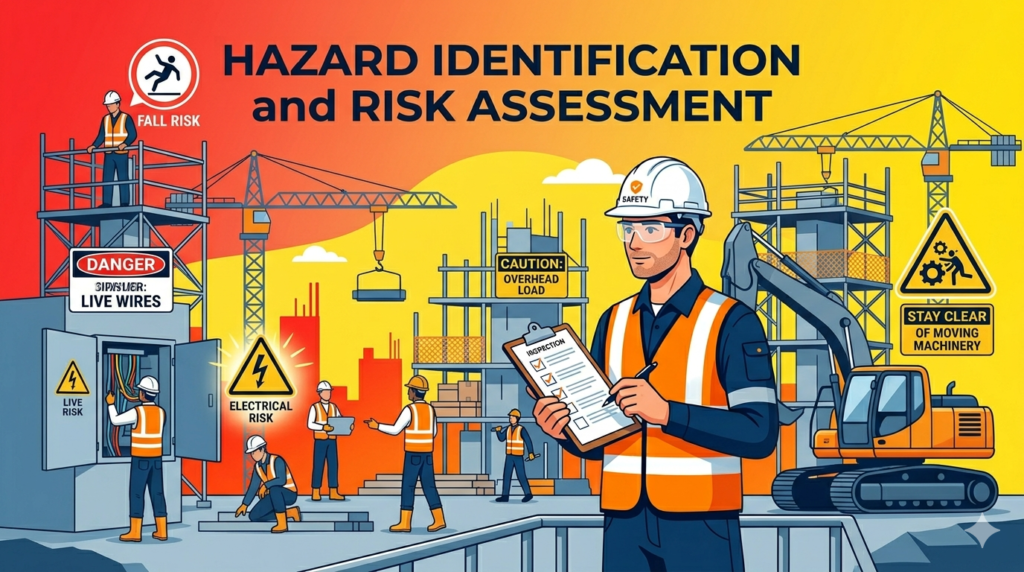
65% of all construction deaths result from a Focus Four incident—falls, struck-by objects, electrocutions, and caught-in/between hazards (Procore, 2023). A safety officer’s job is to identify these risks before they cause harm. This means constantly asking “what could go wrong?” at every stage of construction.
Risk assessment starts during project planning. The safety officer reviews construction drawings, identifies high-risk activities, and develops safe work procedures. They work with engineers and project managers to plan safer work sequences. Sometimes changing the order of operations eliminates hazards entirely.
On site, hazard identification is continuous. Safety officers watch for:
Fall hazards: Unprotected edges, holes in floors, unstable surfaces, missing guardrails, improper scaffolding.
Struck-by hazards: Materials stored overhead, mobile equipment backing up, crane operations near workers, falling tools.
Electrocution hazards: Overhead power lines, damaged cords, improper grounding, wet conditions near electricity.
Caught-in hazards: Unprotected machinery, trenches without shoring, spaces between moving equipment parts.
Real example: A safety officer notices workers digging a trench that’s now over 1.5 meters deep without any shoring or sloping. According to regulations, this requires protective systems. The officer stops the work immediately, arranges for proper shoring equipment, and ensures a competent person inspects it before work resumes.
Risk assessment also means prioritizing which hazards need immediate attention. A loose guardrail on the 10th floor requires instant action. A minor housekeeping issue can be scheduled for the next shift. Safety officers develop this judgment through experience.
They also conduct Job Safety Analysis (JSA) for complex or non-routine tasks. This breaks down each step of a job, identifies associated hazards, and determines control measures. Workers participate in creating these analyses, which improves both the quality of the assessment and worker buy-in.
PPE Enforcement and Compliance Management
Approximately 14% of all construction workers have hearing difficulty (Procore, 2024), often because of inadequate hearing protection. Personal protective equipment (PPE) isn’t optional—it’s the last line of defense when other controls aren’t enough. Safety officers ensure everyone wears appropriate PPE correctly and consistently.
Basic construction PPE includes hard hats, safety glasses, high-visibility vests, steel-toed boots, and gloves. But specific tasks require additional protection:
Working at heights: Full-body harnesses with proper anchor points and shock-absorbing lanyards.
Confined spaces: Respiratory protection, gas monitors, retrieval equipment.
Loud environments: Hearing protection rated for the noise level.
Chemical handling: Face shields, chemical-resistant gloves, protective clothing.
Welding operations: Welding helmets, fire-resistant clothing, respiratory protection for fumes.
The safety officer’s job isn’t just handing out equipment. They ensure proper fit—a loose hard hat or poorly adjusted harness won’t protect anyone. They train workers on correct use and maintenance. They inspect PPE for damage and replace worn-out items.
Real example: During an inspection, a safety officer notices a worker’s safety harness has frayed stitching on the leg straps. The worker says it’s fine because he’s worn it for two years. The officer immediately takes the harness out of service, explains how UV exposure and wear weaken the material, and issues a new one. This five-minute intervention might have saved that worker’s life.
Compliance management extends beyond PPE. Safety officers track permit requirements for hot work, confined space entry, and excavations. They verify that equipment operators have valid certifications. They ensure subcontractors meet the same safety standards as the main contractor. In Saudi Arabia’s construction industry, this includes compliance with Civil Defense requirements and local labor laws.
They maintain safety documentation: inspection reports, training records, incident investigations, safety meeting minutes, and equipment maintenance logs. When regulatory inspectors arrive, these records show the company takes safety seriously. With 31,700 annual OSHA inspections in construction (Procore, 2024), proper documentation is a must.
Our insight: In Saudi Arabia’s booming construction sector, particularly in mega-projects like NEOM and Red Sea developments, safety officers face unique challenges including multilingual workforces, extreme heat conditions, and integration of local and international safety standards. The best officers adapt global best practices to local conditions while maintaining unwavering safety standards.
Accident Investigation and Prevention
80-90% of serious injuries are caused by human error (OSHA Practice, 2026), but that doesn’t mean blaming workers provides a solution. When accidents happen, safety officers investigate to understand root causes and prevent recurrence. This isn’t about finding someone to punish—it’s about learning what went wrong.
Effective accident investigation starts immediately. The safety officer secures the scene to preserve evidence, provides first aid if needed, and ensures emergency services are contacted for serious injuries. They photograph the scene from multiple angles, measure distances, and note environmental conditions.
Then comes the interview process. The safety officer speaks with the injured worker (when possible), witnesses, and supervisors. They ask what happened, not who’s to fault. Questions focus on conditions: Was training adequate? Was equipment functioning properly? Were safe work procedures available and understood? What changed from normal operations?
Real example: A worker suffers a hand injury while operating a table saw. Initial reports suggest the worker removed the guard. But investigation reveals the guard was difficult to adjust, slowed production, and supervisors had tacitly encouraged workers to remove it to meet deadlines. The root cause wasn’t one worker’s decision—it was production pressure and inadequate supervision. The solution includes redesigning the guard system, retraining supervisors about safety priorities, and reviewing production schedules.
Safety officers analyze patterns across multiple incidents. If the same type of accident happens repeatedly, systematic problems exist. Perhaps training is ineffective. Perhaps procedures don’t match reality. Perhaps equipment design is flawed. Identifying these patterns prevents future accidents.
They also track near-misses—incidents that didn’t cause injury but could have. A dropped tool that misses a worker by inches is a warning sign. Safety officers investigate significant near-misses just like actual accidents, because they reveal hazards before someone gets hurt.
Prevention work includes participating in safety committees, reviewing and updating safety procedures, recommending engineering controls to eliminate hazards, and conducting safety audits. The construction worker safety market is valued at USD 3.5 billion in 2025, projected to reach USD 3.75 billion in 2026 (Future Market Insights, 2025), reflecting growing recognition of safety’s importance.
The Human Side of Construction Safety
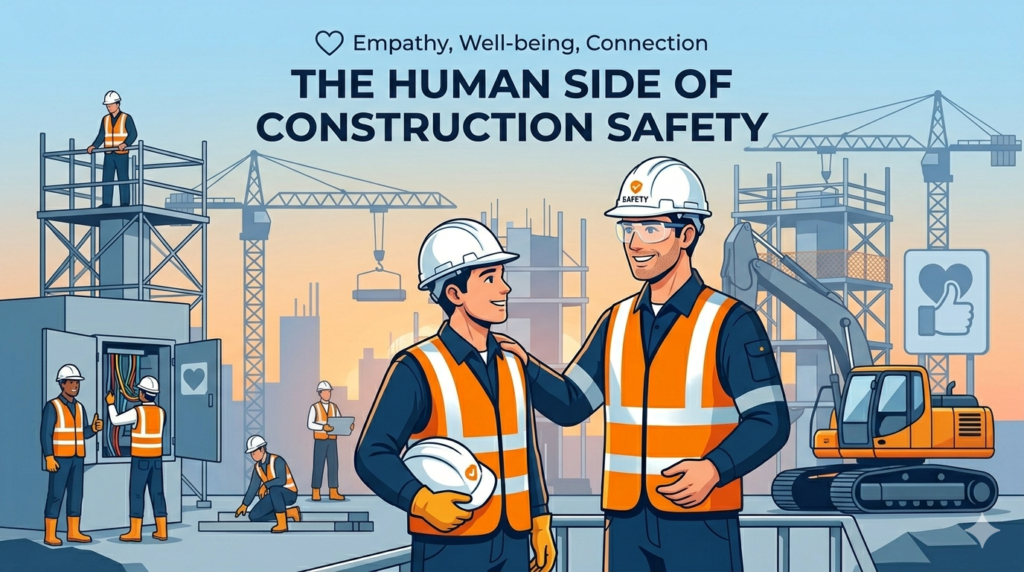
Safety officers deal with people, not just procedures. They persuade skeptical workers who think safety slows them down. They support supervisors balancing safety with productivity. They communicate with management about resource needs. They comfort workers after traumatic incidents.
This requires soft skills that don’t appear in any job description. Patience, because changing behavior takes time. Communication skills, because technical knowledge means nothing if you can’t explain it clearly. Cultural sensitivity, especially in diverse workplaces like those in Saudi Arabia’s construction industry. Assertiveness, because sometimes stopping unsafe work creates conflict.
The best safety officers build relationships. Workers report hazards to officers they trust. Supervisors seek advice from officers who understand construction realities. Management listens to officers who present solutions, not just problems.
They celebrate successes. When a project reaches 100 days without a lost-time incident, they recognize everyone’s contribution. When a worker spots and reports a hazard, they praise that awareness publicly. Positive reinforcement works better than constant criticism.
38% of respondents cite labor shortages as their top challenge, while 32% identify job site safety as a primary concern (ABC Carolinas 2025 Construction Industry Safety Challenges study, 2025). These challenges intersect—skilled safety officers become valuable assets in attracting and retaining workers who want safe workplaces.
Career Pathways and Qualifications
Becoming a construction safety officer typically requires:
Education: High school diploma minimum, though many employers prefer degrees in occupational health and safety, engineering, or related fields. In Saudi Arabia, technical diplomas from institutions like the Saudi Technical and Vocational Training Corporation are valued.
Certifications: OSHA 30-hour construction course is basic. Many positions require NEBOSH International General Certificate, IOSH Managing Safely, or equivalent qualifications. First aid and CPR certification are standard.
Experience: Many safety officers start as construction workers, bringing practical understanding of site realities. Others enter through HSE training programs. Entry-level positions might be safety assistants or junior officers.
Language skills: In KSA’s construction industry, English and Arabic are often required. Additional languages help when working with diverse crews.
Career progression typically moves from junior safety officer to site safety officer, then to senior safety officer, HSE manager, and eventually corporate HSE director. Specialized paths include safety trainer, safety consultant, or regulatory compliance specialist.
OSHA certification programs
Salary varies by location and experience. In Saudi Arabia, entry-level safety officers earn 4,000-6,000 SAR monthly, while experienced HSE managers can earn 15,000-25,000 SAR or more. Oil and gas projects typically pay higher than standard construction.
The demand is strong. Every major project needs safety officers. New regulations increase compliance requirements. Companies recognize that effective safety programs reduce costs, improve productivity, and protect their reputations.
Why This Matters in Saudi Arabia
Saudi Arabia’s construction boom—driven by Vision 2030 initiatives—creates enormous demand for qualified safety officers. Mega-projects like NEOM, Qiddiya, and the Red Sea Project involve billions of dollars and thousands of workers. These projects attract international scrutiny, making safety performance important.
Local regulations continue evolving. The Saudi Civil Defense enforces strict requirements. Companies face substantial penalties for safety violations. Public awareness of worker rights is increasing. All this means professional safety management isn’t optional—it’s a business necessity.
The oil and gas sector, another major employer in KSA, has even higher safety standards. Petrochemical facilities, refineries, and drilling operations involve high risk potentials. Safety officers in these industries require additional specialized knowledge about process safety, hazardous materials, and emergency response.
For job seekers, this creates opportunities. The construction sector needs safety professionals at all levels. Training programs are expanding. International certification opens doors to work across the region. Career stability is strong because safety is always necessary.
Frequently Asked Questions
What qualifications do you need to become a construction safety officer in Saudi Arabia?
Most positions require OSHA 30-hour construction certification, NEBOSH International General Certificate, or equivalent qualifications, plus 2-5 years of construction experience. First aid certification is standard. Many employers prefer candidates with engineering or safety management degrees. Bilingual abilities (English and Arabic) strengthen applications significantly in KSA’s market.
How much does a safety officer earn on construction sites?
In Saudi Arabia, entry-level construction safety officers typically earn 4,000-6,000 SAR monthly, while experienced officers earn 8,000-12,000 SAR. Senior HSE managers can earn 15,000-25,000 SAR or higher. International projects and oil & gas facilities generally offer higher compensation. Benefits often include housing, transportation, and annual leave tickets.
What’s the difference between a safety officer and an HSE officer?
The terms are often used interchangeably, but HSE (Health, Safety, and Environment) officer typically has broader responsibilities including environmental compliance, waste management, and occupational health programs. Safety officers focus primarily on accident prevention and safety compliance. In practice, many positions combine both roles, especially on larger construction projects.
Can construction workers transition into safety officer roles?
Absolutely. Experienced construction workers make excellent safety officers because they understand site realities, know what workers actually face, and have credibility with crews. Over 99% of construction accidents are preventable (OSHA Practice, 2026), and former workers often identify practical solutions others miss. You’ll need to obtain relevant certifications, but your construction experience is valuable.
What are the biggest challenges facing construction safety officers?
According to recent industry surveys, 38% cite labor shortages while 32% identify job site safety as primary concerns (ABC Carolinas 2025 Construction Industry Safety Challenges study, 2025). Other challenges include balancing safety with production pressure, managing multilingual workforces, adapting to new technologies, addressing heat stress in Gulf climates, and changing long-established unsafe practices among experienced workers.
Conclusion: More Than Just a Job Title
Construction safety officers do far more than walk around with clipboards. They’re advocates, educators, investigators, and problem-solvers. They stand between workers and the hazards that make construction one of the most dangerous industries. Their daily efforts prevent the accidents that could end careers, destroy families, and halt projects.
For anyone considering this career, understand that you’ll face challenges. Production pressure, skeptical workers, and resource constraints are real. But you’ll also save lives—not metaphorically, but literally. Every hazard you identify, every unsafe condition you correct, and every worker you train properly makes someone safer.
Key takeaways:
- Safety officers conduct daily site inspections, identifying and correcting hazards before they cause accidents.
- Toolbox talks and training sessions educate workers about specific risks they face.
- PPE enforcement and compliance management ensure protective measures are actually used.
- Accident investigation reveals root causes and prevents recurrence.
- The role requires both technical knowledge and strong interpersonal skills.
- Career opportunities are strong, particularly in Saudi Arabia’s construction and oil & gas sectors.
- Practical construction experience often makes the best foundation for safety careers.
The construction industry needs safety professionals who understand that every worker deserves to go home healthy at the end of their shift. If that mission resonates with you, this career offers meaningful work, strong demand, and the satisfaction of making a real difference every single day.