


Contents
- 1 Is ISO 22000 Certification Mandatory in Saudi Arabia?
- 2 Which Industries Need ISO 22000 in Saudi Arabia?
- 3 What Are the Real Benefits of ISO 22000 for Saudi Food Businesses?
- 4 How Do You Get ISO 22000 Certified in Saudi Arabia?
- 5 What Does ISO 22000 Certification Cost in Saudi Arabia?
- 6 Common Challenges Food Companies Face During ISO 22000 Implementation
- 7 Frequently Asked Questions About
- 7.1 How long does ISO 22000 certification take in Saudi Arabia?
- 7.2 Does ISO 22000 replace HACCP certification in KSA?
- 7.3 Can small restaurants in Saudi Arabia get ISO 22000 certified?
- 7.4 What’s the difference between ISO 22000 and SFDA requirements?
- 7.5 Do food packaging companies in KSA need ISO 22000?
- 8 Key Takeaways: Is ISO 22000 Right for Your Saudi Food Business?
If you’re running a food business in Saudi Arabia, you’ve probably heard about ISO 22000. While not universally mandatory, ISO 22000 certification is essentially required for food manufacturers, processors, importers, exporters, cold storage operators, and increasingly for restaurants and catering companies that want to remain competitive and compliant with SFDA regulations.
According to SFDA data, 72% of food manufacturing firms in KSA already hold ISO 22000 or equivalent food safety management system (FSMS) certification to meet compliance standards (SFDA Annual Food Safety Report, 2025). Over 1,500 food companies in Saudi Arabia obtained ISO 22000 certification by the end of 2024 (Saudi Standards, Metrology and Quality Organization, 2024).
The reality? Whether you’re packaging dates, operating a restaurant chain, managing cold storage, or exporting food products, ISO 22000 isn’t just a certificate on your wall. It’s your ticket to market access, regulatory compliance, and customer trust in a Kingdom that takes food safety seriously.
TL;DR: ISO 22000 certification is effectively mandatory for food exporters, importers, and manufacturers in Saudi Arabia. With 72% of food manufacturers already certified and SFDA pushing for standardized food safety systems, non-compliance increasingly means market exclusion (SFDA Annual Food Safety Report, 2025).
Is ISO 22000 Certification Mandatory in Saudi Arabia?
Here’s where it gets nuanced. 78% of food processing plants in Saudi Arabia implemented ISO 22000 to comply with SFDA food safety standards (KPMG Saudi Arabia Food Industry Report, 2025).
ISO 22000 isn’t legally mandatory for every food business in Saudi Arabia. However, the Saudi Food and Drug Authority (SFDA) strongly encourages—and in many cases practically requires—food safety management systems that align with ISO 22000 standards.
When ISO 22000 becomes effectively mandatory:
- Food exports: 92% of shipments to EU and GCC markets require ISO 22000 certification (Saudi Export Development Authority, 2024)
- Food imports: 85% of food importers need HACCP certification under ISO 22000-aligned regulations (Ministry of Environment Water and Agriculture, 2024)
- Government tenders: Many government food procurement contracts specify ISO 22000 as a prerequisite
- Major retail chains: Supermarket suppliers typically require ISO 22000 or equivalent certification
- B2B contracts: Large food companies demand certified suppliers
The SFDA doesn’t explicitly state “you must have ISO 22000,” but their inspection criteria, SFDA Compliance Guide, and audit standards essentially mirror ISO 22000 requirements. If you fail SFDA inspections, your operations stop.
89% of audited food firms in KSA passed ISO 22000 requirements during SFDA inspections in 2025 (SFDA Food Safety Audit Summary, 2025). That’s not a coincidence. Companies with ISO 22000 certification have systematic controls that align with what inspectors look for.
Our insight: The question isn’t whether ISO 22000 is legally mandatory, but whether you can afford to operate without it. Market access, regulatory smoothness, and commercial viability increasingly depend on certification.
Which Industries Need ISO 22000 in Saudi Arabia?
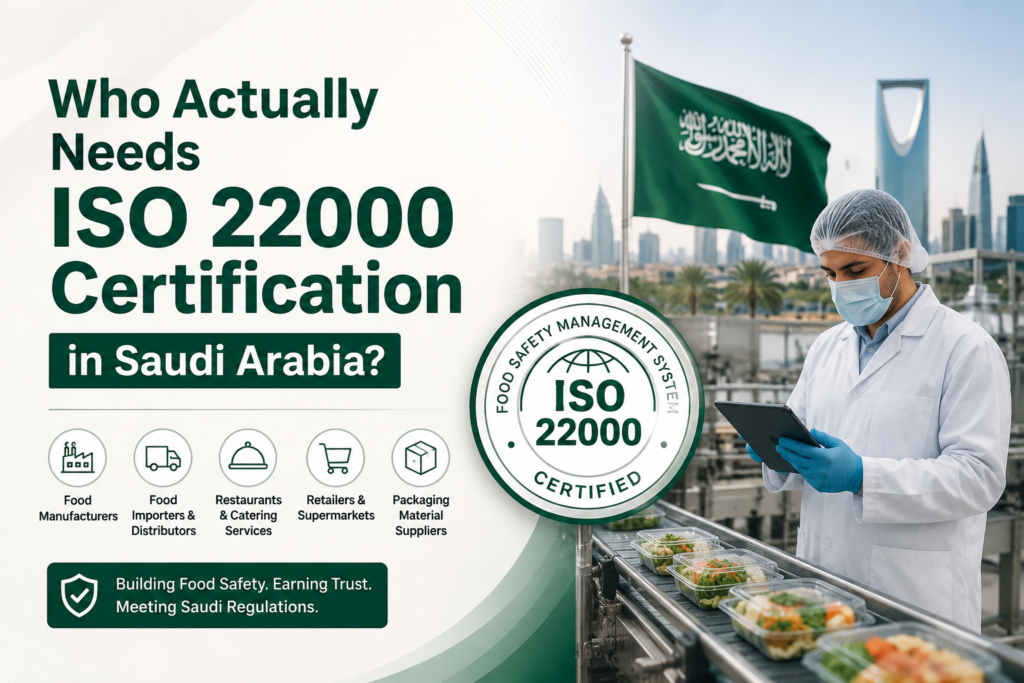
65% of restaurants and catering companies in Riyadh pursued ISO 22000 for food safety certification in 2025 (Riyadh Chamber of Commerce Food Sector Survey, 2025). Let’s break down who actually needs this certification based on industry impact and practical requirements.
Food Manufacturing and Processing Plants
If you manufacture or process food products—bakeries, dairy, meat processing, beverage production, confectionery—you’re at the top of the list. These operations face the highest contamination risks and regulatory scrutiny.
What you manufacture matters less than the fact that you’re transforming raw materials into consumable products. ISO 22000 provides the structure for:
- Hazard analysis and critical control points (HACCP)
- Supplier verification programs
- Traceability systems
- Contamination prevention protocols
Food Import and Export Companies
This sector has no wiggle room. 92% of KSA food exports to EU and GCC markets require ISO 22000 (Saudi Export Development Authority, 2024). Export markets won’t accept your products without recognized certification. Import authorities need assurance your supply chain maintains food safety standards. Without ISO 22000:
- Your products sit in customs
- International buyers reject shipments
- You lose market access to premium destinations
Cold Storage and Warehouse Operators
1,200+ cold storage and food supply chain facilities in KSA achieved ISO 22000 certification by 2026 (SFDA Compliance Database, 2026). Temperature control failures cause massive food safety incidents. If you store food—especially temperature-sensitive products like meat, dairy, or produce—you need systematic temperature monitoring, contamination prevention, and traceability that ISO 22000 provides.
Third-party logistics (3PL) providers handling food products increasingly face contractual requirements for ISO 22000 certification.
Food Packaging Companies
55% of food packaging companies in KSA hold ISO 22000 certification for supply chain compliance (Saudi Industrial Development Fund Manufacturing Stats, 2024). Packaging directly contacts food. Contamination from packaging materials, inks, or adhesives creates serious health hazards. Food manufacturers increasingly demand certified packaging suppliers to maintain their own compliance.
Restaurants and Catering Companies
This might surprise you, but restaurants and catering operations benefit significantly from ISO 22000. While smaller restaurants might find full certification challenging, larger chains, hotel restaurants, and catering companies serving hospitals, schools, or corporate clients find certification opens doors.
Benefits for food service:
- Reduced foodborne illness incidents
- Better staff training systems
- Improved supplier management
- Enhanced reputation and customer confidence
- An advantage in competitive bidding
Food Ingredient Suppliers
Companies supplying raw materials, spices, additives, or ingredients to food manufacturers increasingly need certification. Your customers need assurance about ingredient safety, and ISO 22000 provides that documentation.
Our insight: The certification isn’t just for manufacturers anymore. Saudi Arabia’s food ecosystem increasingly expects systematic food safety management across the entire supply chain—from farm to fork.
What Are the Real Benefits of ISO 22000 for Saudi Food Businesses?
78% of food processing plants implemented ISO 22000 specifically to comply with SFDA food safety standards, but compliance is just the starting point (KPMG Saudi Arabia Food Industry Report, 2025).
Regulatory Advantages
SFDA inspections become smoother when you have documented, systematic controls. Inspectors seek the same elements ISO 22000 demands: hazard analysis, critical control points, monitoring systems, and corrective actions.
Companies without systematic food safety management face:
- More frequent inspections
- Higher violation rates
- Product recalls
- Facility closures
- Financial penalties
Market Access and Commercial Opportunities
Want to export? Need ISO 22000. Want to supply major retailers? Need ISO 22000. Bidding on government contracts? ISO 22000 is often a requirement.
Certification unlocks:
- International market access (EU, GCC, Asia)
- Government procurement opportunities
- Contracts with major retail chains
- B2B relationships with large food companies
- Premium pricing potential
Operational Improvements
ISO 22000 isn’t just paperwork. Properly implemented, it improves how you actually operate:
- Waste reduction: Better process controls mean fewer rejected batches
- Efficiency gains: Standardized procedures reduce training time and errors
- Cost savings: Preventing contamination costs far less than recalls
- Supply chain reliability: Verified suppliers mean fewer disruptions
- Employee competence: Systematic training creates knowledgeable staff
Risk Management
Foodborne illness outbreaks destroy businesses. The financial impact of a recall, liability claims, and reputation damage far exceeds certification costs.
ISO 22000 provides:
- Early hazard identification
- Preventive controls
- Traceability for rapid response
- Documentation for liability protection
- Crisis management frameworks
Customer and Stakeholder Confidence
In Saudi Arabia’s increasingly quality-conscious market, certification signals professionalism. Customers, investors, and partners view ISO 22000 as evidence you take food safety seriously.
How Do You Get ISO 22000 Certified in Saudi Arabia?
Over 1,500 food companies successfully navigated the certification process by 2024, and the pathway is well-established (SASO, 2024).
Step 1: Gap Analysis and Readiness Assessment
Before starting, understand where you stand. Conduct an honest assessment of your current food safety practices against ISO 22000 requirements.
Key questions:
- Do you have documented food safety policies?
- Have you identified food safety hazards in your operations?
- Are critical control points monitored and recorded?
- Do you have supplier verification processes?
- Is management committed to providing necessary resources?
Most companies find significant gaps. That’s normal. The gap analysis creates your roadmap.
Step 2: Develop Your Food Safety Management System
This is where the real work happens. You’re building documented systems for:
- Food safety policy: Management commitment statement
- Hazard analysis: Identify biological, chemical, and physical hazards
- Prerequisite programs: Basic sanitation, maintenance, pest control, hygiene
- HACCP plan: Critical control points, monitoring, verification
- Traceability system: Track products through supply chain
- Emergency procedures: Product recall, crisis management
- Internal audit program: Regular self-assessment
Documentation allows everyone to know what to do and provides proof they did it.
Step 3: Implementation and Staff Training
Systems on paper accomplish nothing. Implementation means:
- Training all staff on relevant procedures
- Installing monitoring equipment
- Establishing record-keeping systems
- Conducting internal audits
- Testing your traceability system
- Performing management reviews
Plan for 3-6 months of implementation depending on your organization’s size and complexity.
Step 4: Internal Audit and Management Review
Before inviting external auditors, verify your system works. Conduct thorough internal audits, identify non-conformances, and implement corrections. Management review ensures leadership understands system performance and commits to continuous improvement.
Step 5: Certification Audit
Select an accredited certification body recognized in Saudi Arabia. The certification audit occurs in two stages:
Stage 1 (Document Review): Auditors examine your documentation, identify gaps, and verify you’re ready for Stage 2.
Stage 2 (Implementation Audit): Auditors visit your facility, observe operations, interview staff, review records, and verify your system works as documented.
Expect auditors to:
- Tour your facility
- Review food safety records
- Interview employees at all levels
- Examine monitoring equipment
- Test traceability systems
- Verify supplier documentation
Step 6: Certification and Surveillance
If you pass, you receive ISO 22000 certification valid for three years. Don’t celebrate too long—surveillance audits occur annually to verify continued compliance. Recertification happens every three years with a comprehensive audit similar to initial certification.
Our insight: Companies that involve operational staff—not just management—in system development achieve better implementation. The workers who actually handle food know where real hazards exist.
What Does ISO 22000 Certification Cost in Saudi Arabia?
Let’s talk money. Costs vary significantly based on multiple factors, but transparency helps you budget appropriately.
Factors Affecting Certification Costs:
Company Size and Complexity
- Small operations (10-50 employees): SAR 40,000-80,000
- Medium operations (50-250 employees): SAR 80,000-150,000
- Large operations (250+ employees): SAR 150,000-300,000+
Number of Sites
Multi-site certification costs more. Each location requires assessment, though centralized systems reduce duplication.
Current Compliance Level
Companies with existing HACCP programs or other food safety systems spend less. Starting from scratch requires more consultant time and system development.
Consultant Fees
Professional consultants charge SAR 500-1,500 per day depending on experience and certification body. Expect 30-90 consultant days depending on your situation.
Certification Body Fees
Accredited certification bodies charge:
- Application fees: SAR 2,000-5,000
- Stage 1 audit: SAR 10,000-20,000
- Stage 2 audit: SAR 15,000-30,000
- Annual surveillance: SAR 8,000-15,000
- Recertification: SAR 15,000-25,000
Internal Costs
Don’t forget:
- Staff time (potentially significant)
- Equipment and infrastructure upgrades
- Training programs
- Documentation systems
- Monitoring equipment
Cost-Benefit Reality Check
A single foodborne illness outbreak or product recall costs exponentially more than certification. One contamination incident can:
- Cost SAR 500,000+ in recalls
- Generate liability claims in millions
- Destroy a reputation built over years
- Result in facility closure
Compare certification investment to potential losses. The math favors certification.
Ongoing Costs
Annual surveillance audits, system maintenance, and continuous improvement create recurring costs. Budget SAR 20,000-50,000 annually for maintenance depending on size.
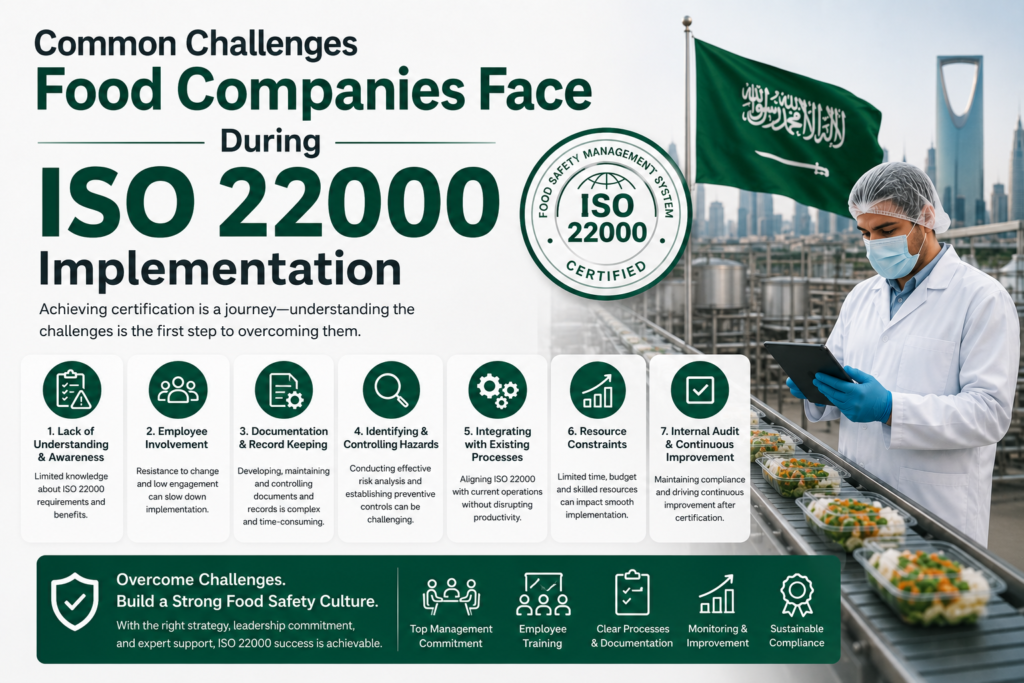
Common Challenges Food Companies Face During ISO 22000 Implementation
Even with 1,200+ facilities certified, companies still encounter predictable obstacles (SFDA Compliance Database, 2026).
Management Commitment Gaps
ISO 22000 requires genuine leadership engagement, not just a signature on documents. When management views certification as a checkbox rather than operational improvement, implementation stalls.
Real commitment means:
- Allocating budget and staff time
- Participating in management reviews
- Supporting necessary changes
- Holding staff accountable
Documentation Burden
Companies often create excessive documentation that nobody uses. Effective food safety management systems are documented sufficiently—not excessively.
Focus on documents that:
- Guide employees in doing their jobs correctly
- Provide evidence of control
- Support investigation when issues arise
Staff Resistance and Training Challenges
Employees accustomed to informal practices resist new procedures. Language barriers (especially with expatriate workers) complicate training.
Successful companies:
- Explain why changes matter
- Provide training in workers’ languages
- Involve staff in procedure development
- Recognize and reward compliance
Supplier Management
Your food safety system depends on supplier reliability. Many Saudi food businesses struggle with:
- Verifying supplier food safety practices
- Obtaining supplier certifications
- Managing imported ingredient risks
- Establishing supplier audit programs
Maintaining Systems During Business Growth
You achieve certification, then expand operations, add products, or open new locations. Your food safety system must scale without issues.
Plan for:
- System scalability
- Training capacity
- Audit programs that cover multiple sites
- Documentation that works across locations
Keeping Systems Current
ISO 22000 certification isn’t static. Annual surveillance audits verify continued compliance. Companies that treat certification as “one and done” fail surveillance audits.
Continuous improvement requires:
- Regular internal audits
- Management reviews
- Corrective action programs
- System updates as operations change
Our insight: Companies that integrate food safety into their culture rather than treating it as a compliance burden sustain certification more easily and gain greater operational benefits.
Frequently Asked Questions About
How long does ISO 22000 certification take in Saudi Arabia?
Typical timelines range from 6-12 months depending on your starting point, company size, and resource commitment. Companies with existing HACCP systems certify faster (4-6 months), while those building from scratch need 8-12 months. With 1,500+ companies certified by 2024, established certification pathways exist (SASO, 2024).
Does ISO 22000 replace HACCP certification in KSA?
ISO 22000 incorporates HACCP principles, making separate HACCP certification unnecessary. 85% of food importers in Saudi Arabia use HACCP certification under ISO 22000-aligned regulations (MEWA, 2024). ISO 22000 provides a more comprehensive structure that includes HACCP plus additional management system elements.
Can small restaurants in Saudi Arabia get ISO 22000 certified?
Yes, though it’s more common for restaurant chains and catering companies. 65% of restaurants and catering companies in Riyadh pursued ISO 22000 certification in 2025 (Riyadh Chamber of Commerce, 2025). Small restaurants might start with simpler food safety programs before pursuing full ISO 22000 certification.
What’s the difference between ISO 22000 and SFDA requirements?
SFDA regulations set mandatory food safety standards in Saudi Arabia, while ISO 22000 provides a systematic structure for meeting those requirements. 72% of food manufacturers hold ISO 22000 to meet SFDA compliance expectations (SFDA Annual Food Safety Report, 2025). ISO 22000 certification demonstrates you’ve implemented systems that align with SFDA standards.
Do food packaging companies in KSA need ISO 22000?
Increasingly, yes. 55% of food packaging companies in KSA achieved ISO 22000 certification for supply chain compliance (SIDF Manufacturing Stats, 2024). Food manufacturers demand certified packaging suppliers to maintain their own food safety systems. If you supply packaging materials that contact food, certification provides a competitive advantage.
Key Takeaways: Is ISO 22000 Right for Your Saudi Food Business?
ISO 22000 certification in Saudi Arabia isn’t optional for serious food businesses anymore. Whether you’re exporting dates, processing dairy, operating cold storage, or running a catering company, systematic food safety management has become the baseline expectation.
Remember these key points:
- Market reality: 72% of food manufacturers already hold ISO 22000 or equivalent certification—you’re competing with certified companies (SFDA Annual Food Safety Report, 2025)
- Export necessity: 92% of KSA food shipments to EU and GCC markets require ISO 22000 certification (Saudi Export Development Authority, 2024)
- Regulatory alignment: 89% of audited firms with ISO 22000 passed SFDA inspections, showing the system works (SFDA Food Safety Audit Summary, 2025)
- Investment value: Certification costs pale compared to recall expenses, liability claims, and market exclusion
- Implementation timeline: Plan for 6-12 months with proper resources and commitment
- Ongoing commitment: Annual surveillance audits and continuous improvement maintain certification value
The food industry in Saudi Arabia has matured. Consumer expectations have risen. Regulatory enforcement has strengthened. Supply chain partners demand assurance. Export markets require proof.
ISO 22000 provides that proof through systematic food safety management that protects consumers, enhances operations, and opens market opportunities.
If you’re in the food business in KSA, the question isn’t whether you need ISO 22000. The question is: when will you start the certification process?
Ready to begin your ISO 22000 certification journey? ISO Certification Services in Saudi Arabia
The Kingdom’s food industry is moving toward comprehensive food safety management. Don’t get left behind.