


Contents
- 1 What Does a Crane Operator Do?
- 2 What Are the Responsibilities of a Rigger?
- 3 Which Certification Is Required for Crane Operators in Saudi Arabia?
- 4 Rigger Certification Requirements in Saudi Arabia
- 5 Can a Rigger Become a Crane Operator?
- 6 Crane Operator vs Rigger: Comparison Table
- 7 Frequently Asked Questions
- 8 Conclusion
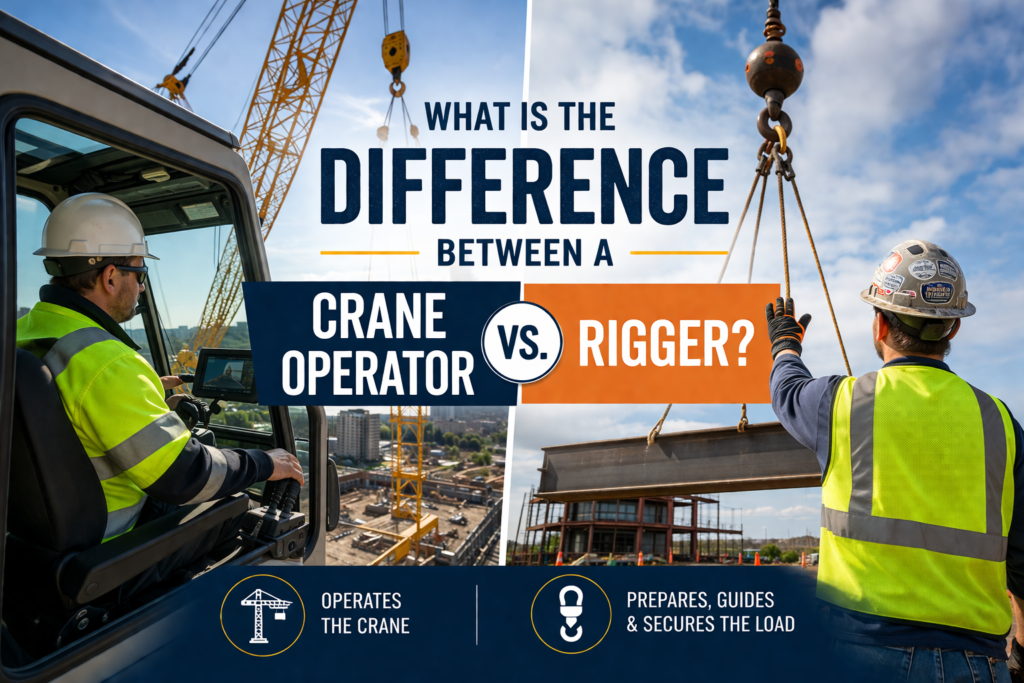
If you’re entering the construction or oil and gas industry in Saudi Arabia, you’ll quickly encounter two essential roles in lifting operations: crane operators and riggers. While both work together on the same job site, their responsibilities are completely different. A crane operator controls and operates the crane itself, moving loads safely from one point to another. A rigger, on the other hand, prepares the load, attaches it to the crane using slings and hardware, and signals the operator during the lift.
Understanding the difference between these two roles matters if you’re planning your career path, seeking Aramco-approved positions, or managing safety on construction sites. Each role requires specific certifications, skills, and training paths. In Saudi Arabia and across the GCC, both positions are in high demand, but the requirements and career progression differ significantly.
This guide breaks down everything you need to know: what each role does daily, which certifications you need in Saudi Arabia, how to transition from one role to another, and what training providers like EUTC Global offer to help you succeed in these careers.
TL;DR: Crane operators control the crane and move loads, while riggers prepare loads and guide the operator. From 2021 to 2024, most crane incidents stem from human error, poor communication, inadequate rigging practices, and power line contact (OSHA Outreach Courses, 2026). Both roles need specific certifications in Saudi Arabia, especially for Aramco projects.
What Does a Crane Operator Do?
In construction, crane operators must be certified by an ANSI accredited third-party certification body, such as NCCCO (Mazzella Companies, 2024). A crane operator’s primary responsibility is to control the crane safely and efficiently, moving materials, equipment, or structural components according to the project plan.
Daily crane operator duties include:
- Pre-operation inspection: Checking hydraulic systems, cables, brakes, and controls before starting work
- Load assessment: Understanding weight limits and crane capacity for each lift
- Operating controls: Using joysticks, levers, and computerized systems to position loads precisely
- Following hand signals: Responding to riggers’ and signal persons’ directions during blind lifts
- Maintaining safety zones: Ensuring no workers enter the swing radius during operations
- Post-operation checks: Documenting issues and securing the crane after shifts
Crane operators work on various equipment types, from mobile cranes on construction sites to tower cranes on high-rise projects and overhead cranes in manufacturing facilities. In Saudi Arabia’s oil and gas sector, particularly on Aramco projects, operators often work with specialized lifting equipment requiring additional certifications.
The role demands constant attention, smooth coordination with ground crews, and the ability to make split-second safety decisions. Weather conditions, site hazards, and communication clarity all affect daily operations.
Skills required for crane operators:
- Mechanical understanding of crane systems
- Depth perception and spatial awareness
- Hand-eye coordination
- Ability to read load charts and technical specifications
- Strong communication skills
- Stress management under pressure
Training programs for crane operators typically allocate 70% classroom time and 30% field training for operation planning (Mazzella Companies, 2024). This theoretical foundation covers load dynamics, safety regulations, and equipment maintenance before hands-on practice begins.
Our insight: Many employers in Saudi Arabia prefer operators who also hold rigger certifications. This cross-training improves job site communication and makes you more valuable in competitive markets like Aramco-approved contractor pools.
What Are the Responsibilities of a Rigger?
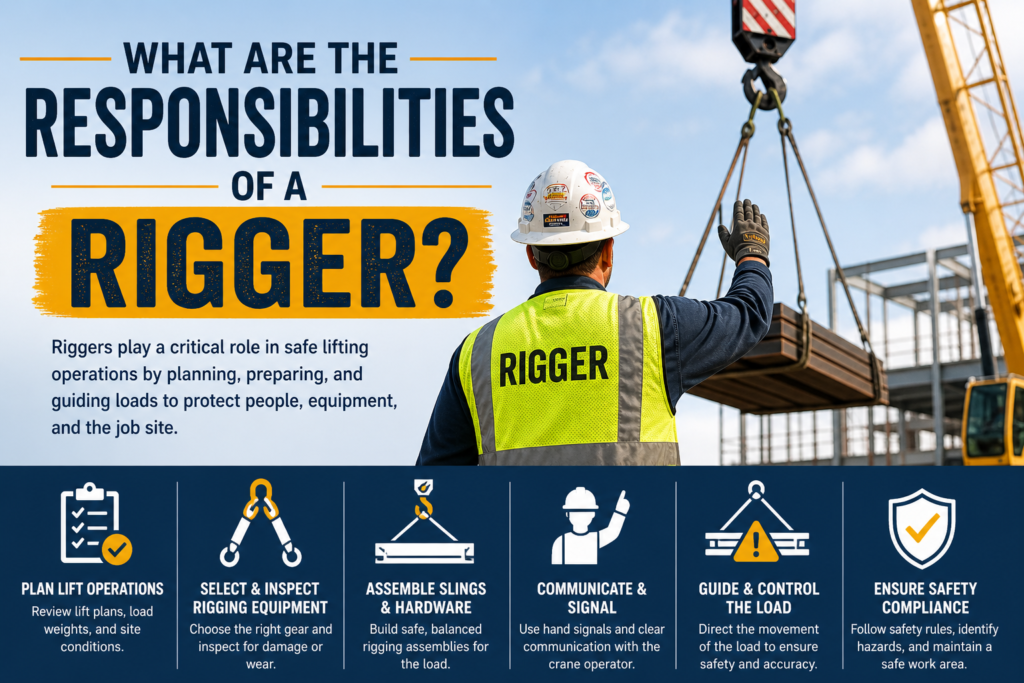
OSHA and ASME require that all personnel performing lifting and rigging activities are trained and evaluated before they perform a task (Mazzella Companies, 2024). Riggers are the ground-level professionals who make safe crane operations possible by preparing loads correctly and guiding operators throughout the lift.
Core rigger responsibilities include:
- Load preparation: Securing materials with appropriate slings, shackles, and hardware
- Weight calculation: Determining load weight and center of gravity before rigging
- Equipment selection: Choosing the right rigging gear based on load characteristics and environmental factors
- Inspection duties: Checking slings, chains, and hardware for wear, damage, or defects
- Signal communication: Using standardized hand signals to direct crane operators
- Safety monitoring: Watching for hazards like power lines, unstable ground, or personnel in danger zones
- Documentation: Recording rigging configurations and equipment inspections
Riggers work closely with crane operators, lifting supervisors, and site safety teams. On complex projects, especially in Saudi Arabia’s industrial sector, riggers often specialize in specific equipment types or lifting scenarios.
Aramco rigger levels follow a clear progression system:
- Rigger Level 1: Basic rigging and lifting operations, working under supervision
- Rigger Level 2: Independent rigging work with standard equipment and moderate complexity
- Rigger Level 3: Advanced rigging scenarios, critical lifts, and supervision of junior riggers
Master Rigger training programs split time evenly, with 50% hands-on and 50% classroom instruction for advanced lifting roles (Mazzella Companies, 2024). This balanced approach ensures riggers understand both theory and practical application.
Training providers like EUTC Global offer comprehensive Basic Rigging Lifting Training that covers equipment identification, load calculations, and safety protocols. For experienced professionals, Rigger Level 3 Training prepares candidates for the most demanding projects.
The chart above shows why proper rigging training matters so much. Inadequate rigging practices account for a significant portion of crane incidents, making qualified riggers essential for job site safety.
Which Certification Is Required for Crane Operators in Saudi Arabia?
NCCCO certification is the national standard required by most employers for crane operators (Operator School, 2025). In Saudi Arabia, crane operator certification requirements combine international standards with local regulatory compliance, especially for major contractors and Aramco-approved projects.
Essential certifications for crane operators in KSA:
1. Third-Party Crane Operator Certification
The primary requirement is certification from an ANSI-accredited body like NCCCO (National Commission for the Certification of Crane Operators). This certification covers:
- Written examination on crane operation theory
- Practical skills assessment on specific crane types
- Knowledge of load charts and capacity calculations
- Safety protocols and emergency procedures
EUTC Global provides Crane Operator License Trfaining that prepares candidates for both written and practical examinations.
2. OSHA Safety Training
OSHA safety training, via 10-hour or 30-hour cards, is required by most employers for heavy equipment operators including cranes (Operator School, 2025). These programs cover:
- Hazard recognition on construction sites
- Fall protection and personal protective equipment
- Electrical safety and power line awareness
- Emergency response procedures
3. Saudi Civil Defense Approval
For work in Saudi Arabia, operators often need approval from the Saudi Civil Defense, which verifies that international certifications meet local standards. This process typically requires:
- Submission of original certification documents
- Medical fitness certificate
- Background verification
- Sometimes a local practical assessment
4. Aramco-Specific Requirements
For contractors working on Saudi Aramco projects, additional requirements include:
- Aramco-approved third-party certification
- Company-specific safety orientation
- Project-specific training for specialized equipment
- Regular recertification (typically every three to five years)
Step-by-step certification path for crane operators:
- Complete basic safety training (OSHA 10 or equivalent)
- Enroll in crane operator training covering theory and practical skills
- Gain supervised operation hours (typically 200-400 hours depending on crane type)
- Pass written examination from NCCCO or equivalent certifying body
- Complete practical skills test on specific crane types you’ll operate
- Obtain Saudi Civil Defense approval if working in KSA
- Complete employer-specific orientation and site safety training
Rigging and signalperson training adds value to any crane operator’s skill set, often combined with hands-on operation and safety protocols (Operator School, 2025). Many training providers, including EUTC Global, offer combined programs that cover both rigging fundamentals and crane operation.
Our insight: In Saudi Arabia’s competitive job market, having multiple certifications dramatically improves your employment prospects. Operators who also hold rigger certifications, OSHA cards, and Aramco approval typically earn 20-30% more than those with basic certifications alone.
Rigger Certification Requirements in Saudi Arabia
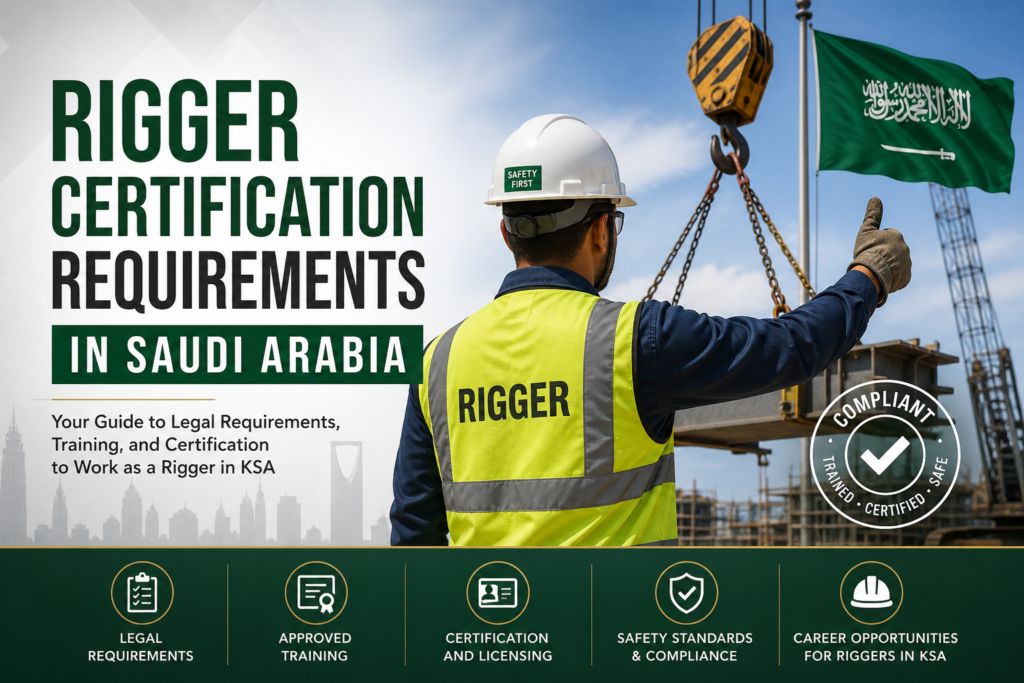
NCCCO Rigger Certification tests knowledge of equipment and safety, recognized nationally for riggers (Certified Safety Experts, 2024). Saudi Arabia and GCC countries require riggers to hold recognized certifications before working on construction, oil and gas, or industrial projects.
Core rigger certification options:
1. NCCCO Rigger Certification (Levels 1 and 2)
This internationally recognized certification covers:
- Rigging equipment identification and inspection
- Load weight estimation and center of gravity calculations
- Proper sling angle and configuration
- Hand signal communication standards
- Safe rigging practices for various load types
The certification requires passing both written and practical examinations. EUTC Global offers Rigger 3 Certification that prepares candidates for advanced rigging scenarios.
2. OSHA Rigging and Signaling Certification
OSHA Rigging and Signaling Certification demonstrates safe rigging and correct signaling for riggers (Certified Safety Experts, 2024). This training covers:
- OSHA regulations for rigging operations
- Proper use of slings, shackles, and hardware
- Load securement techniques
- Communication protocols with crane operators
- Hazard identification and risk mitigation
3. Aramco Rigger Level Certification
For work on Saudi Aramco projects, riggers must complete Aramco’s three-tier certification system:
Rigger Level 1:
- Basic rigging principles
- Simple lifts under direct supervision
- Equipment inspection basics
- Standard hand signals
Rigger Level 2:
- Independent rigging operations
- Moderate complexity lifts
- Advanced equipment knowledge
- Multi-point rigging configurations
Rigger Level 3:
- Critical lift planning and execution
- Supervision of rigging teams
- Complex multi-crane operations
- Incident investigation and safety leadership
Career progression path from rigger to supervisor:
- Start with Basic Rigging Lifting Training to learn fundamentals
- Obtain Rigger Level 1 certification and gain field experience (6-12 months)
- Advance to Rigger Level 2 with demonstrated competency (1-2 years)
- Achieve Rigger Level 3 certification through Advanced Rigging Course (2-3 years total experience)
- Transition to lifting supervisor role overseeing multiple rigging teams
- Consider crane operator training to expand career options
Training providers throughout Saudi Arabia, including EUTC Global, offer structured programs that align with both international standards and local requirements. These courses combine classroom instruction with hands-on practice using actual rigging equipment.
Can a Rigger Become a Crane Operator?
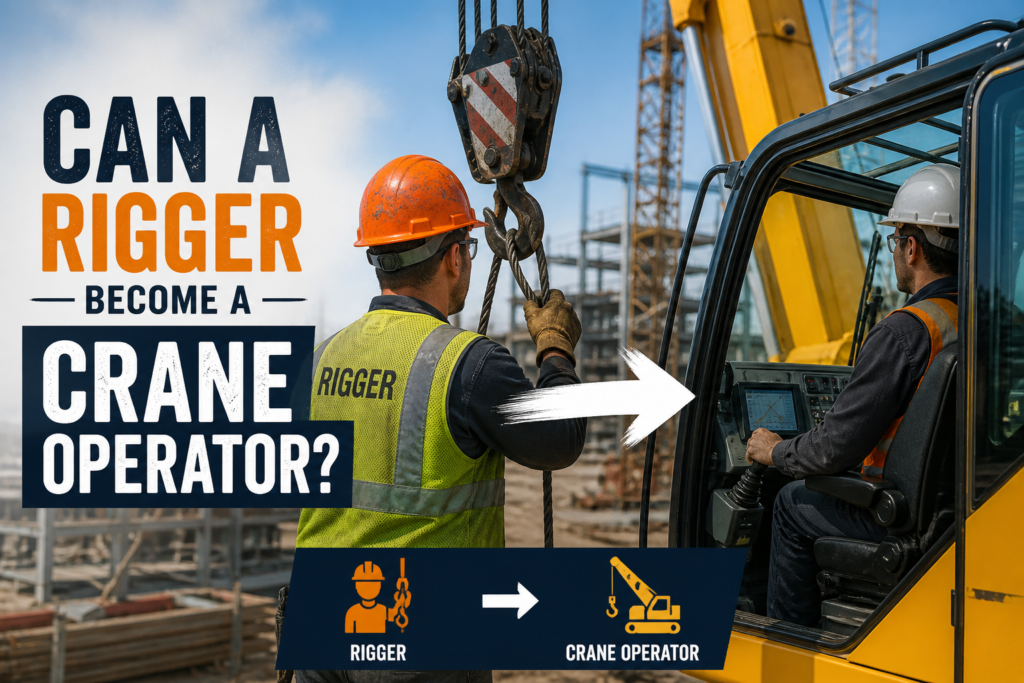
Yes, transitioning from rigger to crane operator is a common and logical career progression. Your rigging experience provides excellent preparation for crane operation because you already understand load dynamics, safety protocols, and job site communication.
Advantages riggers have when becoming crane operators:
- Load behavior knowledge: You’ve seen how loads react during lifts from the ground perspective
- Safety awareness: Your rigging background makes you more cautious about ground hazards
- Communication skills: You’re already fluent in hand signals and lifting terminology
- Equipment familiarity: You know rigging hardware limitations and proper configurations
- Job site experience: You understand workflow, coordination, and project demands
Steps for riggers to become crane operators:
- Maintain your rigger certifications as they remain valuable and often required
- Enroll in crane operator training through accredited providers like EUTC Global
- Complete required classroom hours covering crane-specific theory and regulations
- Log supervised operation time (requirements vary but typically 200+ hours)
- Pass third-party certification exams for your target crane types
- Obtain necessary approvals from Saudi Civil Defense and employer-specific programs
Many employers in Saudi Arabia prefer hiring riggers for crane operator positions because they understand the complete lifting operation. This perspective makes them safer, more efficient operators who communicate better with ground crews.
Crane Operator vs Rigger: Comparison Table
| Aspect | Crane Operator | Rigger |
|---|---|---|
| Primary Role | Operates crane | Prepares and guides loads |
| Location | Crane cabin | Ground |
| Skills | Controls, coordination | Load calc, signaling |
| Physical Demand | Sitting | Heavy work |
| Certifications | NCCCO, OSHA | NCCCO, OSHA |
| Training Time | 3–6 months | 2–4 months |
| Salary | 6,000–12,000 SAR | 4,000–8,000 SAR |
| Growth | Supervisor, inspector | Level 1–3, supervisor |
Frequently Asked Questions
What is the difference between a crane operator and a rigger?
A crane operator controls the crane itself, using levers and controls to lift and position loads safely. A rigger works on the ground, preparing loads by attaching slings and hardware, then signaling the operator during the lift. Both roles require different certifications and work together as a team. In Saudi Arabia, operators typically earn more, but experienced Level 3 riggers command competitive salaries, especially on Aramco projects.
Who earns more, rigger or crane operator?
Crane operators generally earn higher salaries than riggers in Saudi Arabia. Entry-level crane operators earn 6,000-8,000 SAR monthly, while experienced operators can reach 12,000 SAR or more. Riggers start at 4,000-5,000 SAR for Level 1, reaching 7,000-8,000 SAR at Level 3. However, riggers who transition to crane operation or lifting supervisor roles often see the highest total earnings. Aramco-approved positions typically offer 15-25% premiums above standard market rates.
Is rigger a skilled job?
Yes, rigging is absolutely a skilled trade requiring specialized knowledge and training. OSHA and ASME require that all personnel performing lifting and rigging activities are trained and evaluated before they perform a task (Mazzella Companies, 2024). Riggers must understand complex calculations, equipment limitations, load dynamics, and safety protocols. In Saudi Arabia, Level 3 riggers are considered highly skilled professionals who often supervise teams and plan critical lifts on major construction projects.
How long does it take to become a crane operator?
Becoming a certified crane operator typically takes 3-6 months of intensive training and supervised practice. This includes classroom instruction (usually 2-4 weeks), followed by hands-on training and accumulating 200-400 supervised operation hours. NCCCO certification is the national standard required by most employers for crane operators (Operator School, 2025). In Saudi Arabia, add another 2-4 weeks for Civil Defense approval and employer-specific training, bringing total time to approximately 4-8 months from start to full certification.
Is certification mandatory in Saudi Arabia?
Yes, certification is mandatory for both crane operators and riggers working in Saudi Arabia. The Saudi Civil Defense requires proof of third-party certification from recognized bodies like NCCCO. For Aramco projects and major contractors, certification isn’t just mandatory but regularly audited. Working without proper certification can result in project shutdowns, contractor penalties, and personal legal liability. Training providers like EUTC Global offerrigging and crane operator certifications that meet all Saudi requirements.
Conclusion
Understanding the difference between crane operator and rigger roles is essential whether you’re starting your career, hiring for projects, or managing lifting operations in Saudi Arabia. While crane operators control the equipment from above, riggers prepare loads and provide ground-level coordination. Both positions require specific certifications, ongoing training, and commitment to safety.
From 2021 to 2024, most crane incidents stem from human error, poor communication, inadequate rigging practices, and power line contact (OSHA Outreach Courses, 2026). This statistic reinforces why proper training and certification matter so much in these roles.
Key takeaways for aspiring professionals:
- Crane operators and riggers perform complementary but distinct roles in lifting operations.
- Both positions require third-party certifications recognized by Saudi Civil Defense and Aramco.
- Riggers can successfully transition to crane operator roles with additional training.
- EUTC Global offers thorough training for both career paths, from Basic Rigging Lifting Training through advanced crane operator certification.
- Aramco’s three-tier rigger level system provides clear progression from entry-level to advanced roles.
- Cross-training in both rigging and crane operation increases earning potential and job opportunities.
- Proper certification isn’t just regulatory compliance but a career investment that opens doors throughout the GCC region.
Whether you’re pursuingcrane operator training or advancing through rigger levels, investing in quality education from accredited providers prepares you for long-term success in Saudi Arabia’s construction and industrial sectors.