


Basic vs. Advanced Fire Fighting Training: Which Does Your Team Need?
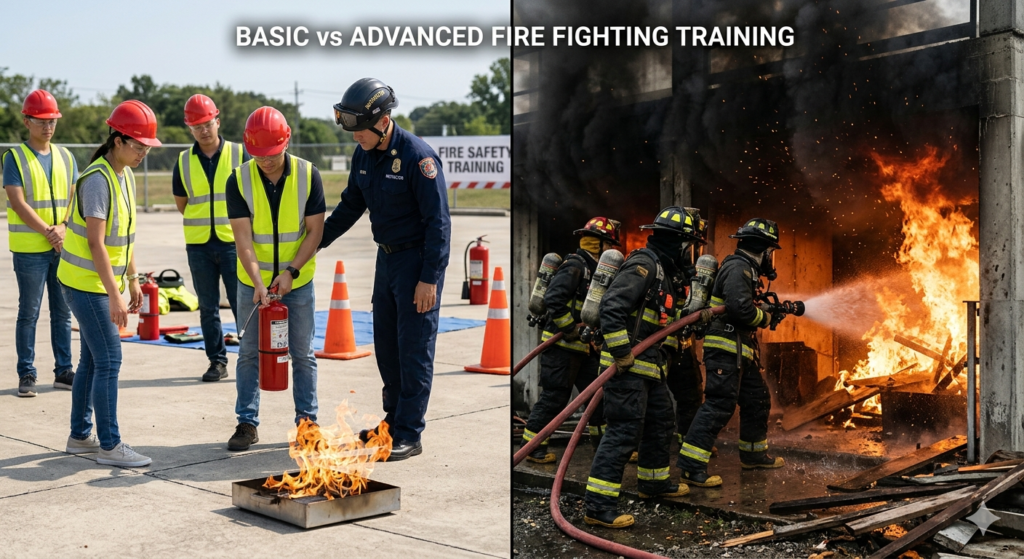
Workplace fires continue to cause thousands of preventable injuries every year. In many cases, the issue is not a lack of safety awareness, but the wrong type of training provided to employees. Organizations often either rely only on basic training or fail to provide advanced training to key personnel responsible for emergency response. Choosing the correct level of fire fighting training is essential for both workplace safety and regulatory compliance. This guide helps safety managers and HR teams understand the difference between basic and advanced fire fighting training and choose the right option based on job roles. Quick Answer (TL;DR) What’s the Difference Between Basic and Advanced Fire Fighting Training? The difference between basic and advanced fire fighting training lies in responsibility and capability, not just course duration. Basic training focuses on early-stage response and evacuation, while advanced training prepares individuals to actively control fire incidents and lead emergency operations. Key Differences Feature Basic Fire Fighting (BFFT) Advanced Fire Fighting Target Audience General workforce Fire marshals, ERT, safety officers Duration 1–2 days 3–5 days Focus Awareness, evacuation, extinguisher use Fire suppression, rescue, command Practical Training Low–moderate High (live fire exercises) Compliance Role Baseline requirement Mandatory for safety roles Cost (KSA) SAR 400–800 SAR 1,200–2,500 Refresher Every 1–2 years Every 2–3 years Who Should Take Basic Fire Fighting Training (BFFT)? Basic Fire Fighting Training is designed for all employees who are not part of a dedicated emergency response team. Suitable for: What BFFT Covers: Why It Matters The purpose of BFFT is not to turn employees into firefighters, but to ensure they: Organizations that train all employees in BFFT typically experience faster and calmer emergency responses. Who Needs Advanced Fire Fighting Training? Advanced Fire Fighting Training is essential for personnel responsible for active fire response and emergency management. Required for: What Advanced Training Includes: Why Advanced Training is Critical Basic training alone is not sufficient for roles that involve: Advanced training provides the skills, confidence, and leadership ability needed during high-pressure situations. Fire Fighting Training Levels in KSA In Saudi Arabia, fire fighting training follows international safety standards along with local civil defence requirements. Typical Training Structure Organizations generally implement a three-level training system: Compliance Requirements High-risk facilities such as: are required to maintain trained personnel at different levels. This ensures: Cost Comparison: Basic vs Advanced Training Cost is often a major consideration when selecting training programs. Average Costs in KSA Is Advanced Training Worth It? While advanced training costs more, it offers significantly higher value for roles that require emergency response. The cost of a single workplace fire incident can exceed the total investment in proper training. Therefore, correct training allocation provides strong return on investment (ROI). How to Choose the Right Training Level Selecting the correct training level depends on employee roles and responsibilities. Choose Basic Training if: Choose Advanced Training if: A balanced, role-based training approach ensures both safety and cost efficiency. Frequently Asked Questions Conclusion Choosing between basic and advanced fire fighting training is not simply a budgeting decision—it is a critical safety strategy based on job roles. Basic Fire Fighting Training should be provided to all employees to ensure they can respond quickly, reduce panic, and evacuate safely during emergencies. It creates a strong safety foundation across the entire workforce. Advanced Fire Fighting Training is essential for personnel responsible for managing fire incidents, including fire marshals, safety officers, and emergency response teams. These roles require practical skills, technical knowledge, and leadership abilities to handle real-life emergencies effectively. The most effective approach is a tiered training system, where: This ensures better preparedness, reduces workplace risks, and supports compliance with safety regulations. In the end, the goal is simple: provide the right training to the right people, so your organization is fully prepared to respond when it matters most.
What Are the Different Types of Fire Extinguishers and When Should You Use Each One?
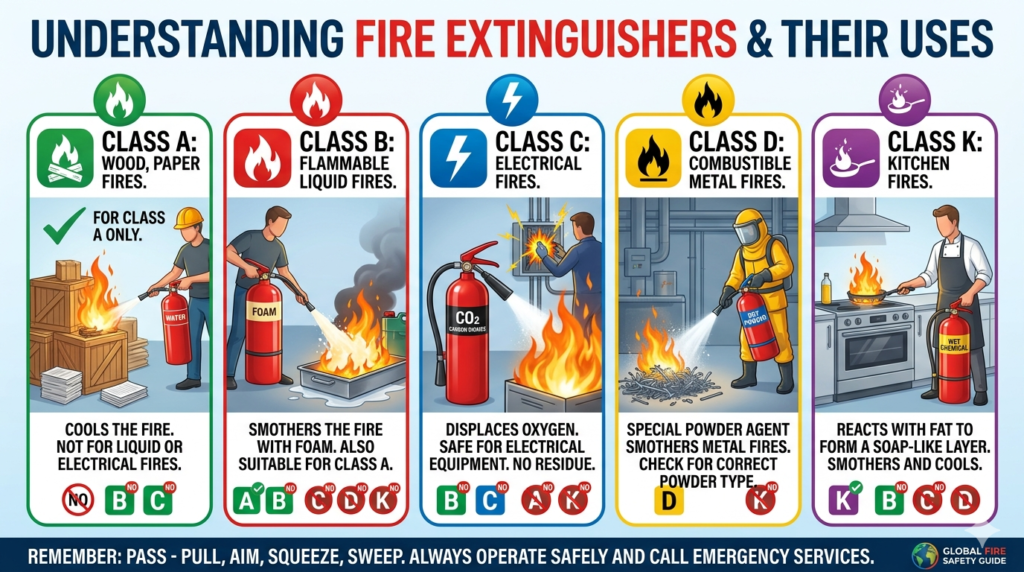
Reaching for the wrong fire extinguisher can turn a containable fire into a disaster. According to the National Fire Protection Association (NFPA), the majority of workplace fires that escalate beyond their starting point do so because the first responder either had no extinguisher or used the wrong type. For safety officers and facility managers, that’s a preventable failure — and it almost always comes down to training gaps, not equipment gaps. This guide covers the five main types of fire extinguishers, the fire classes each one addresses, and the specific situations where using the wrong one creates more danger than it solves. TL;DR: The five main fire extinguisher types, water, foam, CO2, dry powder, and wet chemical — each target specific fire classes. Using the wrong type can spread or intensify a fire. Match the extinguisher to the fire class before an emergency happens. 1. What Are the Main Types of Fire Extinguishers? The five types facility managers need to know are water, foam, CO2, dry powder, and wet chemical. Each works through a different suppression mechanism — cooling, smothering, displacing oxygen, or interrupting the chemical chain reaction — and each is rated for specific fire classes by bodies like the NFPA and the Saudi Civil Defence authority. Getting this wrong isn’t a minor mistake: Fire Extinguisher Types at a Glance Extinguisher Type Label Colour Best Used For Do NOT Use On Water Red Class A (wood, paper, textiles) Electrical fires, flammable liquids Foam (AFFF) Red / Cream Class A & B (liquids, solvents) Electrical fires, cooking oils CO2 Red / Black Class B & C (electrical, liquids) Class A materials (re-ignition risk) Dry Powder (ABC) Red / Blue Class A, B & C (multi-purpose) Enclosed spaces, cooking oil fires Wet Chemical Red / Yellow Class F / Class K (cooking oils, fats) Electrical fires, flammable solvents Understanding Fire Classes Choosing the right extinguisher starts with identifying the fire class in your environment. For a full breakdown of what each class means and which fuel types are involved, see our detailed guide: Classes of Fire A B C D K — Which Extinguisher Stops Each? Fire Class Fuel Type Common Examples Class A Solid combustibles Wood, paper, textiles, cardboard Class B Flammable liquids Petrol, paint, solvents, diesel Class C Flammable gases LPG, butane, propane Class D Combustible metals Magnesium, titanium, sodium Class F / K Cooking oils & fats Vegetable oil, animal fat Electrical Live electrical equipment Panels, servers, machinery Saudi Arabia Note: Dry powder ABC extinguishers dominate most commercial and industrial facilities in the Kingdom. While practical for multi-hazard environments, they are the wrong tool in kitchens or server rooms. Saudi Civil Defence guidelines specifically mandate wet chemical and CO2 in those areas respectively. According to NFPA 10 (Standard for Portable Fire Extinguishers), selecting the correct agent type for the occupancy hazard class is a fundamental requirement in every compliant fire safety plan. 2. When Should You Use a Water or Foam Extinguisher? Water and foam extinguishers are the right choice for Class A fires — those involving ordinary combustibles like wood, paper, cardboard, and textiles. Foam extinguishers extend that coverage to Class B fires involving flammable liquids like petrol, paint, and solvents. Water Extinguishers Foam Extinguishers (AFFF) Key Limitation for Both Types Neither water nor foam extinguishers are safe near live electrical equipment. Even mist-type water extinguishers, which carry a higher safety margin than jet types, are not rated for live electrical panels. Practical warning: Facilities that stock only water extinguishers in mixed-use areas create a real response gap. If a fire starts near a printer or electrical cabinet, grabbing the nearest extinguisher can make the situation significantly worse. According to NFPA fire incident data, Class A fires account for the largest share of reported structure fires in commercial buildings — making water and foam extinguishers the baseline requirement for nearly every facility type. 3. Is a CO2 Extinguisher the Right Choice for Electrical Fires? Yes — CO2 extinguishers are the standard and correct recommendation for electrical fires. They are among the most commonly specified types in server rooms, data centres, and office environments across Saudi Arabia. The UK’s Health and Safety Executive rates CO2 as safe for use on live electrical equipment up to 1,000 volts. CO2 Extinguisher: Pros and Cons Pros Cons Leaves zero residue — safe for electronics Dissipates quickly in open or ventilated spaces Rated safe for live electrical equipment Creates suffocation risk in confined spaces Effective on Class B flammable liquids Does not cool burning material — re-ignition risk on Class A No secondary damage to sensitive equipment Less effective outdoors or in large areas Where CO2 Extinguishers Are Mandatory Critical insight: CO2 extinguishers do not cool the burning material. Once the gas disperses, a Class A fire can re-ignite. They are not a standalone solution for mixed-material environments — always pair with appropriate backup coverage. According to a fire safety analysis of Gulf commercial properties, CO2 extinguishers are the most specified type in IT and telecommunications facilities in Saudi Arabia and the UAE, aligning with international electrical fire suppression standards. 4. What Makes Dry Powder Extinguishers Versatile — and Problematic? Dry powder ABC extinguishers handle the widest range of fire classes: A (solids), B (liquids), and C (gases). That versatility explains why they are the most widely installed type across Saudi industrial, construction, and commercial sites. Where Dry Powder Works Well Where Dry Powder Should NOT Be Used Environment Reason to Avoid Server rooms & IT environments Fine residue permanently damages electronics Electrical control rooms Residue contaminates sensitive equipment Commercial kitchens Ineffective on Class F/K fires; re-ignition risk Enclosed spaces with poor ventilation Dense discharge cloud reduces visibility and causes respiratory irritation Food preparation areas Residue contaminates surfaces and equipment The Class D Variant — A Specialist Product There is also a Class D dry powder formulated specifically for metal fires (magnesium, titanium, sodium). This is a specialist product for laboratories and manufacturing environments. It is chemically distinct from ABC powder
What Are the Classes of Fire A B C D K — And Which Extinguisher Stops Each One?
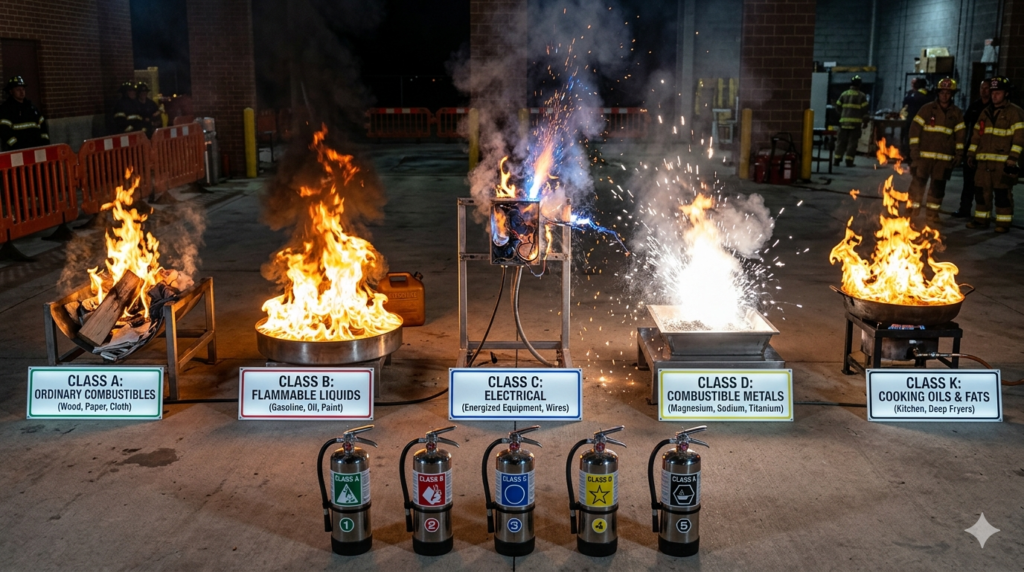
Using the wrong extinguisher on the wrong fire doesn’t just fail to stop it — it can make things dramatically worse. Water on a Class B fuel fire spreads burning liquid across the floor. CO₂ on a Class D metal fire can trigger a violent reaction. Yet across oil rigs, construction sites, and petrochemical facilities throughout Saudi Arabia, workers still reach for the nearest extinguisher without checking the label. TL;DR There are five fire classes A, B, C, D, and K — each requiring a specific extinguisher type. Using the wrong agent (e.g., water on Class B) can spread the fire or cause electrocution. NFPA 10, adopted by Saudi Civil Defense, mandates extinguisher matching by fuel type across all industrial workplaces. The Five Classes of Fire A B C D K: Quick Reference Each class in the A B C D K system is defined by its fuel source — and that determines which suppression agent will actually work. Class Fuel Type Saudi Workplace Example Correct Extinguisher Class A Ordinary combustibles (wood, paper, cloth) Site offices, scaffolding timber Water, foam, ABC dry powder Class B Flammable liquids & gases Diesel spills, LPG, crude oil CO₂, dry powder (ABC/BC), foam Class C Energized electrical equipment Control panels, transformers CO₂, dry powder (non-conductive) Class D Combustible metals Magnesium shavings, titanium parts Dry sand, Class D powder only Class K Cooking oils & fats Rig catering kitchens, site canteens Wet chemical agent Worth noting Most Saudi industrial sites stock ABC dry powder extinguishers as a catch-all. That covers Classes A, B, and C — but creates a false sense of security in areas where Class D metals are processed or Class K cooking equipment is present. Both require entirely different agents that ABC powder can’t handle. What Makes Class B Fires the Biggest Risk in Oil and Gas? Class B fires — flammable liquids and gases — represent the most common and dangerous fire type in Saudi Arabia’s oil and gas sector. Diesel spills, LPG leaks, hydrocarbon vapors, and crude oil exposure are everyday realities on Aramco-affiliated sites, NEOM construction zones, and offshore platforms. The core problem: water makes Class B fires worse. It doesn’t mix with most flammable liquids — it floats on top and splashes burning fuel across a wider area. That’s how a contained spill becomes a facility-wide emergency. The correct agents are CO₂, BC or ABC dry powder, and aqueous film-forming foam (AFFF). The choice depends on the fire: foam works best on pooled liquid; dry powder or CO₂ is more effective on running gas fires. GPCA 2025 safety guidelines specifically reinforce Class B training for Gulf petrochemical workers given the density of hydrocarbon handling in the region. Why Class C and Class D Fires Catch Workers Off Guard Class C: Energized Electrical Fires Class C fires involve live electrical equipment — control panels, junction boxes, motors, transformers. The danger isn’t just the fire: using a conductive agent (especially water) turns the worker into a path for electrical current. CO₂ and dry powder extinguishers are both non-conductive and appropriate. Once power is isolated, the fire may downgrade to Class A if ordinary combustibles are involved. Recurring audit finding Across Saudi industrial sites, workers spray water-based extinguishers on electrical panels during drills. This indicates a persistent training gap rather than a labeling failure — the problem isn’t access to correct equipment, it’s knowledge of when not to use what’s available. Class D: Combustible Metal Fires Class D fires are rare but extremely dangerous. Metals like magnesium, titanium, and sodium can ignite from welding sparks or grinding operations. Standard extinguishers — including ABC dry powder — can react violently with burning metals, intensifying the fire or causing steam explosions. The only safe approach is dry sand or a specialized Class D powder agent, applied gently to avoid scattering burning particles. → Related: What is basic fire fighting training Class K Fires: The Overlooked Hazard on Remote Sites Class K fires involve cooking oils and animal fats at high temperatures. Every oil rig, construction camp, and remote Vision 2030 project site has a catering facility — and those kitchens face real Class K risk. The specific danger is auto-ignition. Cooking oil heated past its flash point doesn’t need an external ignition source. When it ignites, ABC dry powder scatters burning oil and spreads the fire across the kitchen. Wet chemical extinguishers are the correct choice — the agent reacts with burning fat through saponification, turning the oil surface into a soapy foam that cools and prevents re-ignition. Saudi Civil Defense audits increasingly flag missing Class K extinguishers in site catering areas as a compliance violation. How to Match the Right Extinguisher to Each Fire Class Matching extinguisher to fire class comes down to three things: reading the label, knowing your worksite hazards, and never assuming a multi-purpose unit covers every scenario. ABC dry powder covers the majority of Class A, B, and C situations — but Class D and Class K require purpose-specific units. A single missing wet chemical extinguisher in a site kitchen, or a missing Class D unit near a welding bay, is both a compliance failure and a genuine life-safety gap. Practical rule for supervisors Walk every area of your site and list what’s burning if a fire starts there. Then check whether the extinguisher on the wall matches that fuel type. If it doesn’t, that’s a corrective action item before the next audit finds it first. Frequently Asked Questions Key Takeaways Practical next step: today, walk your worksite and verify every mounted extinguisher matches the hazard class in that area. Pay particular attention to welding bays, electrical rooms, and site catering facilities — the three most common compliance gaps found during Saudi Civil Defense inspections.
What is Basic Fire Fighting Training? Complete Guide for Saudi Industries
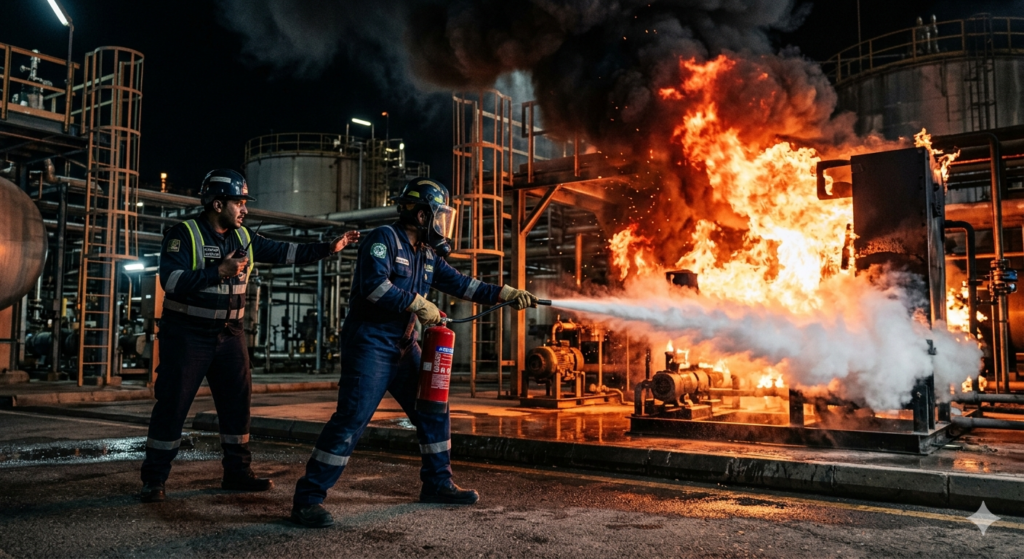
Saudi Arabia records approximately 825 fire-related deaths every year. This highlights how serious fire risks are across workplaces and industries. Basic fire fighting training (BFFT) equips employees with the knowledge and practical skills needed to control small fires, prevent escalation, and protect lives. It also helps organizations meet safety compliance requirements. Basic fire fighting training (BFFT) teaches workers how to detect, control, and extinguish fires safely. It is essential for high-risk workplaces in Saudi Arabia, includes both theory and practical training, requires a minimum 70% passing score, and certification remains valid for 3 years. What Is Basic Fire Fighting Training? Basic fire fighting training is a structured safety program designed to teach workers how fires start, how they spread, and how to respond effectively during an emergency. The training combines theoretical knowledge with hands-on practice, ensuring that participants not only understand fire risks but can also take action when needed. BFFT focuses on two key areas: prevention and response. Employees learn how to identify hazards before a fire starts and how to control a fire safely if it occurs. A fire extinguisher alone is not enough—knowing how to use it correctly under pressure is what truly makes the difference. Who Needs BFFT in Saudi Arabia? Fire hazards exist in almost every workplace, especially in environments that involve machinery, electricity, or flammable materials. Basic fire fighting training is recommended for: In Saudi Arabia, companies operating in high-risk sectors are expected to maintain trained personnel who can respond to fire emergencies. This makes BFFT an essential part of workplace safety. What Does a BFFT Course Cover? A standard BFFT course is designed to provide both knowledge and practical skills required to handle fire emergencies. The course typically covers fire science fundamentals, including how fires ignite and spread. Participants also learn about different fire classes such as Class A, B, C, D, K, and how each type requires a different approach. Another key part of the training is understanding fire extinguishers. Workers learn about different types of extinguishers—such as water, foam, CO₂, and dry powder—and how to choose the right one for each situation. The course also teaches the PASS technique (Pull, Aim, Squeeze, Sweep), which is the standard method for using fire extinguishers. In addition to this, participants are trained in fire prevention strategies, hazard identification, emergency response procedures, and evacuation planning. One of the most important components is practical training. Participants take part in live fire drills and use extinguishers in controlled environments, helping them build confidence and real-world readiness. What Are the Training Objectives? By the end of a basic fire fighting training course, participants are expected to develop essential fire safety skills. They should be able to understand how fires start and spread, identify different fire types, and select the correct extinguishing method. They also learn how to use fire extinguishers properly and follow emergency procedures during a fire incident. Additionally, participants gain the ability to recognize workplace hazards and apply preventive measures to reduce fire risks. These objectives align closely with workplace safety expectations and help organizations maintain a safer working envirHow Do You Get Certified? Getting certified in basic fire fighting training is a straightforward process. First, you need to enroll in an accredited training program. After enrollment, you will attend classroom sessions where fire safety concepts and procedures are explained. Next, you will participate in practical training sessions, including live fire drills. These sessions are essential for developing hands-on skills. After completing the training, you must pass a written assessment. A minimum score of 70% is required to successfully complete the course. Once you pass, you will receive your certification, which is typically valid for 3 years. After this period, renewal is required to stay compliant and up to date with safety standards. The course usually takes 1 to 2 days to complete, making it convenient for working professionals.onment. Frequently Asked Questions Conclusion Basic fire fighting training is a critical part of workplace safety in Saudi Arabia. It equips employees with the knowledge and confidence needed to respond effectively during fire emergencies. With proper training, organizations can reduce risks, protect their workforce, and ensure compliance with safety regulations. Investing in BFFT is not just about certification—it is about being prepared when it matters most.
Top Safety Courses in Saudi Arabia (2026 Guide)
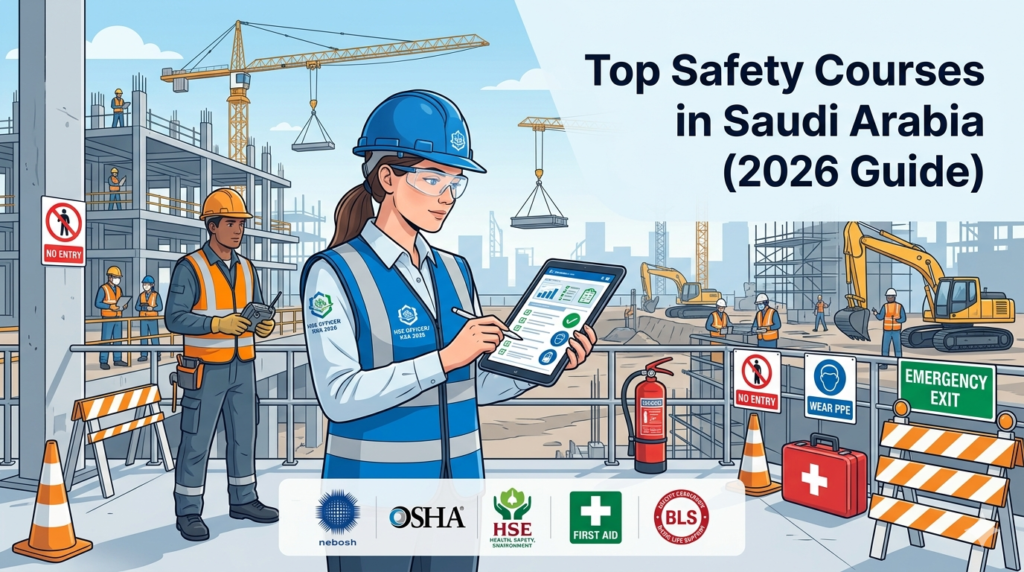
If you’ve been searching for a safety officer course in Saudi Arabia and feeling overwhelmed by all the options, certifications, and price ranges — you’re not alone. The Saudi safety training market is booming right now. With Vision 2030 driving massive construction and industrial projects across the Kingdom, companies are actively hunting for qualified safety professionals. But here’s the challenge: not all courses are equal, and picking the wrong one can cost you time, money, and career momentum. This guide breaks down the top safety courses available in Saudi Arabia in 2026 — what they cover, who they’re for, and what you should realistically expect before signing up. Why Safety Certifications Matter More Than Ever in Saudi Arabia The numbers tell a clear story. Saudi Arabia’s workplace safety market was valued at USD 504.6 million in 2024 and is projected to reach USD 1,396.9 million by 2030. Behind that growth is Vision 2030, driving large-scale projects across construction, oil and gas, manufacturing, and infrastructure — all requiring certified safety professionals. Salaries reflect this demand. Safety officers in Saudi Arabia typically earn between SAR 6,000 and SAR 15,000 per month, depending on certifications, experience, and industry. However, the market is becoming more competitive. Recruiters now look beyond certifications like NEBOSH — they expect: Top Safety Courses in Saudi Arabia 1. Safety Officer Training Course This is the starting point for most people entering the HSE field. What It Covers Who It’s For Important Note Look for courses that include practical simulations or site visits. Theoretical knowledge alone is not enough in 2026. Limitation A standalone safety officer certificate may not be enough for senior roles without additional certifications. 2. NEBOSH International General Certificate (IGC) The NEBOSH IGC is one of the most recognized safety certifications in Saudi Arabia. It qualifies holders for: Key Advantage It includes a practical assessment where candidates identify real hazards and prepare a report. Cost Range Courses typically range from SAR 3,000 to SAR 8,000+, depending on the provider and format. Important Note Always verify that the provider is an authorized NEBOSH learning partner. 3. OSHA Training in Saudi Arabia OSHA training in Saudi Arabia is widely used in construction and industrial sectors. Course Duration Best For OSHA 10-Hour (Construction) 1–2 days Entry-level workers OSHA 30-Hour (Construction) 3–4 days Supervisors OSHA 10-Hour (General Industry) 1–2 days Industrial workers OSHA 30-Hour (General Industry) 3–4 days HSE coordinators Practical Use Many international project sites require OSHA certification, especially for supervisors. Limitation OSHA is not a full safety qualification — it works best as an additional certification. 4. First Aid Training in Saudi Arabia First aid training in Saudi Arabia is required in many workplaces. What It Covers Courses typically last 1 to 3 days and require renewal every 2–3 years. 5. BLS Training in Saudi Arabia BLS (Basic Life Support) focuses on life-threatening emergencies. Skills Covered Courses are usually completed in 4 to 8 hours. 6. HSE Training Programs in Saudi Arabia These programs focus on safety management systems. Key Topics Saudi Arabia updated OSHMS guidelines in 2024, aligning with international standards. Course Comparison Table Course Career Stage Recognition Duration Safety Officer Course Entry to mid-level Regional 1–5 days NEBOSH IGC Mid to senior Global 10–12 weeks OSHA 10/30 Entry to supervisor International 1–4 days First Aid All levels Workplace 1–3 days BLS Safety officers Clinical/site Half to full day HSE Management Senior level Organizational 3–5 days+ Online and Free Safety Courses in Saudi Arabia Online training options have increased significantly. Virtual NEBOSH programs allow professionals to study remotely. However, free safety courses: If cost is an issue, some providers offer installment plans. Next Steps Before Enrolling Frequently Asked Questions
Top 10 Mandatory Safety Trainings for ARAMCO Vendor Companies
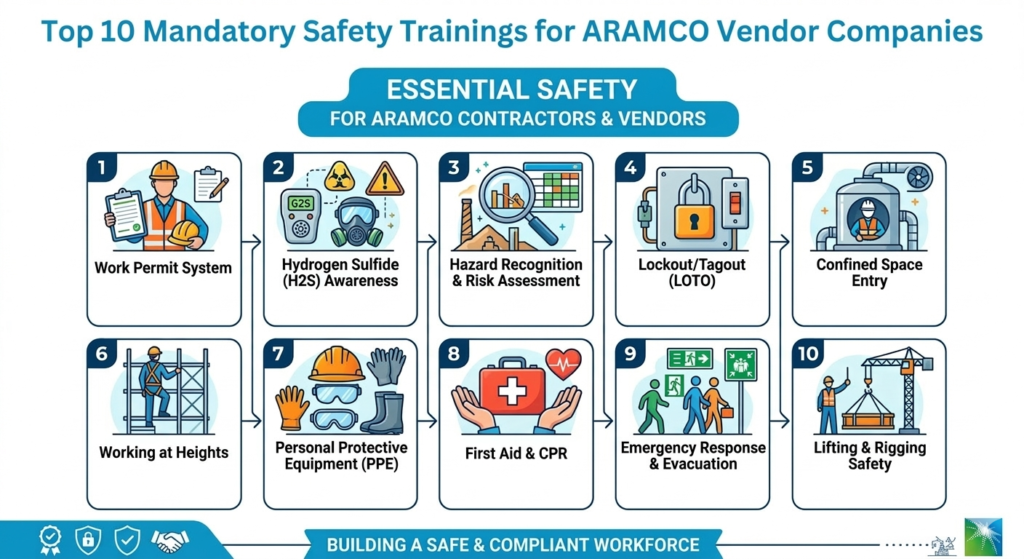
If your company supplies to Saudi Aramco, your workforce must meet strict HSE certification requirements before they can step on site. That’s not a suggestion — it’s a condition of doing business. Whether you’re a small contractor in Al Khobar or a mid-size service firm looking to grow your Aramco book of work, your team’s safety credentials are reviewed before any access is granted. Missing a certification doesn’t just delay a project — it can cost you the contract entirely. Why ARAMCO Enforces Such Strict Vendor HSE Requirements Saudi Aramco operates in one of the most hazardous industrial environments in the world. Oil and gas worksites carry real risks — fires, toxic gases, heavy equipment failures, and confined space incidents are not theoretical concerns. They happen. To manage those risks, Aramco holds its vendors to the same standards it holds its own workforce. Their Contractor Workforce Qualification Assurance Program (CWQAP) requires that technicians working on Aramco sites be evaluated and certified through Aramco-authorized training institutes. Beyond safety, there’s a business case here too. Vendors who maintain proper HSE documentation — training records, risk assessments, incident logs — move through the vendor registration process faster. Companies with ISO 45001-aligned programs and clean training records consistently see stronger bid outcomes and smoother onboarding. The message is simple: certified teams get access. Uncertified teams don’t. The 10 Most Required HSE Training Certifications for ARAMCO Vendors 1. H2S Awareness Hydrogen sulfide is odorless at high concentrations and lethal within seconds. Any worker entering oil and gas facilities in the Eastern Province must understand H2S risks, detection methods, and emergency response. This is non-negotiable on virtually every Aramco site. 2. SCBA (Self-Contained Breathing Apparatus) Knowing H2S exists isn’t enough — workers must be trained to use their breathing equipment correctly under pressure. SCBA training covers donning, doffing, seal checks, and emergency protocols. Aramco’s CSAR standards specify oxygen concentration thresholds (20–23.5%) that SCBA users must be able to identify and respond to. 3. PTW (Permit to Work) The Permit to Work system is Aramco’s primary tool for controlling hazardous work activities. Anyone involved in issuing, approving, or executing permits must understand the system. Errors in PTW procedures are among the most common audit findings at contractor sites. 4. Confined Space Entry Storage tanks, vessels, pipelines, and manholes — confined spaces are everywhere on Aramco facilities. Entry without proper training is a serious compliance violation. Training covers atmospheric testing, isolation procedures, rescue planning, and entry/exit protocols. 5. Fire Watch Aramco requires a designated fire watcher within 3 meters (10 feet) during welding or cutting operations, equipped with a fire extinguisher — and maintained for 30 minutes after work stops. Workers in this role need formal training to understand their responsibilities, not just a job-site briefing. 6. First Aid & Basic Life Support (BLS) Medical emergencies don’t wait for an ambulance. Aramco expects vendor teams — especially supervisors and safety officers — to have certified first aid and BLS training. This directly impacts emergency response capability on site and is a common requirement in vendor prequalification documents. 7. Working at Heights Falls remain one of the leading causes of fatalities in oil and gas construction globally. This training covers fall hazard identification, harness inspection, ladder safety, and rescue procedures. Aramco’s scaffolding and elevated work requirements under CSAR make this one of the most frequently checked certifications during site audits. 8. Rigging & Lifting Crane and lifting operations involve some of the highest mechanical energy on any worksite. Training ensures workers understand load calculations, sling inspection, lifting plan requirements, and communication protocols. An error here can be catastrophic — for people and equipment alike. 9. HAZCOM (Hazard Communication) Workers handling chemicals on Aramco sites must understand Safety Data Sheets (SDS), labeling systems, and proper handling procedures. Particularly relevant for vendor companies supplying maintenance, cleaning, or chemical services, and ties directly into Aramco’s material control requirements. 10. Defensive Driving Vehicle incidents are one of the most frequent causes of contractor fatalities across the GCC oil and gas sector. Aramco mandates defensive driving certification for anyone operating vehicles on or between its facilities — covering journey management, fatigue awareness, and emergency response, not just road rules. How to Manage Training Records for ARAMCO Audits Certification alone isn’t the finish line. Aramco auditors want to see organized, up-to-date training records — and gaps in documentation can be just as problematic as gaps in training. Your HSE management system should include: A common mistake among mid-size vendors in Al Khobar and Dammam is treating training as a one-time event rather than an ongoing compliance program. Aramco’s vendor evaluations look at trends, renewals, and whether your HSE system is actually functioning. Using a simple spreadsheet or HSE management platform to track certifications by employee, by site, and by renewal date can save significant stress when an audit arrives. How EUTC Supports ARAMCO Vendor Companies Coordinating HSE training across a vendor workforce — especially under time and budget pressure — is a real operational challenge. EUTC (Eastern Union Training Center) offers structured corporate training packages specifically designed for companies supplying to Saudi Aramco and other major operators in the Eastern Province. Their programs cover the full scope of Oil & Gas and Construction HSE trainings required for Aramco site access, including all 10 certifications outlined above, with: Getting training organized early — not at the last minute — is the difference between being ready and being turned away at the gate. Frequently Asked Questions
10 Workplace Hazards in Oil & Gas and How to Control Them in Saudi Arabia
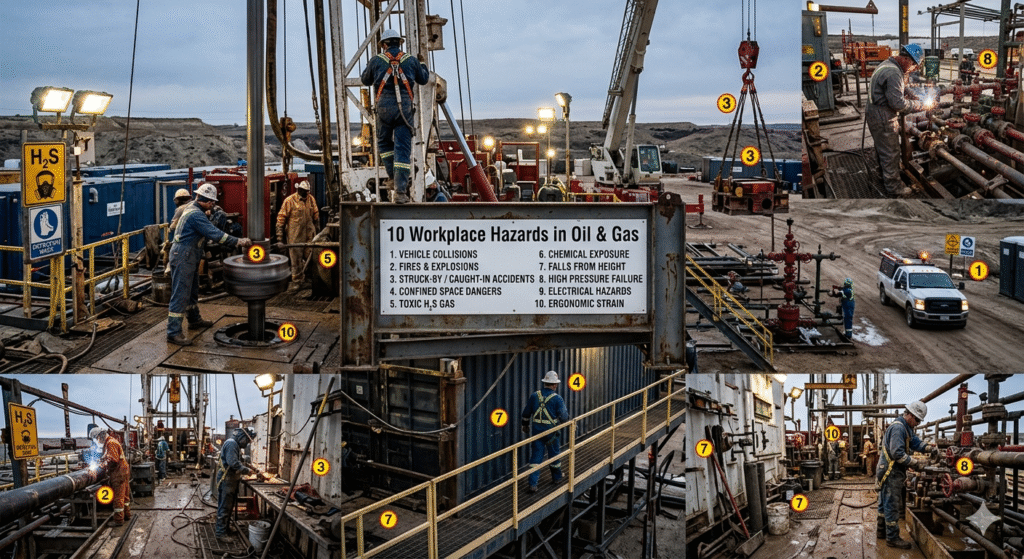
You’re walking onto a site in the Eastern Province. It’s 8 AM and already 42°C. Your crew is prepping for confined space entry while another team handles hot work nearby. A third group is running lifting operations, three high-risk activities, one location, dozens of variables that could go wrong. This is a normal morning in oil and gas operations across Saudi Arabia. The industry drives the Kingdom’s economy and is expanding rapidly under Vision 2030. But growth brings pressure, on timelines, crews, and safety systems that may not always keep up. Whether you’re an HSE officer at a refinery, a site supervisor managing a shutdown, or new to the sector, knowing exactly which hazards you face, and what actually controls them, can be the difference between a productive shift and a tragedy. Here’s what every oil and gas professional needs to know heading into 2026. Why Oil & Gas in Saudi Arabia Carries Unique Risk Most industries deal with hazards. Oil and gas deals with several simultaneously, in conditions that amplify every single one. You’re working with flammable hydrocarbons in temperatures that regularly exceed 50°C, across a workforce that may span 10+ nationalities, on sites that can be hours from the nearest hospital. Regulatory audits under Saudi Aramco HSE standards and MHRSD requirements carry zero tolerance for lapses — a single violation can halt operations and cost you a contract. Saudi Arabia’s workplace safety market reached USD 504.6 million in 2024 and is projected to grow at a 19.1% CAGR through 2030, reflecting both the scale of projects like NEOM and the serious investment required to manage risk at that scale. The Top 10 Oil & Gas Hazards in Saudi Arabia — and How to Control Each One 1. Heat Stress — The Silent Killer in Desert Operations Temperatures above 50°C are not unusual on KSA oil fields. Heat exhaustion can set in within minutes for an unprotected worker, and heatstroke can be fatal. Effective controls: 3. Confined Space Entry — Where Incidents Escalate Fast Tanks, vessels, pipelines, and manholes are everywhere in oil and gas facilities. Hazards inside them — oxygen deficiency, toxic gases, engulfment — can incapacitate a worker in seconds. Effective controls: The most common failure point isn’t equipment — it’s schedule pressure causing teams to skip atmospheric testing or rush the PTW process. 4. Fire and Explosion — Managing the Persistent Top Risk Hydrocarbons are flammable. Everyone knows this. But complacency is what keeps fire and explosion a persistent leading hazard across petrochemical and refinery sites. Effective controls: Practical audit check: When did you last run an unannounced fire drill? Teams that only perform well when they know it’s coming are revealing a critical gap. 5. Falls from Height — A Leading Cause of Fatalities Falls remain one of the leading causes of fatalities across oil and gas globally. On offshore platforms, during turnarounds, or on the major infrastructure projects currently underway across KSA, the exposure is constant. Effective controls: 6. Heavy Equipment and Lifting Operations Cranes, forklifts, and heavy lifting are daily realities on oil and gas construction and maintenance sites. Crush injuries and struck-by incidents are among the most severe. Effective controls: LOTO compliance in Saudi Arabia is under increasing regulatory scrutiny. Undocumented or unpractised energy isolation procedures are a liability on multiple levels. 7. Chemical Exposure in Refinery and Processing Environments Acids, solvents, and process chemicals are standard in refinery operations. Skin contact, inhalation, and eye exposure can cause injuries ranging from chemical burns to long-term respiratory damage. Effective controls: 8. NORM Radiation — The Hazard Most Teams Underestimate Naturally Occurring Radioactive Materials (NORM) are present in oil and gas production — in scale buildup, pipes, and produced water systems. Exposure is gradual, invisible, and easy to overlook without proper monitoring. Effective controls: This is one of the most underestimated hazards in KSA oil and gas operations — and it’s receiving increasing regulatory attention heading into 2026. 9. Ergonomic and Mechanical Strain Repetitive manual handling, awkward working positions, and equipment vibration cause injuries that accumulate quietly — resulting in long-term health problems and productivity loss that rarely appear in incident statistics. Effective controls: 10. Remote Location Emergencies — When Response Time Works Against You Many KSA oil and gas sites are hours from the nearest medical facility. When something goes wrong, distance makes every element of emergency response harder. Effective controls: What’s Changing in Oil & Gas Safety for 2026 The regulatory environment is tightening. Saudi Aramco’s Safety Management System (SMS) requirements, MHRSD nationalization mandates, and ECRA oversight are pushing sites toward documented, fully auditable safety systems. Technology expectations are shifting too. IoT-enabled gas sensors for real-time leak detection, VR and AR training for high-risk simulations, and digital Permit-to-Work platforms are moving from optional to expected — particularly on larger projects. If your team is still managing hazards primarily through paper-based systems and infrequent training, the gap between your current approach and what regulators and clients expect is growing. How to Prioritise Safety Controls on Your Site Managing oil and gas hazards in Saudi Arabia isn’t about choosing which risks matter — all ten are active on most major sites simultaneously. The question is whether your controls are actually working, not just documented. Start here: Frequently Asked Questions
Basic Firefighting Training: What to Expect in Your Course
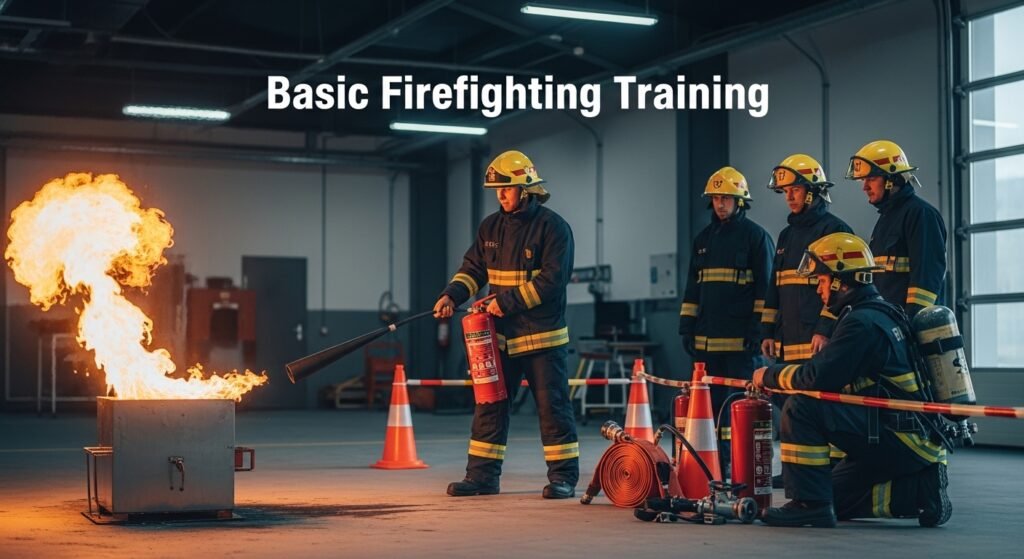
Whether you’re responding to a job posting, attending a recruiter session, or simply feeling drawn to a more meaningful career — one question comes up every time: what actually happens in a firefighting training course? This guide covers everything you need to know before enrolling — from curriculum and certification requirements to costs, physical prep, and free resources. What Is Basic Firefighting Training? Basic firefighting training is a structured, hands-on program that teaches you how to safely suppress fires, rescue civilians, and operate effectively as part of a team. Most U.S. programs follow the NFPA 1001 standard (National Fire Protection Association — Firefighter Professional Qualifications), which ensures a consistent national benchmark for skills and safety. Course lengths vary by goal: What You’ll Learn: Core Curriculum Breakdown 1. Fire Behavior and the Fire Tetrahedron Every firefighting course starts here. You’ll study the fire tetrahedron — the four elements fire needs to survive: Understanding how fires grow, how flashover occurs, and how fires behave in enclosed spaces helps you make safer, faster decisions on scene. 2. Fire Extinguisher Types and Fire Classes Not all fires are the same — and using the wrong extinguisher can make things worse. You’ll memorize all five fire classes: Class Fire Type Example A Ordinary combustibles Wood, paper B Flammable liquids Gasoline, oil C Electrical fires Wiring, appliances D Combustible metals Magnesium, titanium K Cooking oils/fats Commercial kitchens 3. SCBA Training for Firefighters SCBA (Self-Contained Breathing Apparatus) is the air tank and mask system that keeps you breathing inside a burning structure. Training covers: Many students are surprised by how different it feels to breathe through an SCBA while their heart rate is elevated. Programs build in repetitions until it becomes second nature. 4. Fire Suppression Techniques This is the hands-on core of your training. You’ll learn: Some programs include wildland fire modules following NFPA 1051 — covering brush, forest, and open-terrain firefighting, which requires a separate skill set from structural respons 5. Hazmat Awareness You won’t become a hazmat specialist in a basic course, but you will learn to: 6. Search, Rescue, and Basic EMS Firefighters respond to more than fires. Your course covers: How Long Does Firefighting Training Take? Program Type Approximate Hours Typical Duration Workplace fire safety 8–16 hrs 1–2 days Volunteer firefighter basic 32–40 hrs 2–3 weekends Firefighter I certification 200–250 hrs 10–14 weeks Full fire academy (FF I & II) 400–428 hrs 4–6 months Career recruit academy Up to 1,500 hrs Up to 9 months Physical Fitness: The CPAT Test Firefighting is physically demanding — and your training will reflect that. Most career academies require you to pass the CPAT (Candidate Physical Ability Test) before or during enrollment. The CPAT includes 8 events wearing a weighted vest: Start preparing at least 3 months before your course. Focus on: Failing the CPAT is one of the most common reasons applicants don’t advance — don’t wait to start training. Live Fire Training: Where It All Comes Together Near the end of your program, you’ll enter a live burn structure — a controlled building where instructors set real fires for you to suppress. What to expect: Most graduates describe live fire training as the defining moment of their course. It’s where theory becomes instinct. Certification Requirements After completing your course, you’ll sit for: Successful completion earns you a Firefighter I or Firefighter II certification, issued by your state fire authority. Before enrolling, most academies require: Note: Full certification requires in-person skills testing. Online-only programs cover theory but cannot replace the hands-on component. Cost of Firefighting Training Program Estimated Cost Free online (NFA, NWCG) $0 Community college fire academy $300–$800 Private fire academy $1,500–$2,000+ Gear and textbooks (e.g., IFSTA Essentials) $150–$400 Ways to reduce cost: Free Basic Firefighting Training Resources You don’t need to spend money to get started. Several legitimate free options exist: These don’t replace a full certification — but they build your knowledge base, reduce prep time in paid programs, and some count as formal prerequisites. Volunteer Firefighting: A Smart Starting Point If a full academy feels out of reach right now, consider the volunteer firefighter route: Many career firefighters started as volunteers — it’s not a lesser path, it’s often the smarter one. What Makes a Strong Firefighting Student? Instructors aren’t looking for superheroes. They’re looking for people they’d trust in a burning building. That means students who: Your Next Steps: How to Get Started FAQ’s
CPR vs BLS: What’s the Difference and Which Certification Do You Need?
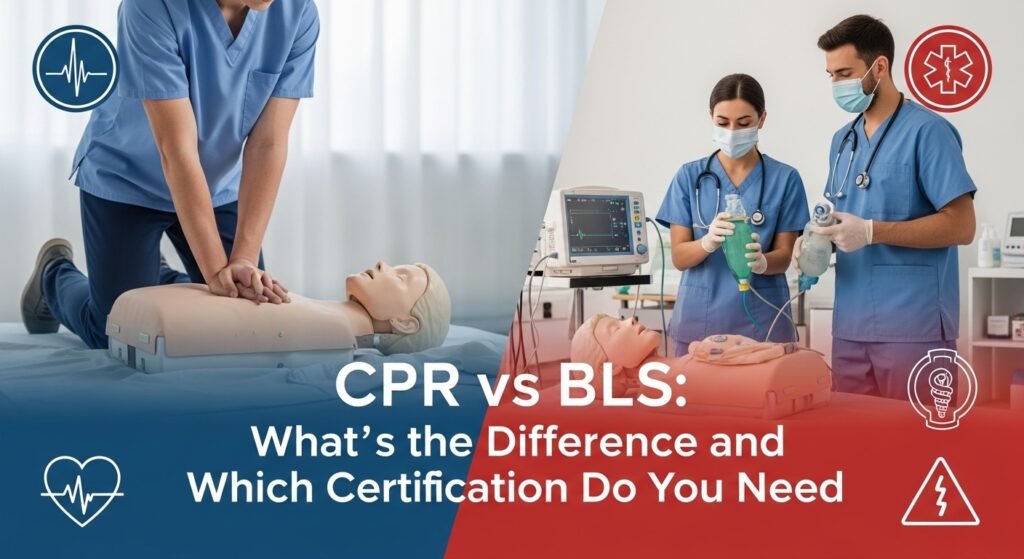
You’re applying for a nursing position, and the job posting says “BLS certification required.” But you already have a CPR certificate sitting in your drawer. Are they the same thing? Can you just submit that? This is one of the most common points of confusion in healthcare and workplace safety training. Getting it wrong can delay your hiring, block your clinical placement, or leave you underprepared in an actual emergency. The short answer: CPR and BLS are related but not the same. One is designed for the general public. The other is built for healthcare professionals who need to perform under pressure, in teams, with clinical tools. This guide breaks down exactly what each certification covers, who needs which one, what they cost, how long they’re valid, and how to choose the right path for your career or workplace. What Is CPR, Really? CPR (cardiopulmonary resuscitation) is a physical technique that uses chest compressions and rescue breathing to keep blood and oxygen moving in someone whose heart has stopped beating. Most people learn CPR in a few hours. The typical CPR certification course covers: In Canada, CPR Level C with AED is the most common standard for workplaces, schools, and general community settings. It’s valid for 3 years and can often be completed through blended online and in-person formats. CPR is designed for lay responders — a teacher, a security guard, a parent — someone who happens to be nearby when a person collapses, without clinical training. What Is BLS (Basic Life Support)? BLS (Basic Life Support) is CPR’s more advanced, clinically focused equivalent. It was developed specifically for healthcare providers — nurses, doctors, paramedics, dentists, and respiratory therapists — who respond to emergencies in structured medical settings. A BLS provider course typically covers: BLS is offered through the Heart & Stroke Foundation and the Canadian Red Cross. As of 2025, it is the standardized requirement across Ontario, Nova Scotia, and most Canadian provinces for clinical placements and healthcare employment. Important: BLS must be completed in person. There is no fully online BLS option. BLS certification is valid for 1 year, with annual renewal required. CPR vs BLS: Side-by-Side Comparison Here is a clear breakdown of how the two certifications compare across the areas that matter most. Feature CPR (Level C + AED) BLS (Basic Life Support) Target audience General public, non-clinical workers Healthcare professionals, clinical staff Chest compressions Yes Yes (high-performance focus) Rescue breathing Basic Advanced (BVM included) AED use Yes Yes Pulse check No Yes Bag-valve-mask (BVM) No Yes 2-rescuer technique Rarely Yes Team dynamics training No Yes Online option Blended formats available In-person only Certification validity 3 years 1 year Typical course duration 4-8 hours 4-7 hours Average cost $50-$100 CAD $80-$150 CAD Required for clinical roles Generally not accepted Mandatory WSIB workplace compliance Yes (non-clinical) Yes (clinical/high-risk) The Real Difference in Practice Consider a patient who goes into cardiac arrest in a hospital hallway. Within seconds, two nurses and a respiratory therapist respond. One nurse starts chest compressions. The second takes over the airway with a BVM. The therapist calls for the crash cart and manages team communication. That coordinated response — role assignments, BVM use, synchronized handoffs — is exactly what BLS trains for. Now imagine the same cardiac arrest in a shopping mall food court. A nearby teacher calls 911, directs a bystander to grab the wall-mounted AED, and begins compressions. That’s CPR doing its job. No BVM. No pulse checks. Just immediate action that keeps the person alive until advanced help arrives. Both are life-saving skills. They simply serve different people in different situations. Does BLS Include CPR and AED? Yes — completely. BLS builds on top of CPR rather than replacing it. If you hold a BLS certification, you have covered everything in a CPR Level C course plus the clinical additions. So if someone asks whether you know CPR, the answer is absolutely yes. The reverse is not true. A CPR certificate does not mean you have completed BLS. For clinical jobs and hospital placements, this distinction is critical. Is BLS the Same as CPR and First Aid? No. BLS focuses specifically on cardiac and respiratory emergencies — it does not cover wound care, fractures, burns, anaphylaxis management, or the broader first aid content required for workplace First Aid Attendant designations. If your workplace requires both first aid and CPR/BLS, you will likely need separate certifications or a combined course that covers both areas. Who Needs What? A Profession-by-Profession Guide Healthcare Professionals — You Need BLS If you work in a clinical environment, BLS is non-negotiable: Non-Clinical Workplaces — CPR Level C Is Your Standard First Responders and Public Safety Education and Childcare Students Entering Healthcare If you are a student in nursing, paramedicine, dentistry, or any allied health field, get your BLS before your placement begins. Most clinical programs will send you home without it. CPR vs BLS vs ACLS: Understanding the Progression CPR, BLS, and ACLS form a progression, not a competition: You cannot take ACLS without a valid BLS certification. BLS is the gateway. Cost, Duration, and Validity: What to Expect CPR Level C + AED BLS Provider Course The annual renewal requirement for BLS is a real operational consideration. Hospitals, clinics, and healthcare programs track expiry dates and require staff to renew before the card lapses. Some employers cover the cost; others require staff to self-fund. Not sure what BLS training will cost for your team or clinic? Get BLS Training Quote to find the right course and pricing for your team. A Note on Online CPR Certification You have probably seen ads for “online CPR certification” promising completion in an hour for $20. Be careful. Legitimate blended CPR courses include online theory with mandatory in-person skills testing. A purely online certificate with no hands-on component is generally not accepted by employers, WSIB, or clinical programs. For BLS, there is no recognized online-only option. When searching for “CPR certification near me” or “BLS certification near me,”
Best Fire Safety Training Courses for Professionals in Saudi Arabia
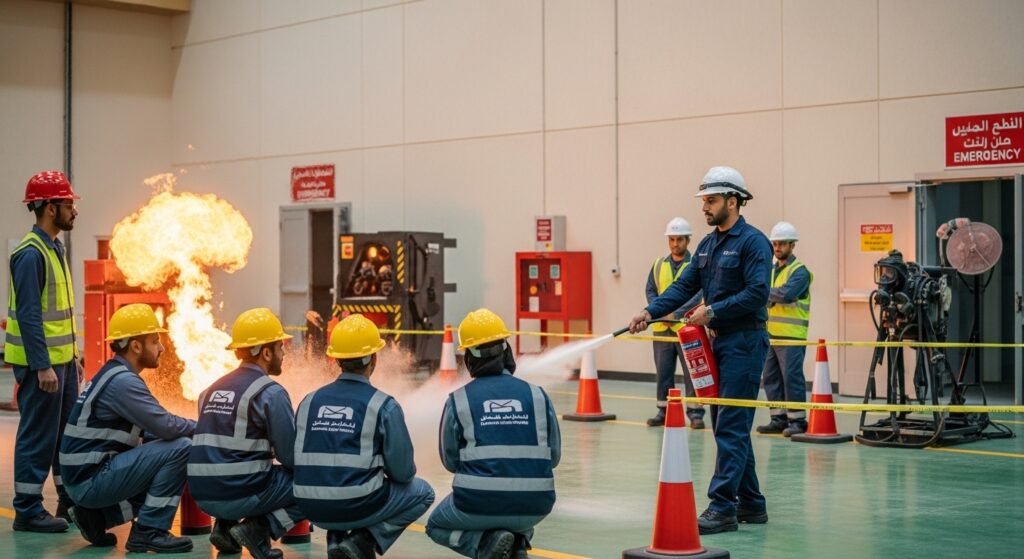
You’re working on a large construction site in Riyadh. There’s welding happening on one floor, flammable materials stored on another, and hundreds of workers going about their day. Then something goes wrong. A spark catches. Within minutes, what started as a small flame becomes a serious emergency. Who steps in? The trained safety officer. Fire safety is not a checkbox exercise in Saudi Arabia — it’s a legal requirement, a professional responsibility, and a career-defining skill. With Vision 2030 driving massive growth in infrastructure, construction, oil and gas, and hospitality, the demand for qualified professionals holding a safety officer course in Saudi Arabia has never been higher. This guide covers everything you need to know: the top fire safety training courses, leading providers, career prospects, salary expectations, and practical advice for both freshers and expatriates. Why Fire Safety Training Matters in Saudi Arabia Saudi Arabia operates in one of the world’s most hazardous industrial environments. The oil and gas sector accounts for a significant share of workplace incidents, and fire-related risks are among the most common and most devastating. According to the Saudi Civil Defense Authority, thousands of fire incidents are recorded annually across commercial, industrial, and residential settings. Workplaces involving chemical storage, heavy machinery, and confined spaces carry a particularly high risk of fire and explosion. Beyond the human cost, businesses face regulatory consequences. Saudi labor law and the General Organization for Social Insurance (GOSI) set out clear employer obligations regarding workplace safety. Companies failing to meet fire safety standards risk penalties, project shutdowns, and serious reputational damage. This is precisely why trained fire safety professionals are in demand — and why the right safety course in Saudi Arabia can open doors that were previously closed to you. Types of Fire Safety Training Available in Saudi Arabia Before choosing a course, it helps to understand what’s available. Fire safety training in Saudi Arabia generally falls into four categories: 1. Internationally Accredited Certifications These globally recognized qualifications carry significant weight with multinational employers and major Saudi contractors: 2. Local Saudi Safety Certifications Training centers in the Kingdom offer locally developed programs aligned with Saudi Civil Defense and SASO (Saudi Standards, Metrology and Quality Organization) requirements. These are particularly useful for professionals working in Saudi-owned firms or government-linked projects. 3. Short Courses and Awareness Programs Typically 1–5 day programs covering fire warden duties, evacuation planning, fire extinguisher operation, and emergency response. Ideal for non-safety staff or professionals adding a specific skill. 4. Online Safety Courses in Saudi Arabia The growth of online learning has made internationally recognized qualifications more accessible than ever. NEBOSH online courses and platform-based programs allow working professionals to study around their schedules. More on this below. Top Fire Safety Training Providers in Saudi Arabia Here are the leading organizations offering quality fire safety and HSE training across the Kingdom. Arabian Safety Training Center One of the most recognized names for safety training in Saudi Arabia, Arabian Safety Training Center offers courses from fire safety fundamentals to advanced HSE certifications. They serve professionals in Riyadh, Jeddah, and Dammam, with programs tailored to Saudi industrial requirements. Corporate training packages are also available. NEBOSH-Accredited Learning Partners Several NEBOSH-approved learning partners operate in Saudi Arabia, offering classroom and online delivery of: Providers like NIST and similar centers have strong track records for NEBOSH delivery in the region. Always verify accreditation status directly on the NEBOSH official website before enrolling. TSQC — Total Safety Courses TSQC offers a broad portfolio of safety training solutions, including fire safety, emergency response, and HSE management, catering to both individual professionals and corporate clients. OSHA-Authorized Training Organizations For professionals targeting US-linked companies, oil refineries, or international contractors, OSHA-authorized centers provide the OSHA Certificate Saudi Arabia programs, including OSHA 10 and OSHA 30 certifications. Most Popular Fire Safety and HSE Courses Explained NEBOSH Fire Safety and Risk Management This is the gold-standard qualification for fire safety specialists. It covers: Duration: 4–6 weeks (varies by study mode)Delivery: Classroom or onlineBest for: Safety officers, fire wardens, facility managers, and anyone responsible for fire risk The qualification is globally recognized and highly valued by Saudi employers in construction, oil and gas, manufacturing, and facilities management. NEBOSH IGC — International General Certificate The NEBOSH IGC is the most popular entry point into professional safety careers worldwide — and Saudi Arabia is no exception. It provides a solid foundation across workplace health and safety, including fire safety, hazard identification, risk assessment, and workplace inspections. Many employers in Saudi Arabia list NEBOSH IGC as a minimum requirement for HSE officer roles. Duration: 10–12 weeksDelivery: Classroom or onlineBest for: Safety officers at all levels, HSE supervisors, professionals transitioning into safety NEBOSH PSM — Process Safety Management For professionals in Saudi Arabia’s oil, gas, and petrochemical sectors, NEBOSH PSM is highly relevant. It focuses on managing fire, explosion, and toxic release hazards in process environments. Best for: HSE professionals, engineers, and process safety specialists in energy industries OSHA Certificate Saudi Arabia OSHA certifications are widely valued on international construction and industrial projects. The OSHA 30-hour course is widely recognized and can be completed in a few days. Duration: 10 or 30 hoursDelivery: Classroom or onlineBest for: Supervisors, safety officers, and construction professionals NEBOSH IDIP — International Diploma For those targeting senior HSE management roles, the NEBOSH IDIP is the advanced qualification. It takes longer to complete but positions you as a senior-level professional. Duration: 12–18 monthsDelivery: Classroom or onlineBest for: Experienced HSE professionals targeting management positions What Makes Good Fire Safety Training? Not all courses are equal. Quality fire safety training should include: Practical, Hands-On Components: Look for live fire extinguisher drills, evacuation simulations, and real-scenario risk assessments. Purely lecture-based courses are a red flag. Scenario-Based Learning: Real workplace case studies and incident investigations deliver lasting learning. Recognized Accreditation: Always verify your course is accredited. For NEBOSH, check the official accreditation list. For OSHA, confirm trainers are OSHA-authorized. Unaccredited courses may not be accepted by serious employers. Rigorous Assessment: Courses with meaningful assessments —