


Contents
- 1 What Is a Confined Space Entry Permit and Why Is It Required?
- 2 Who Is Responsible During Confined Space Entry?
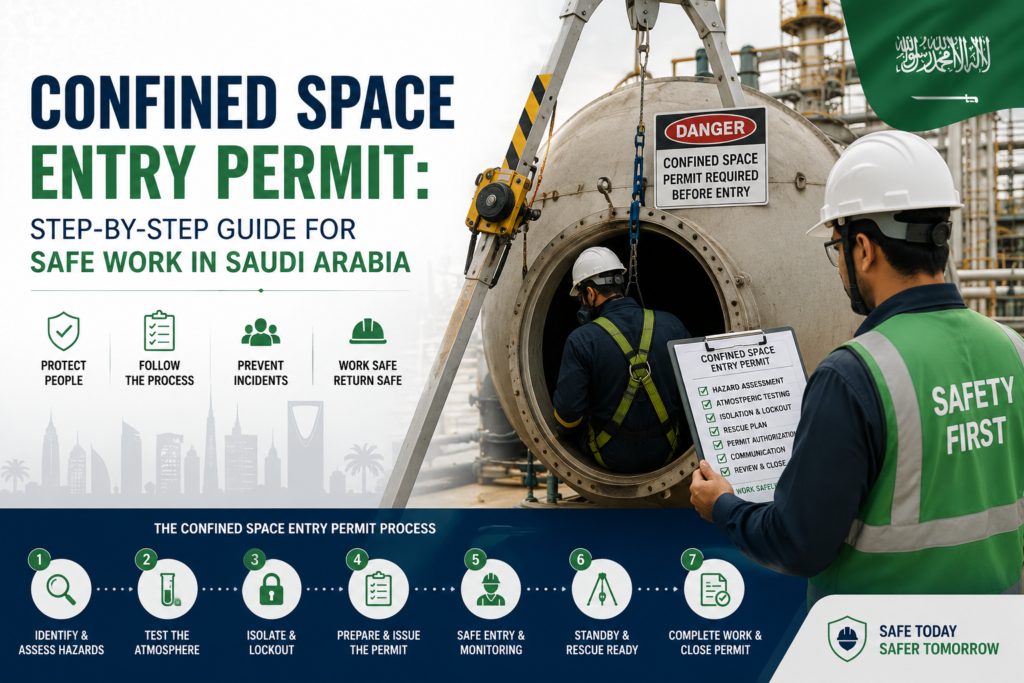
- 3 Step-by-Step Confined Space Entry Permit Procedure
- 4 What Are the Gas Testing Requirements for Confined Spaces?
- 5 What PPE and Equipment Are Required for Confined Space Entry?
- 6 How Do You Plan for Confined Space Rescue and Emergencies?
- 7 What Common Hazards Exist in Confined Spaces?
- 8 What Are the Most Common Mistakes to Avoid?
Working in confined spaces remains one of the most dangerous tasks in Saudi Arabia’s industrial sectors. Whether you’re managing operations at a refinery, overseeing construction projects, or conducting maintenance in the oil and gas industry, understanding the proper confined space entry permit procedure can mean the difference between a safe workday and a potential tragedy. This comprehensive guide walks you through every step of obtaining and executing a confined space work permit in compliance with international standards and Saudi Arabia’s safety regulations.
From gas testing protocols to emergency rescue planning, you’ll learn the practical, actionable steps that safety officers, HSE engineers, and industrial workers need to protect lives and maintain regulatory compliance. EUTC Global (Eastern United Training Center) has trained thousands of professionals across Saudi Arabia in these safety procedures. This guide reflects real-world best practices from the field.
TL;DR: Confined spaces account for approximately 60% of workplace fatalities in industrial settings (OSHA, 2023). A proper confined space entry permit process with thorough gas testing, designated attendants, and rescue planning is mandatory in Saudi Arabia’s oil and gas, construction, and refinery sectors to prevent atmospheric hazards and ensure worker safety.
What Is a Confined Space Entry Permit and Why Is It Required?
According to the Saudi Arabian General Organization for Social Insurance (GOSI), confined space incidents contribute to over 35% of serious workplace injuries in the Kingdom’s industrial sector (GOSI Annual Report, 2022). A confined space entry permit is a documented authorization system. It verifies all safety measures are in place before workers enter potentially hazardous enclosed areas. The permit serves as a formal checklist. It ensures atmospheric testing, hazard assessment, equipment preparation, and emergency procedures have been completed.
Saudi Arabia’s industrial operations follow OSHA (Occupational Safety and Health Administration) standards for confined space management. These standards define a permit-required confined space as any area that:
- Has limited means of entry or exit
- Isn’t designed for continuous human occupancy
- Contains or could contain hazardous atmospheres
- Has the potential for engulfment or entrapment
- Contains configuration hazards (inwardly converging walls, sloped floors)
Common confined spaces in Saudi Arabian industries include:
- Storage tanks and silos
- Sewers and underground vaults
- Pipeline segments
- Reactor vessels in refineries
- Boilers and pressure vessels
- Ship holds and ballast tanks
- Excavations deeper than 1.2 meters
- Concrete manholes and utility tunnels
The permit requirement exists because confined spaces present unique hazards. These hazards cannot be controlled by standard workplace safety measures alone. Atmospheric conditions can change rapidly. Oxygen levels can deplete without warning. Toxic gases can accumulate to lethal concentrations within minutes.
Eastern United Training Center emphasizes that the permit isn’t just paperwork. It’s a systematic approach to identifying hazards and implementing controls before anyone’s life is at risk. In Saudi Arabia’s oil and gas sector particularly, where complex refinery operations and petrochemical facilities create numerous confined space scenarios, the permit system has proven crucial for maintaining the Kingdom’s improving safety record.
Our insight: Many companies treat permits as administrative burdens rather than safety tools. The most successful Saudi Arabian industrial operations we’ve trained see the permit process as a dynamic risk assessment. It engages every team member in hazard awareness and prevention.
Who Is Responsible During Confined Space Entry?
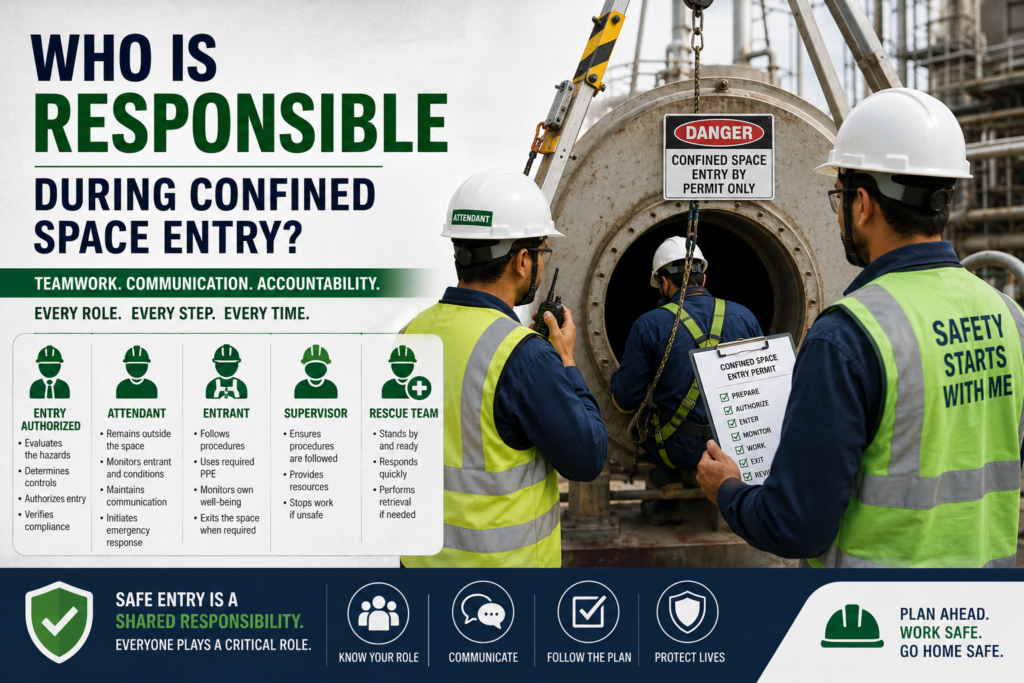
Research indicates that 53% of confined space fatalities involve would-be rescuers. These individuals enter without proper training or equipment (National Institute for Occupational Safety and Health, 2023). This sobering statistic shows why clearly defined roles and responsibilities are fundamental to confined space safety. Saudi Arabia’s industrial safety protocols require specific personnel assignments with documented competencies for each confined space entry operation.
Confined Space Entry Roles and Responsibilities:
| Role | Primary Responsibilities | Required Training |
|---|---|---|
| Entry Supervisor | Authorizes entry, verifies permit conditions, terminates entry if unsafe, coordinates rescue services | Confined space entry supervisor certification, emergency procedures |
| Authorized Entrant | Performs work inside the space, maintains communication, exits immediately when ordered or if hazard detected | Confined space entry training, specific task competencies, equipment use |
| Attendant | Maintains continuous count of entrants, monitors conditions, communicates with entrants, orders evacuation, initiates rescue | Confined space attendant certification, communication systems, rescue procedures |
| Rescue Team | Performs non-entry or entry rescue, provides emergency medical care, maintains rescue equipment | Technical rescue certification, medical first aid, equipment proficiency |
| Gas Tester | Conducts atmospheric testing, calibrates equipment, documents results, advises on ventilation needs | Gas detection equipment training, atmospheric hazard recognition, calibration procedures |
The entry supervisor holds ultimate authority and accountability for the operation. This individual must verify that all permit conditions are met. They must ensure the rescue team is available. They also must have the authority to halt operations immediately if conditions deteriorate. In Saudi Arabia’s regulatory environment, the entry supervisor must be present during entry operations or designate a qualified alternate.
Authorized entrants are the workers who actually enter the confined space. They must grasp the hazards specific to that space. They need to know how to use required PPE and equipment. They maintain constant communication with the attendant. They also recognize symptoms of exposure or distress in themselves and co-workers.
The confined space attendant serves as the entrant’s lifeline. This person never enters the space during operations. They maintain a continuous headcount of workers inside. The attendant monitors conditions both inside and outside the space, stays in communication with entrants, and initiates rescue procedures if needed. EUTC Global training programs stress that attendants must resist the urge to enter during emergencies. The appropriate response is to activate the rescue team.
Key requirements for personnel:
- All personnel must complete confined space training in Saudi Arabia
- Medical fitness evaluations confirming capability for respirator use
- Specific competency verification for assigned roles
- Annual refresher training on procedures and equipment
- Documentation of all certifications in company records
Eastern United Training Center provides role-specific confined space training aligned with Saudi Arabia’s industrial safety requirements and international best practices. The training emphasizes that everyone involved shares responsibility for safety. This includes spotting hazards, speaking up about concerns, and following procedures without shortcuts.
Step-by-Step Confined Space Entry Permit Procedure
Studies show that 90% of successful confined space rescues occur when proper procedures were followed from the start (International Safety Equipment Association, 2022). The confined space entry permit process creates a systematic framework that ensures nothing gets missed. Below is the detailed procedure used across Saudi Arabia’s major industrial facilities:
Step 1: Identify and Classify the Space
Before any permit is issued, conduct a thorough hazard assessment.
- Review engineering drawings and specifications.
- Identify previous contents and residues.
- Assess atmospheric hazards (oxygen deficiency, toxic gases, flammable vapors).
- Evaluate physical hazards (moving equipment, temperature extremes, engulfment materials).
- Determine if the space is permit-required or non-permit.
Document this classification in your facility’s confined space inventory. Saudi Arabia’s oil and gas sector typically maintains detailed databases of all confined spaces with their specific hazard profiles.
Step 2: Develop Entry Plan and Procedures
Create space-specific entry procedures that address:
- Isolation methods (lockout/tagout, line breaking, blanking)
- Ventilation requirements (forced air, natural, continuous monitoring)
- Atmospheric testing protocols (before entry, continuous, after breaks)
- PPE requirements based on hazards identified
- Emergency rescue procedures tailored to the space configuration
- Communication systems (visual, audio, electronic)
- Duration limits for entry personnel
EUTC Global recommends conducting a job hazard analysis for any non-routine entries to identify task-specific risks.
Step 3: Prepare the Space
Physical preparation must be completed before any testing or entry.
- Isolate all energy sources (electrical, mechanical, hydraulic).
- Drain, flush, or purge contents.
- Install blanks on connecting lines.
- Clean residues if necessary.
- Set up ventilation equipment.
- Establish barriers around the entry point.
- Post warning signs and restrict access.
Document each preparation step with verification signatures. Saudi Arabian refineries typically use photographic documentation as an additional verification layer.
Step 4: Conduct Atmospheric Testing
Gas testing is the essential step for safe entry. Testing must be performed by trained personnel using calibrated equipment.
Testing sequence:
- Oxygen level (must be 19.5% – 23.5%)
- Flammable gases (must be below 10% of Lower Explosive Limit)
- Toxic gases (carbon monoxide, hydrogen sulfide, etc.)
- Other contaminants specific to previous contents
Test at multiple levels within the space—top, middle, and bottom—because gases stratify based on density. Document all readings on the permit. Continue monitoring throughout the entry, especially after breaks or changes in work activity.
Step 5: Complete the Permit
The entry supervisor fills out the confined space work permit, which typically includes:
- Space identification and location
- Purpose and scope of work
- Date and authorized duration
- Atmospheric test results
- Hazards identified and controls implemented
- Required PPE and equipment
- Names and signatures of all personnel
- Emergency contact numbers
- Rescue equipment verification
Review the completed permit with all personnel before entry. This briefing ensures everyone understands hazards, procedures, and their responsibilities.
Step 6: Execute the Entry
With an approved permit:
- The attendant takes position at the entry point.
- Entrants don required PPE.
- Communication is tested and confirmed.
- The entry supervisor authorizes entry.
- Continuous monitoring begins.
- Work proceeds according to the plan.
Never exceed authorized personnel count. If anyone must leave, the attendant updates the headcount immediately.
Step 7: Monitor and Maintain Safe Conditions
Throughout the entry:
- Continuous or periodic atmospheric monitoring (based on hazard assessment)
- Constant communication between entrants and attendant
- Regular safety checks by the entry supervisor
- Immediate evacuation if conditions change
- Documentation of any issues or changes
Step 8: Close Out the Entry
When work is complete:
- Verify all personnel have exited.
- Account for all tools and equipment.
- Remove barriers and signage only after space is secured.
- Deactivate ventilation equipment.
- Complete permit closeout section.
- File permit for record retention (minimum 1 year in Saudi Arabia).
- Conduct post-entry debriefing to identify improvement opportunities.
Eastern United Training Center emphasizes that permit closeout is as important as preparation. It ensures accountability and provides valuable documentation for future entries.
Confined Space Entry Preparation Checklist:
| Preparation Item | Verified | Notes |
|---|---|---|
| Space identified and classified | ☐ | Permit-required: Yes/No |
| Hazard assessment completed | ☐ | Primary hazards: |
| Entry plan developed | ☐ | Reviewed by: |
| Isolation completed (LOTO) | ☐ | Lock numbers: |
| Atmospheric testing performed | ☐ | O₂: ___% LEL: ___% H₂S: ___ppm CO: ___ppm |
| Ventilation established | ☐ | Type: Forced/Natural |
| PPE assembled and inspected | ☐ | Respirators: ☐ Harness: ☐ |
| Communication system tested | ☐ | Type: |
| Rescue equipment ready | ☐ | Tripod: ☐ Retrieval: ☐ |
| Rescue team available | ☐ | Contact: |
| All personnel briefed | ☐ | Attendees: |
| Emergency contacts posted | ☐ | Fire: Medical: |
| Permit signed by supervisor | ☐ | Date/Time: |
Our insight: Companies that digitize their permit systems using mobile apps or tablets reduce permit processing time by 40% while improving documentation accuracy. However, paper backup systems remain essential in Saudi Arabia’s remote oil field locations where connectivity can be unreliable.
What Are the Gas Testing Requirements for Confined Spaces?
Atmospheric hazards cause 62% of confined space fatalities, making proper gas testing the single most important safety control (Bureau of Labor Statistics, 2023). In Saudi Arabia’s petrochemical and oil refining industries, where hydrocarbon gases and toxic compounds are routine, comprehensive gas testing protocols have prevented countless incidents.
Mandatory atmospheric testing parameters:
Oxygen (O₂):
- Acceptable range: 19.5% – 23.5%
- Below 19.5%: Oxygen deficient (suffocation risk)
- Above 23.5%: Oxygen enriched (fire/explosion risk)
- Test first, as other sensors may not function properly in oxygen-deficient atmospheres
Flammable gases (LEL/UEL):
- Must be below 10% of Lower Explosive Limit
- Common in Saudi refineries: methane, propane, butane, hexane, gasoline vapors
- Continuous monitoring required when flammable atmospheres possible
Toxic gases:
- Hydrogen sulfide (H₂S): Maximum 10 ppm (Saudi Arabia standard)
- Carbon monoxide (CO): Maximum 35 ppm time-weighted average
- Benzene: Maximum 0.5 ppm
- Other specific contaminants based on previous contents or surrounding processes
Testing equipment requirements:
Use only calibrated, properly maintained gas detection equipment. Multi-gas monitors are standard in Saudi Arabian industrial operations. They typically measure O₂, LEL, H₂S, and CO simultaneously. EUTC Global training center covers:
- Daily bump testing to verify sensor response
- Full calibration per manufacturer specifications (typically monthly)
- Battery maintenance and replacement
- Alarm functionality verification
- Proper sampling techniques
Testing procedures:
- Pre-entry testing: Test the atmosphere before anyone enters, sampling at multiple levels (top, middle, bottom) because gases stratify by weight.
- Initial verification: Allow ventilation equipment to run, then retest to verify acceptable conditions.
- Continuous monitoring: Use personal gas monitors worn by entrants, or continuous fixed monitoring systems.
- Periodic re-testing: If continuous monitoring isn’t used, retest at regular intervals (typically every 2-4 hours) and after any work break.
- Post-incident testing: Immediately retest if conditions change or work activities might alter the atmosphere.
Special considerations for Saudi Arabia’s climate:
Temperature extremes affect gas detector performance and atmospheric conditions:
- High ambient temperatures (40°C+) can cause sensor drift.
- Store equipment in climate-controlled areas.
- Allow instruments to acclimate before use.
- Adjust alarm setpoints for temperature compensation if required.
- Consider that heat accelerates vapor release from liquids and residues.
Eastern United Training Center stresses that gas testing isn’t a one-time checkbox. It’s continuous verification that conditions remain safe. The most dangerous assumption in confined space work is that “safe” conditions will stay that way.
What PPE and Equipment Are Required for Confined Space Entry?
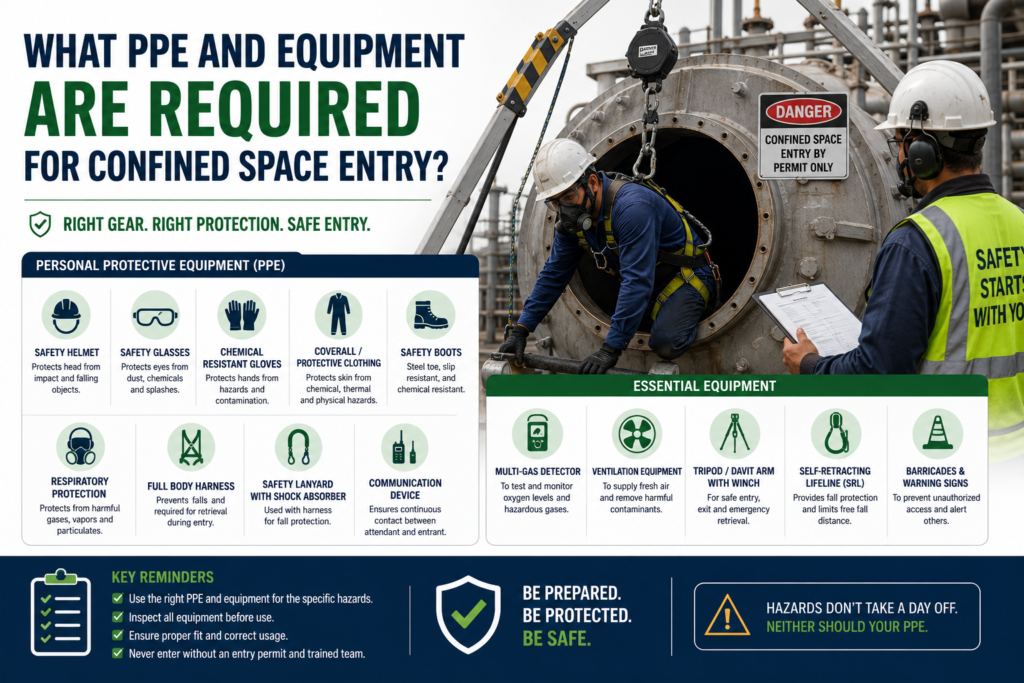
Personal protective equipment serves as the last line of defense when engineering controls and safe work practices can’t eliminate all hazards. Research shows that proper PPE use reduces injury severity by 70% in confined space incidents (Journal of Safety Research, 2023). Saudi Arabia’s industrial standards mandate specific equipment based on hazard assessment, not generic requirements.
Standard PPE for confined space entry:
Respiratory protection:
- Air-purifying respirators (APRs) for atmospheres with adequate oxygen (>19.5%) and known contaminants below immediately dangerous to life or health (IDLH) levels.
- Supplied-air respirators (SARs) for oxygen-deficient atmospheres or high contaminant levels.
- Self-contained breathing apparatus (SCBA) for IDLH atmospheres or emergency rescue.
- Respirators must be fitted, tested, and workers must be medically cleared to wear them.
Saudi Arabia’s oil and gas facilities typically default to supplied-air systems for permit-required confined spaces. These provide maximum protection and unlimited duration.
Fall protection:
- Full-body harness with D-ring between shoulder blades.
- Retrieval line attached to harness (never to wrists, belts, or ankles).
- Tripod and mechanical advantage retrieval system for vertical entries.
- Anchor points rated for 5,000 lbs minimum.
Head protection:
- Hard hats rated for electrical hazards if applicable.
- Chin straps to prevent loss during rescue operations.
- Compatible with respiratory equipment.
Eye and face protection:
- Safety glasses or goggles based on hazards.
- Face shields for chemical splash protection.
- Compatible with respirator facepiece.
Hand protection:
- Chemical-resistant gloves appropriate for substances present.
- Cut-resistant gloves for sharp edges.
- Ensure gloves don’t compromise grip on ladders or equipment.
Body protection:
- Coveralls for general protection.
- Chemical-resistant suits for corrosive or toxic substance exposure.
- Flame-resistant clothing for hot work or fire hazards.
Footwear:
- Safety boots with steel or composite toes.
- Slip-resistant soles.
- Chemical-resistant if needed.
- Electrical hazard rated if appropriate.
Essential equipment for confined space operations:
Ventilation equipment:
- Forced-air blowers rated for hazardous locations.
- Flexible ducting positioned to prevent recirculation.
- Capacity to provide 4-6 air changes per hour minimum.
- Explosion-proof motors if flammable atmosphere possible.
Atmospheric monitoring:
- Multi-gas detector for each entrant.
- Additional monitor for attendant.
- Calibration gas and equipment.
- Documentation logs.
Communication systems:
- Two-way radios (intrinsically safe if required).
- Wired communication systems.
- Visual signals if radio communication not possible.
- Backup communication method.
Lighting:
- Intrinsically safe or approved for classification.
- Hands-free headlamps preferred.
- Backup lighting source.
- External work lights positioned to illuminate entry.
Rescue equipment:
- Tripod or davit arm system (for vertical entries).
- Mechanical advantage retrieval device (3:1 minimum).
- Backup retrieval capability.
- First aid and resuscitation equipment at entry point.
Additional equipment based on work scope:
- Non-sparking tools for flammable atmospheres.
- Grounding and bonding equipment.
- Barriers and signage.
- Equipment lowering lines.
Our insight: Over-specification of PPE can create new hazards. In Saudi Arabia’s extreme heat, excessive PPE contributes to heat stress. EUTC Global helps companies conduct realistic hazard assessments that prescribe necessary protection without unnecessary burden. Workers are more likely to comply with reasonable PPE requirements.
OSHA estimates that 15% of confined space accidents involve equipment failure. This is often because equipment wasn’t inspected or maintained properly (OSHA Technical Manual, 2023). All confined space equipment requires regular inspection, testing, and documentation:
- Daily visual inspection before use.
- Functional testing per manufacturer requirements.
- Documented maintenance schedules.
- Removal from service if damaged or defective.
- Records retained for audit and compliance verification.
Eastern United Training Center’s confined space programs include hands-on equipment training. Knowing what PPE is required isn’t enough; workers must know how to properly use, inspect, and maintain it.
How Do You Plan for Confined Space Rescue and Emergencies?
The most tragic statistic in confined space safety is that 60% of fatalities are would-be rescuers. These individuals rushed in without proper training or equipment (National Safety Council, 2023). This devastating reality drives Saudi Arabia’s strict requirements for rescue planning and trained rescue teams. No confined space entry can begin without a fully developed, rehearsed rescue plan.
Rescue plan development:
Every confined space entry requires a specific rescue plan that considers:
Space configuration and access:
- Can non-entry rescue be performed? (This is always preferred.)
- What retrieval equipment is needed? (Tripod, winch, retrieval lines.)
- How long will rescue take? (Must be immediate for IDLH atmospheres.)
- Are there obstacles to rescue? (Narrow openings, bends, obstructions.)
- Can injured workers be lifted vertically?
Available rescue resources:
Option 1: On-site rescue team
- Designated employees trained in confined space rescue.
- Must practice rescues at least annually in spaces they might enter.
- Equipped with proper rescue and entry equipment.
- Advantages: Immediate response, familiar with facility.
- Challenges: Maintaining proficiency, equipment costs, staffing requirements.
Option 2: Off-site professional rescue
- Private rescue service or municipal fire department.
- Must have confined space rescue capability and equipment.
- Response time must be acceptable for identified hazards (typically 10-15 minutes maximum).
- Written agreement documenting availability and response time.
- Advantages: Professional expertise, maintained proficiency.
- Challenges: Response time, familiarity with facility.
Many Saudi Arabian refineries and large industrial facilities maintain both. They have on-site teams for immediate response and contracted professional backup for complex scenarios.
Rescue equipment and procedures:
Non-entry rescue (always the first choice):
- Full-body harness on every entrant with retrieval line attached.
- Mechanical advantage system (3:1 minimum) at entry point.
- Retrieval line kept taut during entry.
- Attendant capable of operating retrieval system.
- Clear pathway for extraction.
Non-entry rescue can be performed within seconds. It doesn’t put additional workers at risk. It’s mandatory whenever feasible based on space configuration.
Entry rescue (when non-entry isn’t possible):
- Requires two trained rescuers per victim minimum.
- All rescue team members must be equipped for entry.
- Atmospheric testing must confirm safe conditions.
- Entry supervisor must authorize rescue entry.
- Backup team on standby.
- Emergency medical services notified and standing by.
Emergency procedures:
Document and train all personnel on:
- Recognition of emergency: What conditions or observations trigger emergency response?
- Immediate actions: Entrants exit immediately, attendant initiates retrieval or calls rescue team, entry supervisor notified.
- Communication: Who to call, in what order (rescue team, emergency services, management).
- Non-entry rescue execution: Specific steps for retrieval operation.
- Entry rescue protocols: When authorized, equipment needed, air monitoring requirements.
- Medical care coordination: First aid, transport, hospital notification.
- Incident investigation: Preserve evidence, document timeline, identify causes.
Required emergency equipment at entry point:
- Fire extinguisher appropriate for hazards present.
- First aid kit and AED.
- Emergency contact list with phone numbers.
- Facility map showing entry location.
- Material Safety Data Sheets (MSDS) for substances present.
- Rescue equipment specific to the entry.
- Backup atmospheric monitoring equipment.
- Additional PPE for rescue team.
Emergency drills and training:
OSHA and Saudi Arabian regulations require:
- Annual rescue drills for on-site rescue teams.
- Drills must simulate actual rescue from spaces they may enter.
- Evaluation and documentation of drill performance.
- Correction of identified deficiencies.
- Refresher training based on drill outcomes.
EUTC Global provides specialized confined space rescue training that includes:
- Victim assessment techniques.
- Non-entry rescue system operation.
- Entry rescue procedures.
- Use of atmosphere monitoring during rescue.
- Packaging and extraction of injured workers.
- Post-rescue decontamination.
- Psychological preparedness for rescue operations.
Our insight: The most common rescue plan failure in Saudi Arabia isn’t equipment or training; it’s assuming that “someone will come” without confirming rescue capability and availability. Before any confined space entry, verify your rescue team is available, equipped, and ready. It’s not paranoia; it’s professional responsibility.
Post-emergency procedures:
After any emergency (including near-misses):
- Debrief all personnel involved.
- Conduct thorough incident investigation.
- Document findings and corrective actions.
- Update procedures if needed.
- Provide additional training if gaps identified.
- Notify regulatory authorities if required.
- Support affected workers and witnesses.
Eastern United Training Center emphasizes that rescue planning isn’t about expecting the worst. It’s about being prepared so workers have confidence that if something goes wrong, they’ll be brought home safely.
What Common Hazards Exist in Confined Spaces?
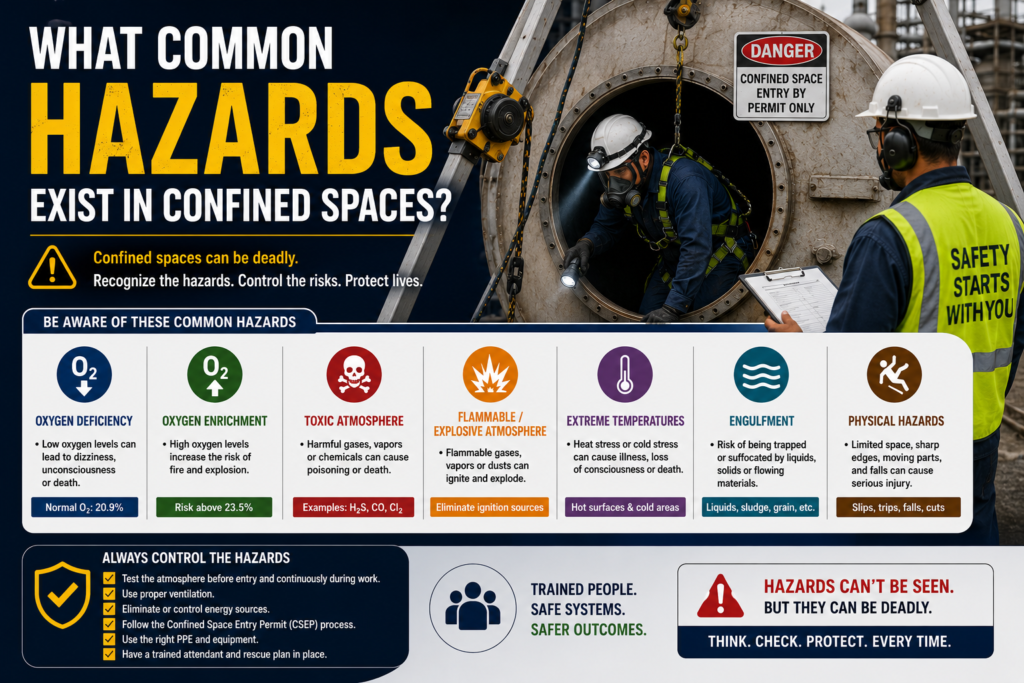
Understanding specific hazards is fundamental to effective control. Analysis of Saudi Arabian industrial incidents reveals that 85% of confined space accidents involve one of four primary hazard categories (Saudi Arabian Ministry of Labor, 2022). Recognition is the first step to prevention.
Atmospheric hazards (most common cause of fatalities):
Oxygen deficiency:
- Causes: Consumption by rusting metal, bacterial action, combustion, displacement by other gases.
- Effects: 19.5%-16%: impaired judgment, rapid breathing; 16%-12%: dizziness, rapid fatigue; below 12%: unconsciousness, death.
- Common locations: Tanks that held petroleum products, sewers, welded enclosures.
- Control: Continuous ventilation, atmospheric monitoring, supplied-air respirators.
Oxygen enrichment:
- Causes: Leaking oxygen systems, decomposition of peroxides.
- Effects: Greatly increases fire and explosion risk—materials that don’t normally burn will ignite.
- Control: Source elimination, ventilation, oxygen monitoring.
Flammable atmospheres:
- Causes: Residual product vapors, methane from decomposition, welding gases, solvent vapors.
- Effects: Fire or explosion when ignition source present.
- Common in Saudi Arabia: Refineries, petrochemical facilities, storage terminals, wastewater treatment.
- Control: Ventilation, inerting with nitrogen, elimination of ignition sources, continuous monitoring.
Toxic gases:
- Hydrogen sulfide (H₂S): “Sour gas” common in oil and gas operations, deadens sense of smell at dangerous concentrations, fatal above 100 ppm.
- Carbon monoxide (CO): Odorless, colorless, produced by combustion or decomposition.
- Benzene: Carcinogen present in petroleum products.
- Chlorine: From water treatment processes.
- Control: Ventilation, respiratory protection, atmospheric monitoring.
Physical hazards:
Configuration hazards:
- Inwardly sloping walls or funnels (engulfment risk).
- Internal obstructions limiting movement.
- Multiple levels creating fall hazards.
- Restricted entry/exit making rescue difficult.
Mechanical hazards:
- Rotating equipment (agitators, mixers, augers).
- Moving parts that could start unexpectedly.
- Stored energy in springs or pressurized lines.
- Control: Lockout/tagout, physical disconnection, blocking.
Temperature extremes:
- Hot environments: Heat stress, burns from surfaces or steam.
- Cold environments: Hypothermia, frostbite, brittleness of equipment.
- Particularly challenging in Saudi Arabia where ambient temperatures already stress cooling systems.
- Control: Ventilation, cooling suits, work-rest schedules, monitoring for heat stress symptoms.
Visibility hazards:
- Poor lighting creating trip and fall risks.
- Dust or vapor reducing visibility.
- Confined space disorientation.
- Control: Adequate lighting, frequent breaks, communication systems.
Engulfment hazards:
Liquid engulfment:
- Flooding from connected pipes or process upsets.
- Rising water in manholes or vaults.
- Control: Line breaking, blanking, continuous monitoring, escape routes.
Solid engulfment:
- Grain, sand, coal, or other flowable solids.
- Can occur rapidly with shifting or collapse.
- Suffocation within minutes.
- Control: Physical barriers, harness with retrieval, lockout of filling equipment.
Noise hazards:
- Equipment operation creating communication difficulties.
- Prevents workers from hearing warnings.
- Long-term hearing damage.
- Control: Hearing protection, communication systems that work in high noise.
Energy hazards:
- Electrical: Exposed conductors, water creating conduction paths, metal spaces conducting current.
- Chemical: Corrosive residues, reactive materials, incompatible substances mixing.
- Radiation: Non-destructive testing equipment, process gauges, contaminated spaces.
- Control: De-energization, testing, shielding, PPE.
Biological hazards:
- Sewage and wastewater: Bacteria, viruses, parasites.
- Animal intrusion: Snakes, rodents, insects (particularly relevant in Saudi Arabia).
- Mold and fungi: In damp or water-damaged spaces.
- Control: PPE, vaccination programs, pest control, thorough cleaning.
Hazard assessment process:
For each confined space, systematically evaluate:
- Previous contents and residues.
- Surrounding processes and potential leaks.
- Atmospheric conditions (testing required).
- Physical layout and access.
- Energy sources present.
- Environmental conditions (temperature, humidity).
- Work activities planned (introducing new hazards?).
- Duration and timing of entry.
Document all identified hazards and implement controls using the hierarchy:
- Elimination: Remove the hazard (clean residues, reclassify space if possible).
- Substitution: Replace hazardous materials with safer alternatives.
- Engineering controls: Ventilation, inerting, remote operation.
- Administrative controls: Procedures, training, time limits, permits.
- PPE: Last line of defense when other controls aren’t sufficient.
Eastern United Training Center’s hazard recognition training uses Saudi Arabian industry-specific scenarios. This helps workers identify hazards they’ll actually encounter. The training emphasizes that multiple hazards often coexist. Addressing one while ignoring others creates a false sense of security.
What Are the Most Common Mistakes to Avoid?
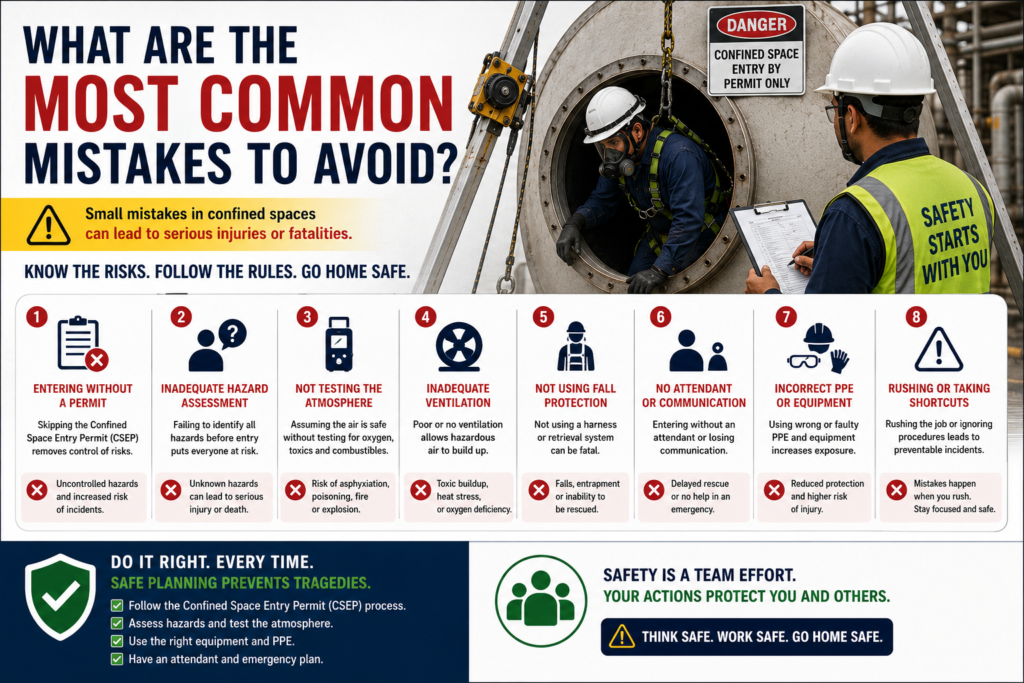
Even experienced professionals make errors that compromise confined space safety. Analysis of incidents in Saudi Arabia’s industrial sector reveals recurring patterns that are entirely preventable (Industrial Accidents Prevention Association, 2023). Knowing these common mistakes is better than discovering them the hard way.
Critical mistakes and how to avoid them:
1. Inadequate hazard assessment:
- Mistake: Assuming a space is safe because previous entries were uneventful.
- Reality: Atmospheric conditions change based on weather, surrounding processes, and recent activities.
- Solution: Treat every entry as unique. Conduct fresh testing, review recent maintenance or process changes.
2. Skipping atmospheric testing or testing improperly:
- Mistake: Single-point testing, testing only before entry, using uncalibrated equipment.
- Reality: Gases stratify by density. Conditions change during work. Faulty sensors give false readings.
- Solution: Test at multiple levels. Use continuous or periodic monitoring. Perform daily bump tests and regular calibration.
3. Inadequate ventilation:
- Mistake: Assuming natural ventilation is sufficient, pointing ventilation away from workers.
- Reality: Natural ventilation rarely provides adequate air changes. Positioning matters.
- Solution: Use forced-air ventilation. Position discharge near workers. Continue ventilation throughout entry.
4. Poor isolation of energy sources:
- Mistake: Relying on valves alone, not verifying zero energy, inadequate lockout.
- Reality: Valves leak. Unexpected energization kills workers.
- Solution: Proper lockout/tagout. Install physical blanks. Verify zero energy before entry.
5. Unauthorized entry:
- Mistake: “Quick look” without permit, experienced workers bypassing procedures.
- Reality: Most fatalities occur within minutes of entry.
- Solution: Enforce zero-tolerance policy. Use security measures at entry points. Require management accountability.
6. Inadequate rescue preparation:
- Mistake: No rescue plan, untrained “rescuers,” no retrieval equipment in place.
- Reality: 60% of confined space deaths are would-be rescuers.
- Solution: Have non-entry rescue capability for every entry. Use a trained rescue team. Practice procedures. Ensure equipment is in place before entry.
7. Communication failures:
- Mistake: No designated attendant, attendant leaves post, communication system failure.
- Reality: Entrants can become incapacitated within seconds.
- Solution: Have a dedicated attendant who never leaves. Use tested communication systems. Have a backup communication method.
8. Complacency from routine entries:
- Mistake: “We do this every day” mentality, taking shortcuts to save time.
- Reality: Routine creates complacency. Most accidents happen during “routine” entries.
- Solution: Consistent procedure adherence. Use fresh eyes on hazard assessment. Develop a near-miss reporting culture.
9. Inadequate training:
- Mistake: Assuming workers understand confined spaces, one-time training, no role-specific training.
- Reality: Confined space work is specialized. It needs comprehensive, role-specific, and recurring training.