


Contents
- 1 What Is Frame Scaffolding and When Should You Use It?
- 2 What Is System Scaffolding and Why Is It Gaining Popularity?
- 3 When Should Tube & Coupler Scaffolding Be Used?
- 4 Which Scaffolding Type Is Best for Industrial Projects?
- 5 What Training and Safety Requirements Apply to Different Scaffolding Types?
- 6 Frequently Asked Questions
- 6.1 What’s the most common scaffolding type used in Saudi Arabia?
- 6.2 How long does it take to learn scaffolding erection and dismantling?
- 6.3 Can you mix different scaffolding types on the same project?
- 6.4 What’s the weight capacity difference between scaffolding types?
- 6.5 How often should scaffolding be inspected?
- 7 Conclusion
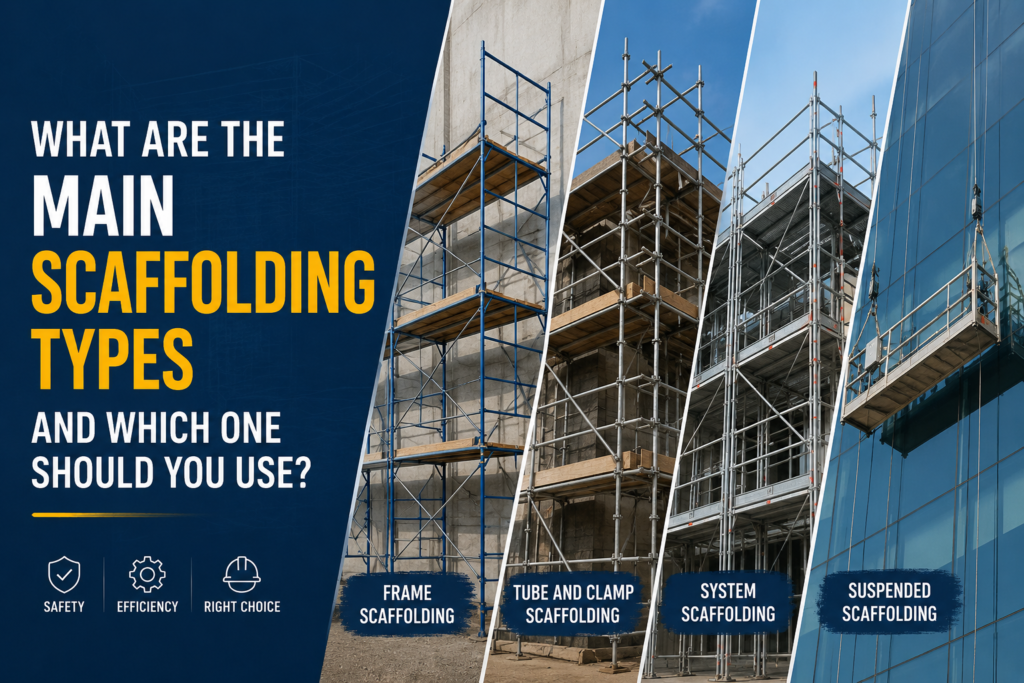
Choosing the right scaffolding type can make or break your construction project. Whether you’re working on a residential building in Riyadh or an industrial facility in Jubail, understanding frame scaffolding, system scaffolding, and tube & coupler scaffolding is essential for safety, efficiency, and cost management.
Each scaffolding system has unique characteristics that make it suitable for specific applications. Frame scaffolding offers quick assembly, system scaffolding provides versatility, and tube & coupler scaffolding delivers maximum adaptability for complex structures. This guide explains everything you need to know about these three primary scaffolding types, their applications in Saudi Arabian construction projects, and the training requirements that keep workers safe.
TL;DR: The global scaffolding market reached USD 53,548.5 million in 2024, with supported scaffolding capturing 65.8% of market share (Market Data Forecast, 2025). Frame scaffolding suits straightforward projects, system scaffolding excels in versatility, and tube & coupler offers unmatched flexibility for complex industrial work.

What Is Frame Scaffolding and When Should You Use It?
The construction industry held 65.7% of the scaffolding market share in 2024 (Market Data Forecast, 2024), with frame scaffolding being one of the most popular choices for standard building projects. Frame scaffolding consists of pre-manufactured frames that connect together using cross braces and coupling pins, creating a rigid structure that’s quick to assemble and dismantle.
This scaffolding type uses welded frames as its main vertical support, typically measuring 5 or 7 feet tall. Workers connect these frames horizontally with cross braces, then add platforms for working surfaces. The straightforward design makes it suitable for projects prioritizing speed.
Key Components of Frame Scaffolding:
- End frames (vertical support structures)
- Cross braces (diagonal supports connecting frames)
- Coupling pins (connect frames vertically)
- Base plates and adjustable legs
- Platform boards or decks
- Guardrails and toe boards
Advantages of Frame Scaffolding:
- Fast assembly: Pre-manufactured components snap together quickly.
- Cost-effective: Lower equipment and labor costs compared to other types.
- Standardized: Easy to inspect and maintain.
- Stable: Rigid frame design provides excellent stability.
- Minimal training: Simpler assembly process requires less specialized training.
- Widely available: Common rental inventory in Saudi Arabia.
Disadvantages of Frame Scaffolding:
- Limited flexibility: Fixed frame dimensions restrict configuration options.
- Not suitable for curves: Works best on flat, straight surfaces.
- Height restrictions: Generally limited to medium-height projects.
- Harder to modify: Adjustments require complete disassembly of sections.
Common Applications in Saudi Arabia:
Frame scaffolding works best for residential construction, warehouse projects, and commercial buildings with straightforward designs. You’ll see it used extensively in housing developments across Jeddah, Dammam, and Riyadh where repetitive structures require efficient scaffolding solutions.
EUTC Global emphasizes proper frame scaffolding training as the foundation for scaffolding workers. Even though it’s the simplest type, proper scaffolding erection and dismantling training ensures workers understand load capacities, bracing requirements, and safety protocols.
Our insight: Many contractors in Saudi Arabia choose frame scaffolding for projects with tight deadlines because it can be erected up to 40% faster than tube and coupler systems. This speed advantage, however, only applies when working with experienced teams who understand proper assembly sequences.
What Is System Scaffolding and Why Is It Gaining Popularity?
System scaffolding (also called modular scaffolding) has become increasingly popular as construction projects demand more adaptability. Steel materials dominate the scaffolding market with a 53.5% share (Market Data Forecast, 2024), and system scaffolding utilizes steel’s strength and durability through its innovative connection system.
Unlike frame scaffolding’s simple pin connections, system scaffolding uses a rosette or node point system where multiple components connect at predetermined intervals. This design allows for three-dimensional configuration while maintaining structural integrity.
Types of System Scaffolding:
- Ringlock/Rosette System: Circular nodes with multiple connection points.
- Cuplock System: Cup-shaped nodes with wedge connectors.
- Kwikstage System: Snap-on ledgers with V-press connections.
- Layher System: Layher Allround with rosette connections.
Key Features:
- Vertical standards with connection points every 50cm.
- Horizontal ledgers that lock into standards.
- Diagonal braces for stability.
- Platform options including steel, aluminum, and plywood.
- Integrated stair towers and access solutions.
Advantages of System Scaffolding:
- Versatile configuration: Adapts to irregular shapes and structures.
- Quick assembly: No loose fittings or bolts required.
- Load capacity: Higher load ratings than frame scaffolding.
- Height capability: Suitable for high-rise construction.
- Professional appearance: Clean, uniform look.
- Safety features: Built-in guardrails and toe boards.
- Quality control: Precision-manufactured components ensure consistency.
Disadvantages of System Scaffolding:
- Higher initial cost: More expensive equipment investment.
- Training requirement: Requires specific training for each system type.
- Weight: Heavier components can slow manual handling.
- System-specific: Components from different manufacturers don’t mix.
Common Applications:
System scaffolding excels in commercial construction, high-rise buildings, industrial facilities, and infrastructure projects. In Saudi Arabia’s Vision 2030 mega-projects, system scaffolding provides the flexibility needed for architectural complexity while meeting strict safety standards.
Refineries, petrochemical plants, and power generation facilities in the Eastern Province rely heavily on system scaffolding. This is because it accommodates pipe racks, equipment platforms, and complex industrial structures. The modular nature allows contractors to reconfigure the same equipment for different project phases.
Eastern United Training Center offers specialized training programs that cover multiple system scaffolding types, preparing workers for the diverse requirements of Saudi Arabia’s construction and industrial sectors. Proper scaffolding supervisor training becomes especially important with system scaffolding due to the complex planning and load calculations involved.

When Should Tube & Coupler Scaffolding Be Used?
Supported scaffolding includes frame scaffolding, tube & clamp scaffolding, and other subtypes (Intel Market Research, 2024), with tube & coupler representing the most adaptable option available. This traditional scaffolding type uses individual steel tubes connected with various coupler fittings, allowing broad configuration possibilities.
Tube & coupler scaffolding consists of separate tubes (standards, ledgers, and transoms) that connect using different types of couplers: right-angle, swivel, putlog, and sleeve couplers. This component-based approach gives scaffolders complete freedom to create any shape or configuration needed.
Essential Components:
- Standards: Vertical tubes forming the main support.
- Ledgers: Horizontal tubes running parallel to the structure.
- Transoms: Horizontal tubes perpendicular to ledgers.
- Braces: Diagonal tubes providing stability.
- Base plates: Distribute load at ground level.
- Couplers: Various types for different connections.
Types of Couplers:
- Right-angle couplers: Connect tubes at 90 degrees.
- Swivel couplers: Connect tubes at any angle.
- Putlog couplers: Attach transoms to ledgers.
- Sleeve couplers: Join tubes end-to-end.
- Girder couplers: Attach scaffolding to structural beams.
Advantages of Tube & Coupler Scaffolding:
- Maximum flexibility: Any shape or configuration possible.
- Precise fitting: Adjusts to irregular structures perfectly.
- Repair-friendly: Replace individual damaged components.
- Cost-effective materials: Basic tubes and fittings are affordable.
- Universal application: Suitable for any project type.
- Easy storage: Components nest together efficiently.
- Adaptable: Modify structures without complete dismantling.
Disadvantages of Tube & Coupler Scaffolding:
- Slower assembly: More time-consuming than other types.
- Skill intensive: Requires highly trained scaffolders.
- Quality dependent: Relies heavily on worker expertise.
- Inspection challenges: Each connection must be checked.
- Labor intensive: More man-hours needed for erection and dismantling.
- Consistency issues: Different teams may build differently.
Ideal Applications:
Tube & coupler scaffolding excels in situations where other systems can’t adapt. Restoration projects on historic buildings in Jeddah’s Al-Balad district, complex industrial maintenance in ARAMCO facilities, and specialized access for curved architectural features all benefit from this flexible system.
Oil and gas facilities throughout Saudi Arabia rely on tube & coupler scaffolding for turnarounds and maintenance projects. This is because it molds around vessels, reactors, and piping systems with precision. The system adapts to existing structures without requiring modifications to the permanent facility.
Safety Considerations:
The flexibility of tube & coupler scaffolding comes with serious safety responsibilities. Every coupler must be properly tightened, typically requiring 50-55 Newton meters of torque. Loose couplers represent one of the most common scaffolding hazards.
EUTC Global Eastern United Training Center emphasizes comprehensive training programs that teach proper coupler installation, torque requirements, and inspection procedures. The training center’s hands-on approach ensures workers can build safe, stable structures even in challenging conditions.
Our insight: While tube & coupler scaffolding takes longer to erect, it often proves more economical for complex industrial projects because it eliminates the need for specialized components or custom modifications that system scaffolding would require. The key is having properly trained workers who understand structural principles.
Which Scaffolding Type Is Best for Industrial Projects?
The global construction scaffolding market reached USD 11.55 billion in 2024 (Intel Market Research, 2024), with industrial projects representing a significant portion of this demand. Choosing the appropriate scaffolding type for industrial applications depends on several factors specific to refineries, petrochemical plants, power generation facilities, and manufacturing operations.
Evaluation Criteria for Industrial Scaffolding:
1. Project Duration:
- Short-term maintenance: Frame scaffolding for quick turnarounds.
- Extended shutdowns: System scaffolding for stability and efficiency.
- Long-term access: Tube & coupler for adaptability.
2. Structural Complexity:
- Straight runs and flat surfaces: Frame scaffolding.
- Moderate complexity with standard configurations: System scaffolding.
- Complex curves, angles, and irregular shapes: Tube & coupler.
3. Load Requirements:
- Light duty (75 lbs/sq ft): All types suitable.
- Medium duty (50 lbs/sq ft): System or tube & coupler preferred.
- Heavy duty (75+ lbs/sq ft): System scaffolding or reinforced tube & coupler.
4. Height Requirements:
- Low level (under 20 feet): Frame scaffolding adequate.
- Medium height (20-60 feet): System scaffolding recommended.
- High level (60+ feet): System scaffolding with proper engineering.
5. Environmental Factors:
- High temperatures: Steel system scaffolding.
- Corrosive atmospheres: Aluminum system scaffolding or galvanized tube & coupler.
- Hazardous areas: System scaffolding with integrated safety features.
Industrial Applications by Type:
| Scaffolding Type | Best Industrial Use | Why It Works |
|---|---|---|
| Frame Scaffolding | Tank farms, warehouse maintenance | Fast setup, adequate for straight runs |
| System Scaffolding | Refinery units, power plants | High load capacity, excellent height capability, built-in safety features |
| Tube & Coupler Scaffolding | Reactor maintenance, vessel work | Precise fit, highly adaptable to complex equipment geometry |
Saudi Arabian Industrial Context:
Industrial facilities in Jubail Industrial City, Yanbu Industrial City, and the refineries of the Eastern Province each present unique scaffolding challenges. High temperatures, corrosive environments, and stringent safety regulations make scaffolding selection particularly important.
ARAMCO projects typically specify system scaffolding for major turnarounds because it meets international safety standards while providing the strength needed for heavy industrial work. SABIC facilities often use a combination approach: system scaffolding for primary structures and tube & coupler for specialized access.
Training Requirements:
Industrial scaffolding demands higher skill levels than commercial construction. Workers must understand:
- Process safety management principles.
- Permit-to-work systems.
- Hot work precautions.
- Confined space awareness.
- Emergency response procedures.
- Load calculations and engineering principles.
EUTC Global designs its scaffolding programs specifically for Saudi Arabia’s industrial environment. It incorporates local regulations, industry best practices, and practical experience from actual industrial projects. The training center maintains strong connections with major industrial operators, ensuring training content reflects current industry requirements.
What Training and Safety Requirements Apply to Different Scaffolding Types?
Suspended scaffolding emerges as the fastest-growing category in the scaffolding market (Cognitive Market Research, 2024), but regardless of scaffolding type, proper training remains essential. Saudi Arabian labor laws and international standards require specific competencies for anyone working on or around scaffolding structures.
Fundamental Training Requirements:
Level 1: Basic Scaffolding User
- Recognizes safe vs. unsafe scaffolding.
- Understands load limits.
- Reports defects and hazards.
- Uses access points correctly.
- Follows site-specific safety rules.
Level 2: Scaffolding Erector
- Assembles and dismantles scaffolding safely.
- Selects appropriate components.
- Checks connections and stability.
- Installs fall protection systems.
- Conducts pre-use inspections.
- Understands specific system requirements.
Level 3: Scaffolding Supervisor
- Plans scaffolding layouts.
- Performs engineering calculations.
- Supervises erection and dismantling.
- Conducts thorough inspections.
- Manages scaffold handover documentation.
- Ensures compliance with regulations.
Type-Specific Training Needs:
Frame Scaffolding:
- Basic coupling pin installation.
- Bracing patterns and requirements.
- Platform installation and securing.
- Guardrail requirements.
- Inspection points specific to frame systems.
System Scaffolding:
- Manufacturer-specific connection methods.
- Node point loading limitations.
- System-specific components and accessories.
- Advanced bracing configurations.
- Height and span limitations.
Tube & Coupler:
- Coupler types and applications.
- Proper torque requirements.
- Structural principles and load paths.
- Independent vs. putlog configurations.
- Advanced geometry and calculations.
Saudi Arabian Regulatory Context:
Construction sites in Saudi Arabia must comply with:
- Ministry of Human Resources and Social Development regulations.
- Saudi Building Code requirements.
- ARAMCO specifications (for oil and gas projects).
- SABIC requirements (for petrochemical facilities).
- International standards (BS EN 12811, OSHA equivalents).
Essential Safety Requirements Across All Types:
- Inspection schedules: Daily pre-use checks, weekly formal inspections, post-incident inspections.
- Tag systems: Green (safe), yellow (caution), red (do not use).
- Load limits: Clearly posted and enforced.
- Fall protection: Guardrails, mid-rails, toe boards at all working levels.
- Access: Proper ladders, stairs, or access towers—no climbing standards.
- Foundation: Adequate base plates, sole boards, and ground preparation.
- Bracing: Sufficient ties to structure, internal bracing as required.
- Weather: Wind speed limitations, rain precautions, extreme temperature considerations.
Common Safety Violations:
Understanding what goes wrong helps prevent accidents. The most frequent violations include:
- Missing guardrails or incomplete fall protection.
- Overloading platforms beyond rated capacity.
- Using damaged or modified components.
- Inadequate foundation or base support.
- Insufficient ties to structure.
- Improper access methods (climbing uprights).
- Working during high winds or storms.
- Poor housekeeping on platforms.
The Role of Competent Persons:
Every scaffolding project requires a competent person—someone with training, knowledge, and authority to identify hazards and correct them. For frame scaffolding, this might be a trained lead scaffolder. For complex system or tube & coupler structures, a qualified scaffolding supervisor or engineer is necessary.
Eastern United Training Center provides comprehensive certification programs that create competent persons across all scaffolding types. The training center’s programs align with international standards while addressing specific requirements of Saudi Arabian projects. Graduates receive certifications recognized by major contractors and operators throughout the Kingdom.
Practical Training Approach:
Effective scaffolding training combines:
- Classroom theory: Load principles, regulations, hazard recognition.
- Hands-on practice: Actual erection and dismantling under supervision.
- Assessment: Written tests and practical demonstrations.
- Site-specific training: Company or project-specific procedures.
- Refresher training: Regular updates as skills and regulations evolve.
The training center maintains practice scaffolding systems for all three major types, allowing students to gain real experience before working on actual construction sites. This practical approach builds confidence and competence simultaneously.
Documentation Requirements:
Proper scaffolding documentation protects workers and organizations:
- Scaffold design drawings for complex structures.
- Inspection reports with dates and inspector signatures.
- Training certificates for all workers.
- Handover certificates between erectors and users.
- Modification records.
- Incident reports.
Frequently Asked Questions
What’s the most common scaffolding type used in Saudi Arabia?
Frame scaffolding dominates residential and small commercial construction in Saudi Arabia due to its cost-effectiveness and simplicity. However, system scaffolding is increasingly preferred for larger projects and industrial facilities. According to market data, supported scaffolding (which includes frame and tube & coupler types) captured 65.8% of the global market share in 2025 (Market Data Forecast, 2025), reflecting its widespread use.
How long does it take to learn scaffolding erection and dismantling?
Basic scaffolding training typically takes 3-5 days for frame scaffolding, 5-7 days for system scaffolding, and 7-10 days for tube & coupler scaffolding. EUTC Global Eastern United Training Center offers comprehensive programs that include classroom instruction and hands-on practice. However, becoming truly proficient requires several months of supervised site experience. Scaffolding supervisor training requires additional time and prerequisites.
Can you mix different scaffolding types on the same project?
Mixing scaffolding types is generally not recommended and often violates safety standards. Each system has specific load ratings, connection methods, and structural requirements that don’t integrate safely. However, you can use different systems in separate areas of the same project—for example, frame scaffolding for building facades and tube & coupler for complex industrial equipment access. Always consult with a qualified scaffolding engineer before combining systems.
What’s the weight capacity difference between scaffolding types?
All scaffolding types can achieve similar load capacities when properly designed and erected, but system scaffolding generally offers higher ratings with less material. Light-duty scaffolding supports 25 lbs per square foot, medium-duty supports 50 lbs per square foot, and heavy-duty supports 75+ lbs per square foot. Steel materials dominate the scaffolding market with 53.5% share (Market Data Forecast, 2024), providing the strength needed for demanding applications regardless of system type.
How often should scaffolding be inspected?
Saudi Arabian regulations require scaffolding inspections before first use, after any modification, following adverse weather events, and at least every seven days during continuous use. Daily visual checks by users are also mandatory. Industrial projects may require more frequent inspections. EUTC Global Eastern United Training Center teaches proper inspection procedures as part of its comprehensive scaffolding safety programs, ensuring workers can identify hazards before they cause accidents.
Conclusion
Selecting the right scaffolding type directly impacts project success, worker safety, and cost efficiency. Frame scaffolding delivers speed and simplicity for straightforward projects, system scaffolding provides versatility and strength for complex construction, and tube & coupler scaffolding offers unmatched flexibility for specialized industrial applications.
Understanding these differences helps construction professionals, contractors, and safety officers make informed decisions that align with project requirements, budget constraints, and safety priorities. In Saudi Arabia’s dynamic construction environment—with its mega-projects, industrial facilities, and regulatory standards—proper scaffolding selection and training are essential foundations for success.
Key Takeaways:
- Frame scaffolding: Best for residential and simple commercial projects requiring fast assembly.
- System scaffolding: Ideal for high-rise construction and industrial facilities needing versatility.
- Tube & coupler: Perfect for complex industrial maintenance and irregular structures.
- Training matters: Proper certification prevents accidents and improves efficiency regardless of system type.
- Industry growth: The global scaffolding market reached USD 53,548.5 million in 2024, reflecting construction industry expansion.
- Material choice: Steel dominates with 53.5% market share for its strength and durability.
- Safety first: Regular inspections, proper training, and competent supervision are essential.
Eastern United Training Center stands ready to provide the comprehensive scaffolding training that Saudi Arabia’s construction and industrial sectors demand. From basic scaffolding erection and dismantling to advancedscaffolding supervisor certification, the training center equips workers with the knowledge and skills to build safely, efficiently, and professionally across all scaffolding types.
Whether you’re planning your next project or developing your workforce, understanding scaffolding types and investing in proper training creates the foundation for construction excellence.