


Contents
- 1 What is ISO 9001 and what does it cover?
- 2 What is ISO 14001 and who needs it?
- 3 What is ISO 45001 and why is it important?
- 4 Which ISO certification should a business in Saudi Arabia get first?
- 5 Can you implement ISO 9001, 14001, and 45001 together?
- 6 What are Aramco or major client requirements in KSA?
- 7 ISO Certification Comparison: What you need to know
- 8 Step-by-step decision guide for choosing your ISO certification
- 9 Frequently Asked Questions
- 10 Key takeaways
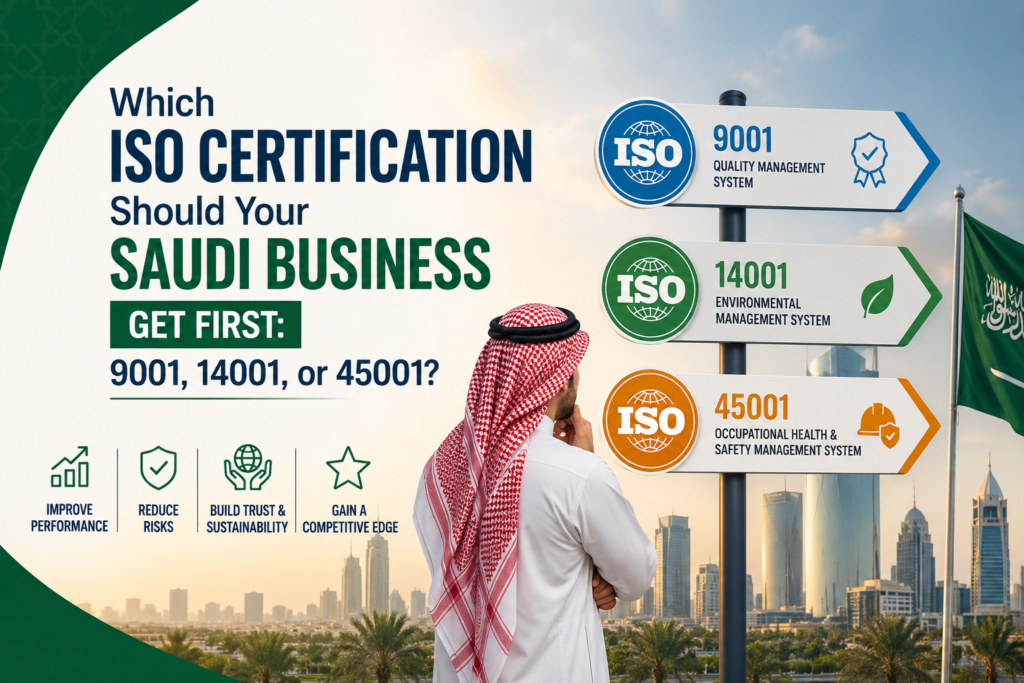
If you’re a business owner in Saudi Arabia trying to figure out which ISO certification to pursue first, you’re not alone. Many SMEs, startups, and contractors encounter this exact question when developing compliance and certification strategies. The choice among ISO 9001, ISO 14001, and ISO 45001 isn’t merely about accreditation; it influences your costs, client relationships, and competitive position in the Saudi market.
Most Saudi businesses should prioritize ISO 9001. It establishes fundamental quality management systems essential for any organization, regardless of its industry. Approximately 70-80% of Saudi organizations that hold multiple certifications still opt for ISO 9001 first due to its foundational significance in quality and customer management.
This article will outline what each ISO standard entails, which one aligns best with your situation, and how Aramco and major Saudi contractors view these certifications. You’ll gain practical decision-making frameworks, realistic cost and timeline estimates for KSA businesses, and guidance on whether to integrate multiple standards from the outset.
TL;DR: ISO 9001 is the best first choice for most Saudi businesses because it builds foundational quality systems, opens more contract opportunities, and costs 15-25% less than starting with ISO 14001 or ISO 45001. Worldwide, ISO 9001 holds 1,340,349 active certificates, making it the most widely recognized management standard globally. (ISO Survey 2024, 2024)
What is ISO 9001 and what does it cover?
ISO 9001 is a quality management system (QMS) standard. It helps businesses deliver consistent products and services, meeting customer expectations. As of 2024, there were 1,340,349 active ISO 9001 certificates worldwide, making it the most widely held management system standard. (ISO Survey 2024, 2024)
This standard outlines approaches to managing processes, documents, and customer relationships. It focuses on:
- Process management: Controlling every step from order to delivery.
- Customer focus: Understanding and meeting customer requirements.
- Continuous improvement: Measuring performance and resolving issues.
- Leadership commitment: Top management’s role in quality objectives.
- Risk-based thinking: Identifying and addressing potential issues proactively.
ISO 9001 doesn’t dictate your specific processes. Instead, it requires you to define and document them, follow them consistently, and improve them over time. This adaptability makes it suitable for virtually any industry.
In Saudi Arabia, ISO 9001 certification signals to clients that your business has reliable systems. For manufacturing companies in Dammam, this could mean controlled production processes. For service providers in Riyadh, it demonstrates consistent service delivery. For construction firms bidding on government projects, it is often a minimum qualification.
The standard does not mandate particular quality levels for your products. A luxury car manufacturer and a budget furniture maker can both be ISO 9001 certified. The key is that each company consistently delivers what it promises to its customers.
Between 2022 and 2024, the number of ISO-certified sites in Saudi Arabia for quality, environmental, and OH&S management systems rose by an estimated 65%. This growth was driven by localization and industrial diversification policies. (RisksControl “ISO Consulting in Saudi Arabia 2026”, 2026)
What is ISO 14001 and who needs it?
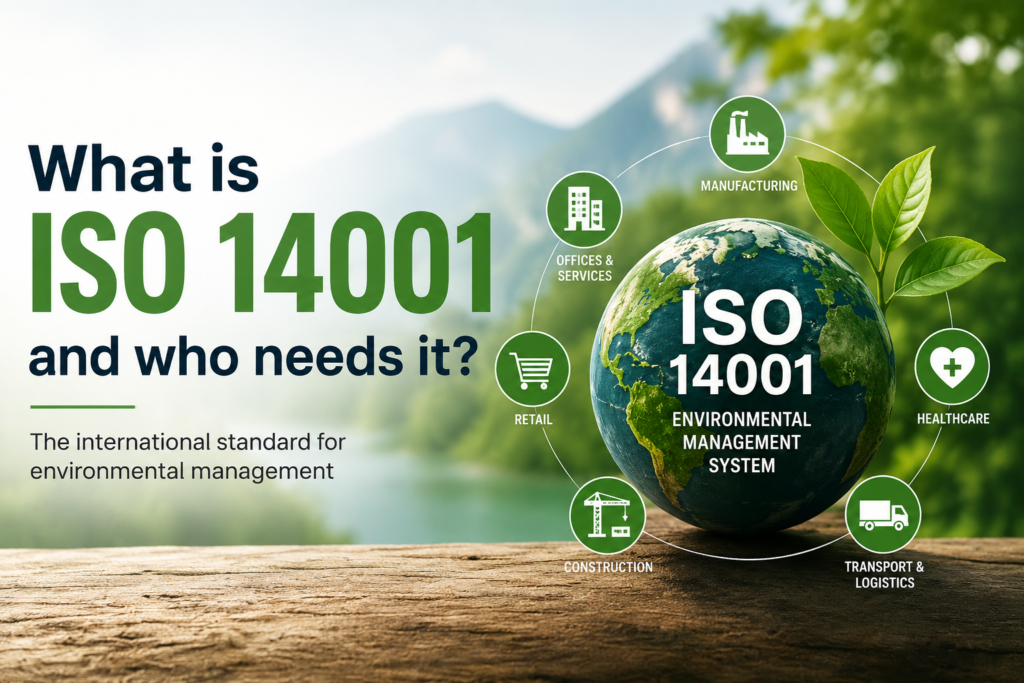
ISO 14001 provides a framework for environmental management systems (EMS). It helps businesses minimize their environmental impact and conform to regulations. The number of ISO 14001 certificates globally increased by 124% from the previous year in the 2024 ISO Survey. This shows rapid growth in environmental management adoption. (SimpleQue “A Look at the 2024 ISO Survey…”, 2024)
This standard is particularly important for businesses whose operations have significant environmental footprints. It addresses:
- Environmental aspects: Identifying how your activities affect air, water, soil, and resources.
- Legal compliance: Tracking and meeting environmental regulations.
- Pollution prevention: Systems to minimize waste, emissions, and resource consumption.
- Environmental objectives: Setting measurable targets for improvement.
- Emergency preparedness: Plans for potential environmental incidents.
Which Saudi businesses benefit most from ISO 14001? Companies in these situations:
Heavy industrial operations: Oil and gas facilities, chemical plants, and refineries, where environmental incidents have serious consequences.
Resource-intensive manufacturing: Factories using significant water, energy, or raw materials that aim to reduce costs through efficiency.
Construction and infrastructure: Large projects where dust, waste management, and site rehabilitation are important considerations.
Export-focused businesses: Companies selling to European or North American markets where clients expect environmental credentials.
Aramco supply chain participants: Vendors working on projects with high environmental exposure, where ISO 14001 is listed as “preferred.”
In 2024, roughly 15-20% of new Saudi ISO certificates were integrated systems combining ISO 9001 and ISO 14001. About 8-12% also included ISO 45001, indicating growing adoption of integrated management systems. (KBS Certification “Certification Priority Guide 2026”, 2026)
For a small trading company with minimal environmental impact, ISO 14001 is likely not a priority. However, for a metal fabrication shop in Jubail or a logistics company managing fuel-intensive operations, it demonstrates environmental responsibility and can open specific contract opportunities.
Our insight: Many Saudi businesses pursue ISO 14001 only after securing a contract that specifically requires it, rather than proactively. This reactive approach can delay project starts by 4-6 months. Companies in environmentally sensitive industries should consider ISO 14001 earlier in their certification journey.
What is ISO 45001 and why is it important?
ISO 45001 establishes occupational health and safety (OH&S) management systems that protect workers from job-related injuries, illnesses, and fatalities. The number of ISO 45001 certificates worldwide surged by 205% from the previous year in the 2024 ISO Survey. This reflects an accelerating focus on occupational health and safety. (SimpleQue “A Look at the 2024 ISO Survey…”, 2024)
This standard superseded the older OHSAS 18001. It represents the international consensus on workplace safety management. It covers:
- Hazard identification: Systematic methods to spot potential dangers before accidents occur.
- Risk assessment: Evaluating and prioritizing safety risks across operations.
- Worker participation: Involving employees in safety decisions and reporting.
- Legal compliance: Meeting Saudi labor law and safety regulations.
- Incident investigation: Learning from near-misses and accidents to prevent recurrence.
ISO 45001 is especially important for high-risk industries common in Saudi Arabia:
Construction and contracting: Where falls, equipment accidents, and heat stress present daily hazards.
Oil and gas operations: Facilities where process safety failures can cause catastrophic incidents.
Manufacturing and fabrication: Workshops with heavy machinery, welding, and material handling risks.
Logistics and transport: Companies managing fleets and warehouse operations.
Facilities management: Organizations responsible for building maintenance and technical services.
For these businesses, ISO 45001 is more than just compliance. It safeguards your most valuable asset (your people), reduces insurance costs, prevents project delays due to incidents, and meets increasingly rigorous client expectations.
In 2026, Aramco-related vendor prequalification checklists will require ISO 9001 for quality supply chains. They will increasingly refer to ISO 14001 and ISO 45001 as “preferred” for projects with high environmental or safety exposure. (RisksControl “ISO Consulting in Saudi Arabia 2026”, 2026)
The Saudi Arabian government has strengthened workplace safety enforcement in recent years. This makes ISO 45001 certification a practical way to demonstrate compliance. Many construction and industrial service companies find that certified OH&S systems reduce incident rates by 30-50% within the first year.
Which ISO certification should a business in Saudi Arabia get first?
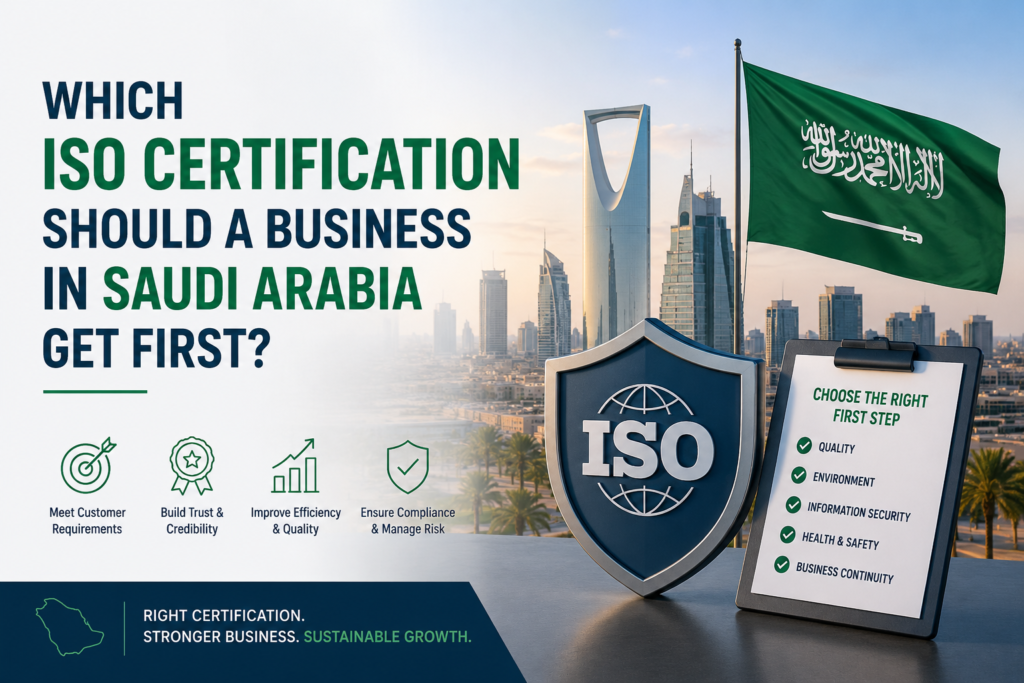
For most Saudi businesses, ISO 9001 should be their first certification. Guidance for 2026 prioritization indicates that about 70-80% of multi-certified Saudi organizations still seek ISO 9001 first. This is due to its foundational role in quality and customer management expectations. (KBS Certification “ISO 45001 vs 14001 vs 9001: Certification Priority Guide 2026”, 2026)
Why ISO 9001 makes sense as a starting point:
It applies universally across all industries and company sizes. Quality management is crucial, whether you are a software startup, a restaurant chain, or a mechanical workshop.
It costs less to implement. A 2025 study of small and medium enterprises in Saudi Arabia found that 34% of ISO-certified SMEs viewed ISO 9001 as the most cost-effective first-step certification. Its average consultancy and audit budgets were 15-25% lower than ISO 14001 or ISO 45001. (QualityMakers1 “New ISO Standard 2026: A Guide for Businesses in Saudi Arabia”, 2025)
It opens the most doors. Many tender specifications in Saudi Arabia list ISO 9001 as mandatory. Other certifications are often “preferred” or “advantageous.”
It creates infrastructure for other standards. The document control, training records, and management review processes you build for ISO 9001 form the backbone of ISO 14001 and ISO 45001 systems.
When to prioritize differently:
Start with ISO 45001 if:
- You operate in construction, oil and gas, or heavy manufacturing.
- You’ve recently experienced safety incidents that damaged your reputation.
- You’re bidding on projects where safety performance is a significant consideration.
- Your insurance premiums are high due to past incidents.
Start with ISO 14001 if:
- Environmental regulations directly threaten your operating license.
- You are in petrochemicals, mining, or waste management.
- Export customers specifically require environmental certification.
- You face community pressure regarding your environmental impact.
Start with multiple standards combined if:
- You have ample resources and experienced management.
- Client contracts require all three certifications.
- You are establishing operations from scratch and can build integrated systems.
- You already have informal management systems that merely require formalization.
Our insight: Saudi SMEs often underestimate how much ISO 9001 preparation helps with later certifications. Companies that implement quality management first typically achieve ISO 14001 or ISO 45001 certification 30-40% faster than those attempting them independently. This is because core system elements are already in place.
Here’s a practical decision framework:
New businesses (under 2 years old): Start with ISO 9001 unless your specific industry or client explicitly requires otherwise. Establish strong foundations first.
Growing SMEs (2-5 years old): Obtain ISO 9001 now if you haven’t yet, then add ISO 45001 within 12-18 months if your operations have higher risks.
Established companies (5+ years): If you already have ISO 9001, consider whether business development priorities point to environmental (ISO 14001) or safety (ISO 45001) certification next.
Aramco vendors and major project bidders: ISO 9001 is typically mandatory. ISO 14001 and ISO 45001 are increasingly expected. Plan to achieve all three within a 24-36 month timeframe.
Can you implement ISO 9001, 14001, and 45001 together?
Yes, you can implement ISO 9001, ISO 14001, and ISO 45001 together as an integrated management system (IMS). In fact, in 2024, roughly 15-20% of new Saudi ISO certificates were integrated systems combining ISO 9001 and ISO 14001, with 8-12% also including ISO 45001. (KBS Certification “Certification Priority Guide 2026”, 2026)
An integrated approach is sensible because these standards share common elements:
Structural alignment: All three share the same “high-level structure” with identical clause numbering and core requirements. These include context, leadership, planning, support, operation, performance evaluation, and improvement.
Shared documentation: Policy statements, management reviews, internal audits, corrective actions, and competence records serve all three systems, often with minimal adjustments.
Combined resources: A single management representative can oversee the integrated system. Training programs can address multiple standards simultaneously. Single audits can cover all three certifications.
Unified objectives: Business goals naturally span quality, environmental, and safety considerations. Integrated systems align them, preventing siloed initiatives.
Advantages of implementing together:
You save time and money. Instead of three separate exercises for gap analysis, documentation, and training, you undertake one comprehensive initiative. Total consulting and certification costs can be 20-30% lower than sequential certification.
You avoid redundant work. Establishing separate document control systems or conducting distinct internal audits for each standard wastes resources.
You adopt a holistic perspective. A production process simultaneously affects quality (defect rates), environment (waste generation), and safety (worker exposure). Integrated systems address all aspects concurrently.
You simplify maintenance. Annual surveillance audits, management reviews, and system updates occur together, rather than on three different schedules.
Challenges of integrated implementation:
It’s more complex initially. Teams must grasp three sets of requirements simultaneously, which can overwhelm organizations new to management systems.
It requires broader expertise. You need consultants or internal staff proficient in quality, environmental, and safety management, not just a single domain.
It demands stronger project management. Coordinating multiple workstreams, maintaining documentation consistency, and preparing for combined audits requires meticulous organization.
It extends initial timelines. While integrated systems save time overall, the first certification cycle typically takes 12-18 months, compared to 6-9 months for ISO 9001 alone.
When integrated implementation makes sense:
- You are establishing a new facility or operation and can build systems correctly from the start.
- You operate in industries where all three standards are expected (oil and gas, construction, heavy manufacturing).
- You have experienced management and sufficient staff to manage the complexity.
- Client contracts or vendor requirements explicitly list all three certifications.
- You have the budget for comprehensive Integrated Management System Training.
When to implement sequentially instead:
- Your organization is new to management systems and needs to develop capability gradually.
- Resources are limited, and you need to distribute costs over multiple years.
- You have an urgent business need for one specific certification.
- Your team lacks experience and would benefit from mastering one standard before adding others.
Many Saudi companies adopt a hybrid strategy: they begin with ISO 9001 but design their quality management system with future integration in mind. They use high-level structure terminology, create adaptable documentation templates, and select software that supports multiple standards. This facilitates a smoother addition of ISO 14001 or ISO 45001 later.
If you choose integrated certification, invest in ISO 9001 Certification Training at EUTC Global. Work with consultants experienced in IMS implementation, and allocate ample time for thorough preparation.
What are Aramco or major client requirements in KSA?
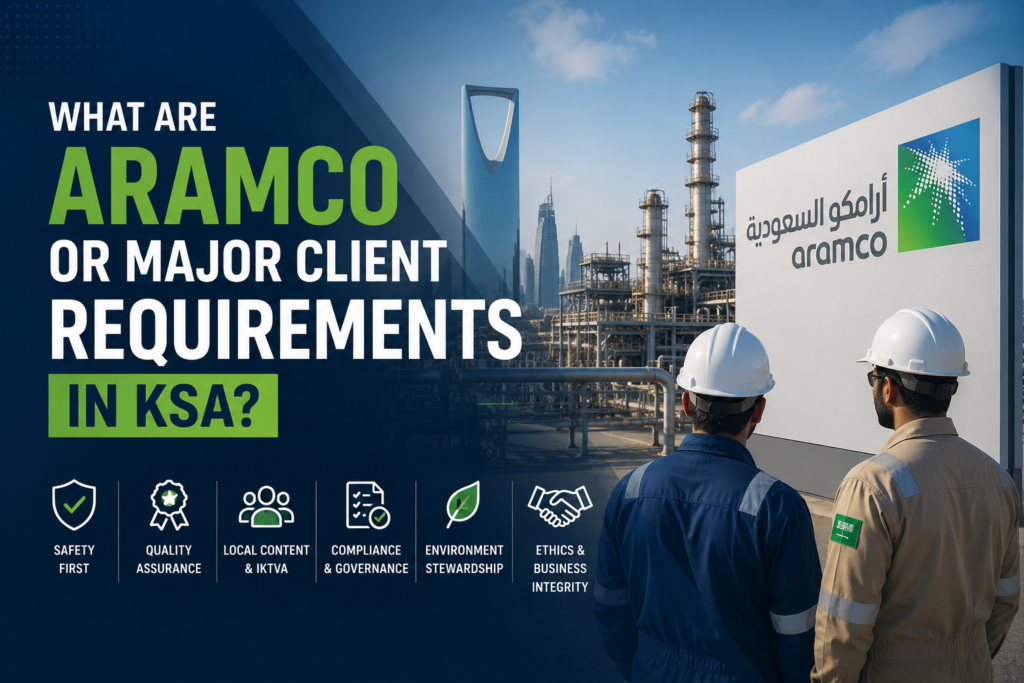
Understanding what Aramco and other major Saudi clients expect aids in prioritizing the correct certifications. In 2026, Aramco-related vendor prequalification checklists will require ISO 9001 for quality supply chains. They will increasingly refer to ISO 14001 and ISO 45001 as “preferred” for projects with high environmental or safety exposure. (RisksControl “ISO Consulting in Saudi Arabia 2026”, 2026)
Saudi Aramco requirements:
Aramco’s vendor registration system assesses suppliers across multiple aspects. For most supply and service categories:
ISO 9001 is mandatory: You cannot complete vendor registration without a valid ISO 9001 certificate. This applies to manufacturers, suppliers, service providers, and contractors.
ISO 14001 is situation-dependent: For contracts involving environmental risk (chemical handling, waste management, site work in sensitive areas), ISO 14001 becomes a strong preference or requirement.
ISO 45001 (or older OHSAS 18001) is expected for safety-critical work: Construction, industrial maintenance, technical services, and operations with significant safety exposure typically require occupational health and safety certification.
Aramco also scrutinizes your certification body’s accreditation. Certificates must originate from bodies accredited by recognized organizations (SABC, ANAB, UKAS, or similar). Self-declared compliance is insufficient.
Other major clients in Saudi Arabia:
SABIC and petrochemical companies: Similar to Aramco, they require ISO 9001 as a baseline. They increasingly expect ISO 14001 and ISO 45001 for plant work, turnarounds, and maintenance contracts.
Royal Commission for Jubail and Yanbu: Vendors operating in industrial cities often need environmental and safety certifications. This is due to sensitive ecosystems and concentrated industrial activity.
Large construction developers: Major real estate and infrastructure developers (such as those for Vision 2030 projects) frequently require ISO 9001 and ISO 45001. This is especially true for contractors managing large workforces.
Government entities: Tender specifications from ministries and government agencies commonly list ISO 9001 as a qualification criterion. Some tenders award additional points for ISO 14001 or ISO 45001.
International companies operating in KSA: Foreign firms with Saudi operations often apply their global vendor standards. These typically include quality, environmental, and safety certifications.
Practical implications for vendors:
If Aramco or similar clients are your target market, plan your certification roadmap accordingly:
Year 1: Obtain ISO 9001 certified to register as a vendor and bid on opportunities.
Year 2: Add ISO 45001 if you are pursuing construction, maintenance, or field service contracts where safety is a primary concern.
Year 3: Finalize your certification portfolio with ISO 14001 if you work in environmentally sensitive contexts or aim to maximize your competitive standing.
This sequencing allows you to pursue contracts quickly while progressing toward full certification over a reasonable timeframe.
Some vendors err by waiting until they secure a contract before starting certification. This creates problems because certification typically takes 6-12 months. This can delay project mobilization and frustrate clients. It is better to get certified first, then confidently pursue contracts.
If you are preparing for Aramco vendor qualification, consider ISO 45001 Safety Courses by EUTC Global that addresses specific expectations for oil and gas contractors.
ISO Certification Comparison: What you need to know
Here’s a detailed comparison of ISO 9001, ISO 14001, and ISO 45001 to help you understand each standard:
| Aspect | ISO 9001 | ISO 14001 | ISO 45001 |
|---|---|---|---|
| Purpose | Quality management | Environmental management | Occupational health and safety |
| Focus Area | Customer satisfaction, product or service consistency, process control | Environmental impact reduction, legal compliance, pollution prevention | Worker safety, injury prevention, workplace hazard control |
| Primary Beneficiaries | Customers, business efficiency | Environment, community, regulatory authorities | Employees, contractors, workplace visitors |
| Industries That Need It Most | All sectors, universal application | Manufacturing, construction, chemicals, oil and gas, logistics | Construction, oil and gas, manufacturing, industrial services, facilities management |
| Key Benefits | Contract eligibility, customer confidence, operational efficiency, reduced errors and rework | Environmental compliance, resource efficiency, community relations, sustainability credentials | Reduced accidents, lower insurance costs, improved morale, legal compliance |
| Implementation Difficulty | Moderate, good starting point for beginners | Moderate to high, requires environmental expertise | Moderate to high, requires safety expertise |
| Typical Cost Range in KSA | SAR 40,000 to 80,000 for SMEs | SAR 50,000 to 100,000 for SMEs | SAR 50,000 to 100,000 for SMEs |
| Timeline to Certification | 6 to 9 months for first time certification | 8 to 12 months for first time certification | 8 to 12 months for first time certification |
| Annual Surveillance | Required, lighter audit each year | Required, lighter audit each year | Required, lighter audit each year |
| Certificate Validity | 3 years with annual surveillance audits | 3 years with annual surveillance audits | 3 years with annual surveillance audits |
| Common Requirements | Document control, internal audits, management review, corrective action, training records | Document control, internal audits, management review, corrective action, training records | Document control, internal audits, management review, corrective action, training records |
| Specific Requirements | Customer feedback, product conformity, supplier evaluation | Environmental aspects register, legal register, emergency preparedness | Hazard identification, risk assessment, incident investigation, worker consultation |
Cost breakdown for Saudi businesses:
When budgeting for ISO certification in KSA, expect these typical expenses:
Gap analysis and planning (SAR 8,000 – 15,000): An initial assessment to compare your current state with necessary requirements.
Consultant fees (SAR 20,000 – 50,000): External expertise to guide implementation, develop procedures, and prepare for auditing. Costs vary based on company size and complexity.
Training (SAR 5,000 – 15,000): ISO 9001 Certification Training, awareness sessions, and specialized courses for implementation teams.
Documentation development (SAR 5,000 – 12,000): Creating manuals, procedures, forms, and records to demonstrate compliance.
Certification body fees (SAR 15,000 – 35,000): The actual audit conducted by an accredited certification body. Fees depend on company size, number of employees, and complexity.
Integrated systems cost more initially but less than three separate certifications. Expect to save about 25-35% compared to implementing each standard independently.
Timeline considerations:
The certification process in Saudi Arabia typically follows this pattern:
Months 1-2: Gap analysis, management commitment, resource allocation, and planning.
Months 3-6: Documentation, process mapping, training, and system implementation.
Months 7-8: Internal audits, management review, and corrective actions.
Month 9: Stage 1 audit (documentation review by certification body).
Month 10: Stage 2 audit (on-site assessment by certification body).
Month 11: Addressing any non-conformances and final certification decision.
Some companies achieve certification faster, especially if they already have informal systems. Others take longer if they are building everything from scratch or lack dedicated resources.
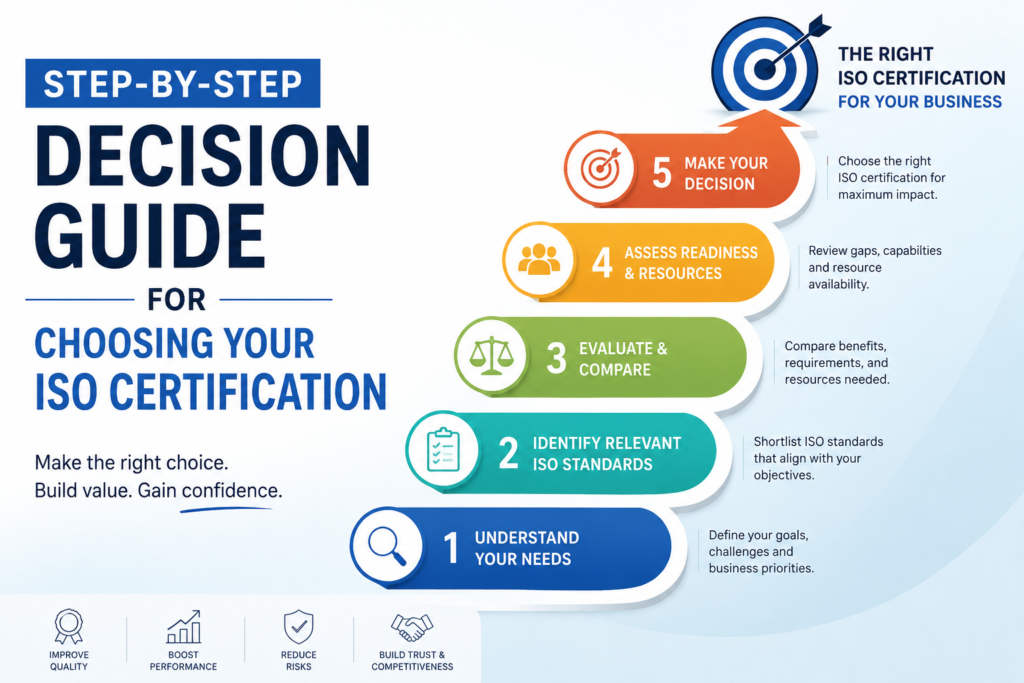
Step-by-step decision guide for choosing your ISO certification
Here’s a practical framework to help you decide which ISO certification to pursue first:
Step 1: Assess your current business situation
Ask yourself these questions:
- Which industry do you operate in?
- Who are your target customers or clients?
- Do any tender specifications you’ve encountered mention ISO requirements?
- Have you missed opportunities due to a lack of certification?
- What are your biggest operational challenges (quality issues, environmental concerns, or safety incidents)?
Step 2: Review specific client requirements
Check tender documents, vendor registration portals, and contract specifications from clients you wish to work with:
- Is ISO 9001 listed as mandatory or just preferred?
- Are environmental or safety certifications mentioned?
- What certifications do your competitors hold?
- What is required to qualify versus what is required to score highly?
Step 3: Evaluate your risk profile
Consider the impact of your operations:
Low environmental impact (office-based services, trading, IT): ISO 14001 is not urgent unless clients demand it.
Low safety risk (professional services, retail, hospitality): ISO 45001 is a lower priority unless you have specific safety concerns.
High quality risk (manufacturing, construction, healthcare): ISO 9001 should be your top priority.
High environmental impact (chemicals, oil and gas, heavy manufacturing): Plan for ISO 14001 early in your certification journey.
High safety risk (construction, industrial services, logistics): ISO 45001 should be among your first or second certifications.
Step 4: Consider your resources
Be realistic about what you can manage:
Limited budget (under SAR 60,000 for certification): Start with ISO 9001 alone.
Limited staff (under 20 employees): Implement one standard, master it, then add others.
Experienced management: Consider integrated implementation of multiple standards.
No prior ISO experience: Start with ISO 9001 as a foundational learning step.
Step 5: Chart your certification roadmap
Based on the answers above, create a simple timeline:
Priority A scenarios (start immediately):
- New business targeting Aramco or major contractors: Obtain ISO 9001 within 12 months.
- Construction company: Obtain ISO 9001 and ISO 45001 together within 18 months.
- Petrochemical manufacturer: Obtain ISO 9001, then add ISO 14001 and ISO 45001 within 24 months.
- Service business with environmental contracts: Obtain ISO 9001, then add ISO 14001 within 18 months.
Priority B scenarios (plan for 18-36 months out):
- Established business expanding to new clients: Add certifications as market demands.
- Growing SME seeking operational improvements: Secure ISO 9001 first, reassess needs after 18-24 months.
- Company with safety incidents: Add ISO 45001 immediately after ISO 9001.
Step 6: Acquire training and support
Do not try to implement ISO standards without proper knowledge. Invest in Integrated ISO Training programs from EUTC Global that covers:
- Understanding standard requirements.
- Internal auditor skills.
- Documentation techniques.
- Implementation project management.
Training minimizes costly errors, accelerates implementation, and builds internal capabilities that your organization will use for years.
Step 7: Choose your certification body carefully
Select an accredited certification body with:
- SABC (Saudi Accreditation Body) or international accreditation.
- Experience in your industry.
- Auditors who understand the Saudi business context.
- Transparent pricing and reasonable timelines.
- A strong reputation among certified companies.
The certification body you choose will be listed on your certificate. Clients sometimes have preferences or requirements regarding accreditation.
Frequently Asked Questions
Which ISO certification should be implemented first?
For approximately 70-80% of Saudi businesses, ISO 9001 should be implemented first. It creates foundational quality management systems relevant to all organizations. (KBS Certification “Certification Priority Guide 2026”, 2026) It is the most cost-effective starting point, with implementation costs averaging 15-25% less than ISO 14001 or ISO 45001. However, high-risk industries like construction and oil and gas should consider implementing ISO 9001 and ISO 45001 together, or prioritizing safety if workplace incidents are a pressing concern.
Is ISO 9001 mandatory in Saudi Arabia?
ISO 9001 is not legally mandatory for all Saudi businesses, but it is practically essential for many sectors. Government tenders, major contractor prequalification processes, and private sector supply chains frequently list ISO 9001 as a mandatory qualification. In 2024, approximately 65% more Saudi sites achieved ISO certification compared to 2022. This was driven by localization policies and industrial diversification initiatives. (RisksControl “ISO Consulting in Saudi Arabia 2026”, 2026) If you sell to government entities, large corporations, or Aramco’s supply chain, you will find ISO 9001 effectively mandatory for business development.
Can a company get multiple ISO certifications at once?
Yes, companies can pursue ISO 9001, ISO 14001, and ISO 45001 simultaneously through integrated management system implementation. In 2024, 15-20% of new Saudi ISO certificates were integrated systems combining multiple standards. (KBS Certification “Certification Priority Guide 2026”, 2026) This approach saves time and costs in the long run. However, it requires more resources, expertise, and project management capability initially. It is most suitable for organizations with experienced management teams, adequate staff, and clear business needs for all certifications. Smaller companies or those new to management systems typically find sequential implementation more manageable.
How long does ISO certification take in KSA?
ISO certification in Saudi Arabia typically takes 6-9 months for ISO 9001 and 8-12 months for ISO 14001 or ISO 45001 for first-time certification. The timeline includes gap analysis, documentation development, implementation, internal audits, and the two-stage certification audit. Companies implementing integrated management systems covering multiple standards should plan for 12-18 months. The timeline varies based on company size, complexity, existing systems, resource availability, and the level of external consulting support utilized. Organizations with dedicated implementation teams and strong management commitment can sometimes complete certification faster.
What is the cost of ISO certification in Saudi Arabia?
ISO certification costs in Saudi Arabia range from SAR 40,000 to 80,000 for ISO 9001 in small to medium enterprises. ISO 14001 and ISO 45001 typically cost SAR 50,000 to 100,000 each. Research shows that ISO 9001 is considered 15-25% more cost-effective than the other standards as a first certification. (QualityMakers1 “New ISO Standard 2026”, 2025) Total costs include consultant fees, training, documentation development, and certification body audit fees. Integrated management systems covering multiple standards cost approximately 25-35% less than implementing each standard separately. Larger organizations and more complex operations incur higher costs due to longer audit times and greater documentation needs.
Key takeaways
Choosing which ISO certification to pursue first is a strategic decision for your Saudi business. The right choice accelerates market access, strengthens operations, and positions you competitively.
Here’s what to remember:
- ISO 9001 is the best first certification for most Saudi businesses. It applies universally, costs less to implement, opens the most contract opportunities, and builds the foundation for adding ISO 14001 or ISO 45001 later.
- High-risk industries should prioritize safety early. This means implementing ISO 9001 and ISO 45001 together or in immediate sequence. This is especially true in construction, oil and gas, and heavy manufacturing, where workplace incidents have serious consequences.
- Environmental certification is vital when regulations or clients require it. ISO 14001 is particularly important for petrochemicals, large-scale construction, resource-intensive manufacturing, and export-focused businesses.
- Aramco and major Saudi contractors increasingly expect all three certifications. ISO 9001, ISO 14001, and ISO 45001 are part of vendor qualification, with ISO 9001 mandatory and the others “preferred” for contracts with environmental or safety exposure.
- Integrated management systems save time and money. If you can manage the complexity, they reduce total certification costs by 25-35% compared to sequential implementation. They also build unified systems that function more effectively.
- Certification requires planning and investment. Typical timelines are 6-12 months. Costs range from SAR 40,000-100,000 per standard. The returns come through contract eligibility, operational improvements, and competitive standing in the growing Saudi market.
The Saudi business environment is evolving rapidly. Vision 2030 is driving localization, industrial diversification, and rising standards for quality, safety, and environmental performance. ISO certification is not just about meeting current requirements. It is about building the management capability your organization needs to compete effectively in the KSA market for years to come.
Whether you begin with ISO 9001 alone, combine it with safety or environmental certification, or adopt an integrated management system covering all three standards, the important step is to start now. Every month you delay is another month your competitors gain ground and contracts are lost due to missing qualifications.
Need help planning your ISO certification journey? EUTC Global offers specialized training programs relevant to ISO 9001, ISO 14001, ISO 45001, and integrated management systems. These are designed specifically for Saudi businesses navigating these certification choices.