


Contents
- 1 What Does a Fire Watcher Do in KSA Industrial Sites?
- 2 What’s a Fire Warden’s Role in Saudi Arabia Workplaces?
- 3 Fire Marshal Saudi Arabia: Who Takes Command During Emergencies?
- 4 Can One Person Be a Fire Warden, Watcher, AND Marshal in Saudi Arabia?
- 5 Why TUV-Approved Fire Safety Training Matters on KSA Projects
- 6 Frequently Asked Questions
- 6.1 How long must a fire watcher stay after hot work ends in Saudi Arabia?
- 6.2 Do fire wardens need refresher training every year?
- 6.3 Can a fire watcher leave their post to check other areas?
- 6.4 What’s the ratio of fire wardens to employees in KSA facilities?
- 6.5 Is online fire safety training accepted on Saudi Aramco projects?
- 7 Conclusion: Get the Right People in the Right Roles
You’re about to approve a hot work permit on your Jubail construction site. Your supervisor asks: “Do we need a fire watcher or a fire warden for this welding job?” Then your HSE officer mentions a fire marshal for the evacuation drill tomorrow. Wait—aren’t these all the same person?
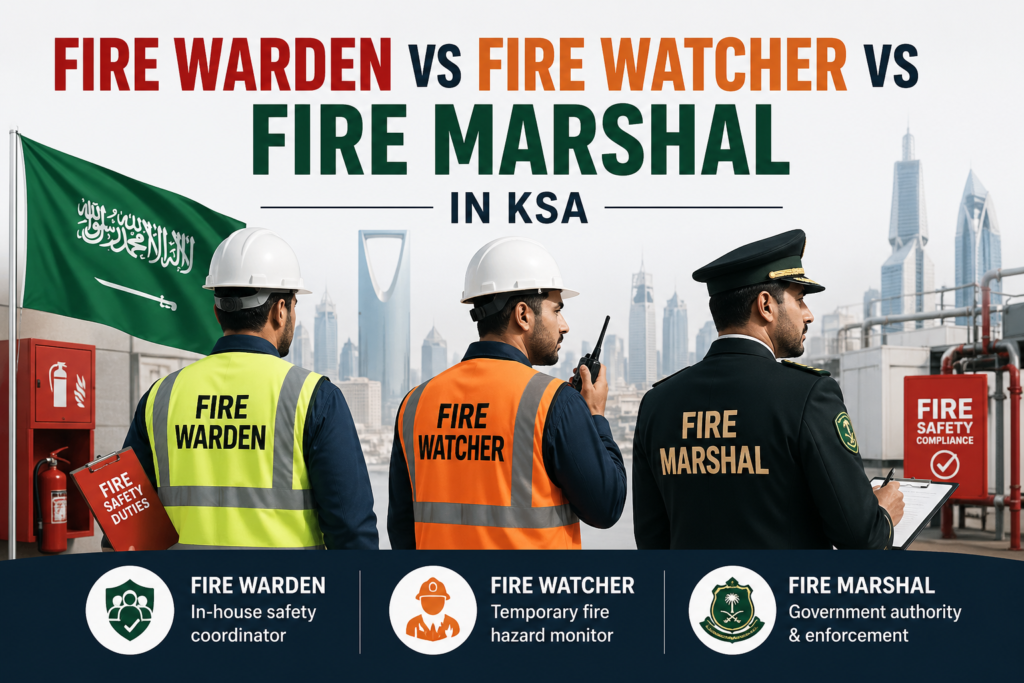
If you’ve ever been puzzled about which fire safety role applies to which situation on your Saudi Aramco contractor project, NEOM site, or SAFCO facility, you’re not alone. These three titles are often used interchangeably. However, they are distinct roles with different responsibilities under Saudi Civil Defence regulations and international standards like NFPA and OSHA.
What makes it even more confusing is that on smaller KSA sites, one person might fulfill all three roles. Even in such cases, they still need separate training and certification for each role. Incorrect assignment of responsibilities can lead to work stoppages, Civil Defence violations, or, more seriously, preventable incidents.TL;DR: Fire watchers monitor active hot work and stay on-site 60 minutes post-job (NFPA 51B requirement). Fire wardens handle daily prevention and assist with evacuations. Fire marshals take command during emergencies. In Saudi Arabia, industrial sites typically need all three roles certified separately, with TUV-approved training preferred on Aramco-approved projects. (NFPA, 2023)
What Does a Fire Watcher Do in KSA Industrial Sites?
According to OSHA 29 CFR 1910.252, fire watchers are required whenever welding, cutting, or other hot work operations create ignition risks. This covers about 90% of maintenance and construction activities on Saudi industrial sites. (OSHA, 2023)
A fire watcher’s job is focused: they monitor a specific hot work location before, during, and after the operation. They are not to roam the facility checking fire extinguishers. They are not to lead evacuations. They are stationed at that one welding station, cutting torch, or grinding area, making sure sparks do not ignite nearby combustibles.
Here’s what that looks like in practice on a SABIC facility or KEMYA plant:
Before hot work begins:
- Inspect the work area within 35 feet (10.7 meters) for combustible materials.
- Verify fire extinguishers are accessible and functional.
- Confirm hot work permit conditions are met.
- Check that fire blankets or barriers are properly positioned.
During hot work:
- Maintain continuous visual monitoring of the work area.
- Watch for sparks traveling through cracks, pipes, or wall openings.
- They have the authority to stop work immediately if unsafe conditions develop.
- Stay alert—no phone scrolling, no other tasks.
After hot work ends (this is where most sites make errors):
- Only depart once proper sign-off is documented.
- Remain on watch for at least 60 minutes after the last spark.
- Continue monitoring for smoldering fires or delayed ignition.
- Some KSA sites with high-risk materials require 180-minute watch periods.
- Only depart once proper sign-off is documented.
Fire watchers must be trained specifically in NFPA 51B standards, which covers fire prevention during welding, cutting, and hot work. On Aramco contractor projects, TUV-approved fire watcher certification is frequently a requirement. Get certified as a Fire Watcher.
Our insight: On multi-level construction sites (common in NEOM and Red Sea projects), you might need fire watchers on BOTH the level where hot work occurs AND the level directly below. Sparks and slag can fall through floor openings and ignite materials several meters away.
What’s a Fire Warden’s Role in Saudi Arabia Workplaces?
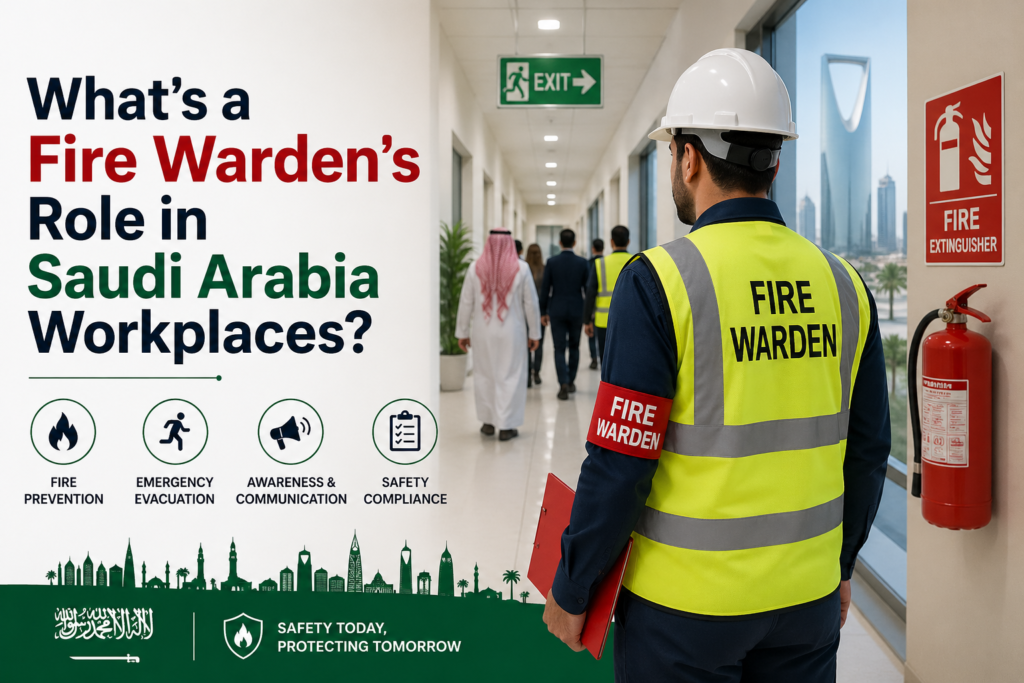
Fire wardens operate at the prevention level. Saudi Civil Defence regulations mandate that commercial and industrial facilities designate trained fire wardens for each floor, building section, or work area. This typically means one warden per 50-75 occupants, depending on facility type. (Saudi Civil Defence, 2023)
Consider fire wardens your primary defense before any fire starts. They are proactive, not reactive.
On a typical HADEED steel plant or SAFCO petrochemical facility, fire wardens manage:
Daily/weekly prevention tasks:
- Inspect fire safety equipment (extinguishers, hose reels, alarm call points).
- Check that evacuation routes and exits remain clear.
- Verify emergency lighting functions properly.
- Report maintenance issues through appropriate channels.
- Document inspection findings.
Education and awareness:
- Conduct informal fire safety talks during toolbox meetings.
- Remind workers about smoking restrictions and housekeeping standards.
- Identify and report fire hazards (blocked exits, improper storage, damaged equipment).
During evacuation (but NOT as incident commander):
- Assist with the orderly evacuation of their assigned area.
- Direct occupants to assembly points.
- Perform quick visual sweeps of accessible areas (not search-and-rescue).
- Report status to the fire marshal or emergency coordinator.
Fire wardens do not fight fires; they prevent them and help people exit safely when prevention fails. This distinction is important because their training focuses on hazard recognition, inspection protocols, and evacuation assistance rather than emergency command.
Train your site team as Fire Wardens
Most GCC-based industrial projects require fire warden training that covers NFPA 1 (Fire Code), local Saudi regulations, and facility-specific emergency procedures. The certification often takes one day and should be renewed annually.
Fire Marshal Saudi Arabia: Who Takes Command During Emergencies?
When the alarm sounds on your Aramco facility, someone needs to take charge—that person is your fire marshal. According to NFPA standards, fire marshals serve as the on-site emergency coordinator until professional firefighters (Saudi Civil Defence) arrive and assume command. (NFPA, 2023)
This role commands significant authority and responsibility. Fire marshals do not merely assist with evacuation; they manage the entire process.
On a typical incident at a KEMYA chemical plant or large construction site, the fire marshal performs these duties:
Immediate response:
- Assumes command as soon as the alarm activates or a fire is reported.
- Confirms alarm activation (or triggers it if automatic systems failed).
- Contacts Saudi Civil Defence (998) with accurate location and hazard details.
- Initiates facility-specific emergency procedures.
Evacuation management:
- Orders full or partial evacuation based on incident severity.
- Coordinates with fire wardens to sweep their assigned areas.
- Ensures personnel move to designated assembly points.
- Prevents re-entry to the building.
Accountability and communication:
- Conducts roll call at assembly points using attendance records.
- Identifies and reports missing persons to Civil Defence.
- Maintains communication with emergency services.
- Provides facility layout, hazard information, and access details to responding firefighters.
- Briefs site management and HSE leadership.
Post-incident:
- Documents the incident timeline and response actions.
- Participates in incident investigation.
- Identifies areas for improvement in emergency procedures.
Fire marshals require more advanced training than fire wardens. This is because they make real-time decisions under pressure. They must understand fire behavior, hazardous materials protocols, emergency communication systems, and how to interact with Saudi Civil Defence responders.
On major Saudi industrial sites, you will often find a Chief Fire Marshal (site-wide authority) and Area Fire Marshals (building or zone-specific). The training usually lasts 2-3 days and covers incident command basics, evacuation strategy, and coordination with emergency services.
Our insight: During Aramco shutdown projects, contractors often need to supply all three roles from their own workforce. The main contractor usually appoints the Chief Fire Marshal, while subcontractors provide area-specific wardens and watchers for their scope of work. Ensure your mobilization plan accounts for the training lead time—TUV-approved certification takes time.
Can One Person Be a Fire Warden, Watcher, AND Marshal in Saudi Arabia?
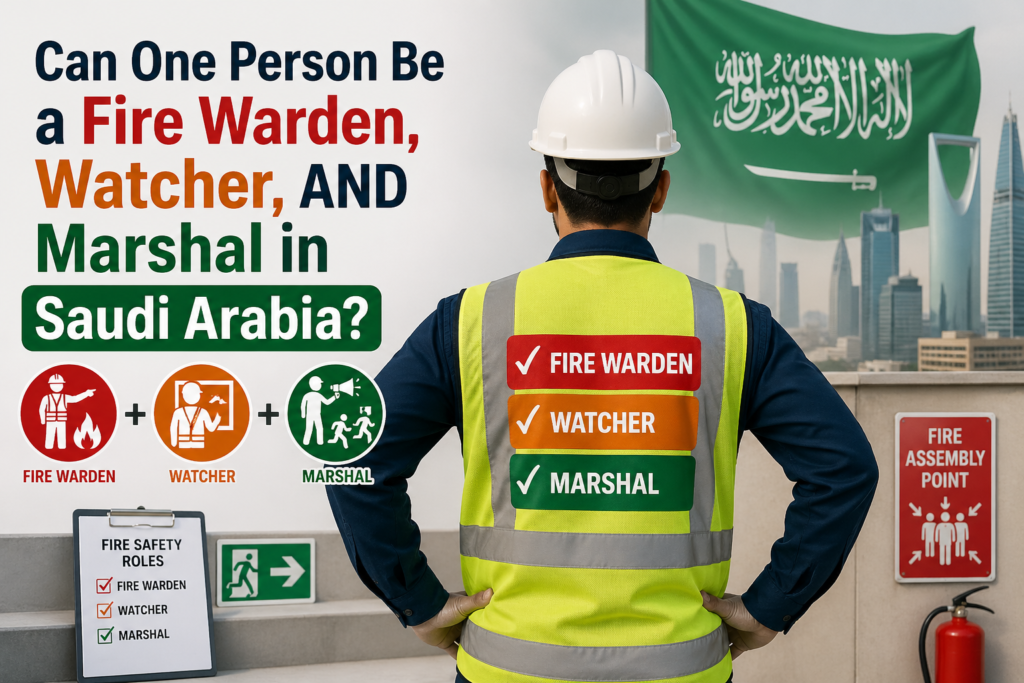
Yes, but with significant considerations. Small KSA facilities (under 50 occupants) often designate one HSE officer or supervisor to fulfill all three roles. However, Saudi Civil Defence and major clients like Aramco expect separate training and certification for each function.
Here’s why simply calling someone “the fire guy” is insufficient:
Different competencies:
- Fire watcher training focuses on hot work hazards and NFPA 51B protocols (4-8 hours).
- Fire warden training covers prevention, inspection, and evacuation assistance (8 hours).
- Fire marshal training involves incident command and emergency coordination (16-24 hours).
Different legal requirements:
- Hot work permits specifically require a “trained and certified fire watcher” by name.
- Evacuation plans must list designated fire wardens per area.
- Emergency procedures must identify the fire marshal and chain of command.
Different timing:
- You cannot watch hot work and conduct a building evacuation simultaneously.
- During emergencies, marshals coordinate while wardens act—the same person cannot do both effectively.
What works in practice:
On smaller sites, structure it this way:
- Designate your HSE supervisor as the Fire Marshal (primary emergency commander).
- Train your shift supervisors as Fire Wardens (one per building/area).
- Train maintenance and contractor supervisors as Fire Watchers (for their own hot work).
- Have backup personnel for each role (for holidays, shifts, or turnover).
On larger facilities like SAFCO Jubail or HADEED Yanbu, you will need multiple people in each role. A 200-person plant might require:
- 1 Chief Fire Marshal + 2 Area Fire Marshals.
- 6-8 Fire Wardens (covering different zones and shifts).
- 4-6 certified Fire Watchers (for typical daily hot work volume).
The training investment yields benefits. According to HSE contractors operating in KSA’s industrial zones, sites with properly trained and certified personnel in all three roles experience 60% fewer fire-related incidents and near-misses compared to sites that rely on generic “fire safety awareness” training. (Industrial Safety Review, 2023)
Why TUV-Approved Fire Safety Training Matters on KSA Projects
You’ve likely seen “TUV-approved” or “TUV-certified” listed as requirements on Aramco, SABIC, or Ma’aden contractor pre-qualification documents. What does that signify, and why is it important?
TUV (Technischer Überwachungsverein) is an internationally recognized certification body that audits training programs against strict quality standards. When a training provider holds TUV approval, it means:
For you as the employer:
- Training content adheres to NFPA, OSHA, and GCC regulatory standards.
- Certification will be accepted across multiple KSA clients and projects.
- Reduced risk of training rejections during document reviews.
- Improved incident defense if something goes wrong (due diligence documented).
For your workers:
- The certificate holds value beyond one specific project.
- Training quality is independently verified.
- Improved career mobility across GCC countries.
Major KSA industrial clients specifically require TUV-approved fire safety training because it ensures standardization. When Saudi Aramco manages a major shutdown involving 50+ contractors, they need confidence that everyone understands the same protocols—TUV approval provides that assurance.
EUTC Global provides fire watcher, fire warden, and fire marshal training throughout Saudi Arabia with full TUV approval and NFPA/OSHA alignment. Their programs are:
- Customizable to your facility-specific procedures.
- Available as on-site training (minimum 8 participants) or at their training centers.
- Delivered by instructors with active industrial experience.
- Recognized by major KSA industrial clients.
Whether you’re mobilizing for a new project, preparing for a Civil Defence inspection, or building long-term HSE capability, start with appropriate certification
The investment is minimal compared to the costs of incidents, work stoppages, or contractor disqualification. A typical fire watcher certification costs 500-800 SAR per person, fire warden 800-1200 SAR, and fire marshal 1500-2000 SAR. Compare that to the daily rate of a shutdown delay or the reputational damage of a preventable fire incident.
Frequently Asked Questions
How long must a fire watcher stay after hot work ends in Saudi Arabia?
NFPA 51B mandates fire watchers to observe for at least 60 minutes after the last spark or flame. However, some KSA facilities handling Class I flammable materials extend this to 180 minutes based on a risk assessment. Your site-specific hot work permit should specify the required watch duration. (NFPA 51B, 2023)
Do fire wardens need refresher training every year?
Yes. Saudi Civil Defence regulations and most major industrial clients require annual refresher training for fire wardens. The refresher typically lasts 4 hours and includes updates to regulations, incident case studies, and facility-specific procedure changes. Some sites conduct refresher training quarterly for high-risk areas. (Saudi Civil Defence, 2023)
Can a fire watcher leave their post to check other areas?
No. The fire watcher must maintain continuous observation of the specific hot work area. If you have multiple simultaneous hot work locations, you need multiple certified fire watchers—one per location. This is a common violation identified during Aramco safety audits. (OSHA 1910.252, 2023)
What’s the ratio of fire wardens to employees in KSA facilities?
There is no single specific regulation, but industry practice suggests one fire warden per 50-75 occupants for typical industrial facilities. High-rise buildings need at least one warden per floor. High-hazard areas (chemical storage, processing units) often require dedicated wardens regardless of occupancy. Check your facility’s Civil Defence inspection report for specific requirements. (Fire Safety Engineering, 2023)
Is online fire safety training accepted on Saudi Aramco projects?
Generally no. Aramco and most significant Saudi industrial clients require classroom-based training with practical demonstrations for fire watcher, fire warden, and fire marshal roles. Online theory components may supplement classroom training, but hands-on extinguisher use, alarm activation, and evacuation drills must be conducted in person. Always confirm with your specific client’s HSE requirements. (Saudi Aramco Contractor HSE Standards, 2023)
Conclusion: Get the Right People in the Right Roles
The lack of clarity between fire watcher, fire warden, and fire marshal is not just about words. It’s about ensuring trained personnel are in positions to prevent incidents or manage emergencies effectively. Your welding supervisor cannot lead a building evacuation if they are required to observe their hot work area for 60 minutes post-job. Your HSE coordinator cannot manage emergency response from an assembly point if they are assigned to sweep floors as a warden.
Here’s what is important:
- Fire watchers are specialists for hot work operations—they monitor one location, before, during, and after, per NFPA 51B requirements.
- Fire wardens are your prevention team—they inspect, educate, and assist with evacuations in their assigned areas.
- Fire marshals are your emergency commanders—they oversee operations when the alarm sounds until Civil Defence arrives.
- All three roles need separate, specific training—general fire safety awareness is insufficient for severe industrial sites.
- TUV-approved certification opens opportunities across KSA’s major industrial clients and demonstrates due diligence.
Smaller sites can assign multiple roles to one person if they are properly trained for each. Larger sites need dedicated personnel in each role with clear documentation of responsibilities.
Do not wait for a Civil Defence inspection finding or a client audit non-conformance to address this. If you are conducting hot work without certified watchers, carrying out evacuations without trained wardens, or lacking a designated fire marshal, you are one incident away from severe consequences.
Certify your team effectively Their team can evaluate your specific project requirements and deliver NFPA-aligned, TUV-approved training that prepares your people for real KSA industrial conditions—not generic scenarios from UK office buildings.
The right training investment today helps prevent unfavorable outcomes tomorrow.