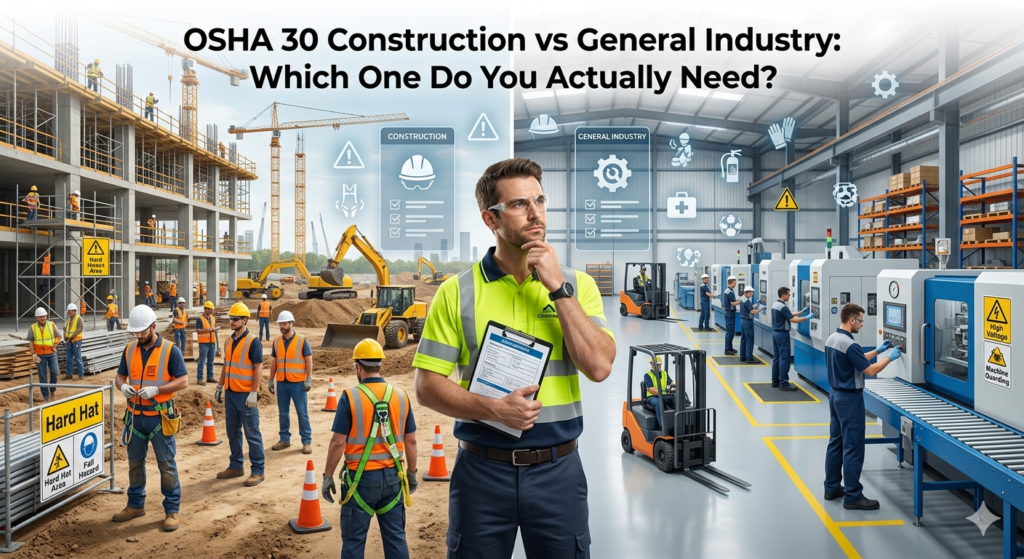
If you’re working on a construction site, giga-project, or capital expansion in Saudi Arabia, you need OSHA 30 Construction. If you work in a manufacturing plant, refinery, warehouse, or process facility, you need OSHA 30 General Industry. The course choice depends on the type of work you do, not just your employer’s name. A NEOM site supervisor needs Construction. A SABIC maintenance supervisor needs General Industry. However, many Saudi job postings just say “OSHA 30 required” without specifying which track, leading to confusion for workers and HR teams.
Both courses offer OSHA-authorized Outreach Training and issue the same DOL card format, but their content is entirely different. One course covers scaffolding and trenching. The other covers machine guarding and confined spaces. Choosing incorrectly could lead to issues at site induction or delays during mobilization. This guide clarifies which OSHA 30 Construction vs General Industry track you need in Saudi Arabia, based on your actual work environment.
TL;DR: OSHA 30 Construction is for jobsites like NEOM, Red Sea Project, and Aramco capital projects. OSHA 30 General Industry is for plants and facilities like SABIC, Ma’aden, and Petro Rabigh. Most mega-project contractors in KSA require Construction. Most refineries and manufacturing plants require General Industry.
What is the difference between OSHA 30 Construction and General Industry?
The distinction between OSHA 30 Construction and General Industry comes down to two distinct sets of federal regulations: 29 CFR 1926 for Construction and 29 CFR 1910 for General Industry. Construction applies to temporary, project-based work such as building structures, roads, pipelines, and towers. General Industry pertains to permanent facilities like factories, refineries, warehouses, and processing plants. Each course trains you on the hazards specific to that environment.
Both courses require 30 hours to complete. Both issue a DOL card from the U.S. Department of Labor. Both are recognized across Saudi Arabia by Aramco, SABIC, NEOM, and major EPC contractors. Despite these similarities, their curricula are entirely different.
Here’s a side-by-side comparison:
Feature
OSHA 30 Construction
OSHA 30 General Industry
CFR Standard
29 CFR 1926
29 CFR 1910
Who It’s For
Workers and supervisors on construction sites and capital projects
Workers and supervisors in manufacturing plants, refineries, and permanent facilities
Main Hazards
Falls, scaffolding, trenching, cranes, electrical (Focus Four)
Machine guarding, hazcom, confined spaces, lockout/tagout, PPE
Sample Topics
Fall protection, excavations, rigging, ladders, concrete work
Bloodborne pathogens, ergonomics, fire safety, industrial hygiene
Common KSA Job Titles
Site supervisor, foreman, construction HSE officer, project engineer
Maintenance supervisor, plant HSE officer, production supervisor, safety engineer
Typical KSA Employers & Projects
NEOM, Red Sea Global, Qiddiya, Aramco capital projects, Saudi Binladin, Nesma, AlKifah, Almabani, Bechtel KSA
SABIC, Ma’aden, Petro Rabigh, SEC facilities, Aramco refineries, Royal Commission facilities in Jubail and Yanbu
If you’re building something, choose Construction. If you’re operating or maintaining something, choose General Industry.
Which OSHA 30 do I need in Saudi Arabia?
You need the OSHA 30 track that matches your work environment. If your job involves erecting structures, working at heights, excavation, scaffolding, or demolition, you need OSHA 30 Construction. If your job involves operating machinery, working in a process plant, maintaining equipment, or warehouse logistics, you need OSHA 30 General Industry. Always check your job description and site type first.
Most Saudi Arabia mega-projects require Construction. NEOM, The Line, Trojena, Red Sea Project, Qiddiya, Diriyah Gate, Jeddah Tower, and Aramco’s capital projects like Marjan and Berri expansions all require OSHA 30 Construction. If you’re hired by a contractor working on these projects, you should pursue the Construction track.
Refineries, petrochemical plants, mining operations, and manufacturing facilities fall under General Industry. SABIC plants in Jubail, Petro Rabigh facilities, Ma’aden mining sites, and Aramco’s operating refineries all require OSHA 30 General Industry. If you’re a maintenance supervisor, instrument technician, or plant HSE officer, General Industry is the appropriate choice.
Our insight: Many workers assume Aramco always means General Industry because it’s an oil company. But Aramco has both operating facilities (General Industry) and ongoing construction projects (Construction track). Always clarify with your hiring manager or recruitment agency which track matches your specific role.
Not sure which track applies to your role in KSA?Contact EUTC Global’s advisors — they’ll match you to the right course in under a minute.
What does OSHA 30 Construction cover? (29 CFR 1926)
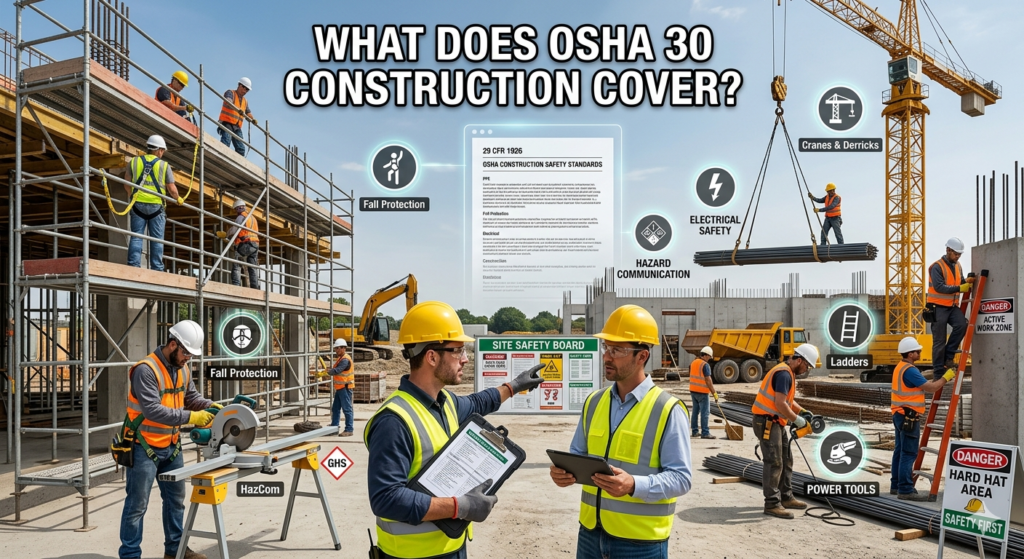
OSHA 30 Construction addresses hazards on jobsites and is based on the 29 CFR 1926 standard. The course primarily focuses on the “Focus Four” hazards, which accounted for 60.2% of all construction worker fatalities in 2022, according to the U.S. Bureau of Labor Statistics: falls, struck-by objects, caught-in/between hazards, and electrical hazards. You’ll gain knowledge on fall protection systems, scaffolding standards, excavation and trenching safety, crane and rigging operations, electrical safety on site, and personal protective equipment (PPE) requirements.
Topics include:
Fall protection (6-foot rule for general construction)
Scaffolding types and inspection
Ladder safety and proper use
Excavation, trenching, and soil classification
Concrete and masonry work
Cranes, hoists, and rigging
Stairways and floor openings
Electrical hazards on construction sites
Heavy equipment and motor vehicles
Materials handling and storage
Steel erection
Demolition operations
Fire protection and prevention
This track is ideal if you’re working on a NEOM site, a Red Sea Project resort, a Qiddiya entertainment zone, or a new Aramco processing facility under construction. It’s also a requirement for foremen, site supervisors, and construction HSE officers managing crews on these projects.
Real example: A Pakistani supervisor was hired by a NEOM contractor in 2023. He had OSHA 30 General Industry from a previous refinery role. Upon arrival in Tabuk, the site induction team rejected his card because NEOM’s construction scopes require 29 CFR 1926 training. His mobilization was delayed by six weeks while he completed OSHA 30 Construction online.
What does OSHA 30 General Industry cover? (29 CFR 1910)
OSHA 30 General Industry covers hazards in permanent facilities, based on the 29 CFR 1910 standard. The course highlights machine guarding, lockout/tagout (LOTO), confined space entry, hazard communication (HazCom), electrical safety in plants, and industrial hygiene. You’ll learn how to manage machinery hazards, work safely in confined spaces, handle hazardous chemicals, and prevent common injuries in manufacturing and processing environments.
Topics include:
Machine guarding and point-of-operation safeguards
Lockout/tagout (LOTO) procedures
Confined space entry and permits
Hazard communication (HazCom) and Safety Data Sheets (SDS)
Electrical safety in facilities (NFPA 70E references)
Walking-working surfaces and fall protection (4-foot rule)
Powered industrial trucks (forklifts)
Fire prevention and emergency response
Personal protective equipment (PPE)
Bloodborne pathogens
Ergonomics and repetitive motion injuries
Material handling and storage
Permit-required spaces
Noise and hearing conservation
This track is ideal if you work at a SABIC plant in Jubail, a Ma’aden mining facility in Ras Al-Khair, a Petro Rabigh refinery, or an Aramco operating facility like Abqaiq or Ras Tanura. It’s also required for maintenance supervisors, production supervisors, plant safety engineers, and facility HSE officers.
Real example: An HSE officer in Yanbu assumed General Industry was sufficient because he worked at a petrochemical plant. However, during a turnaround project, his responsibilities expanded to include scaffolding, rigging, and hot work on temporary structures. The site induction team noted his training as incomplete because the turnaround fell under 29 CFR 1926 regulations. He then had to complete OSHA 30 Construction to continue with the project.
Which OSHA 30 does Aramco require?
Aramco requires the OSHA 30 track that aligns with your work scope, not a single default course. If you’re working on an Aramco construction project like Marjan, Berri, or Jafurah, you need OSHA 30 Construction. If you’re working in an operating facility such as a refinery, gas plant, or processing unit, you need OSHA 30 General Industry. Aramco’s Contractor Safety Management (CSM) system references both 29 CFR 1926 and 29 CFR 1910 depending on the job type.
Aramco CSM requirements state that supervisors and foremen must have OSHA 30 training relevant to their scope of work. For capital projects and shutdowns involving construction activities, this means OSHA 30 Construction. For maintenance, operations, and routine plant work, it means OSHA 30 General Industry.
Many Aramco contractors require both. Turnarounds often blend operating plant work (General Industry) with scaffolding, rigging, and temporary structures (Construction). If your role involves both types of work, consider obtaining both certifications.
A Filipino foreman in Jubail took both courses after transitioning between SABIC’s manufacturing sector and a subcontractor’s construction scope. He found that having both cards prevented any confusion during site inductions and enhanced his value to his employer.
Which OSHA 30 does NEOM, Red Sea Project, or Qiddiya require?
NEOM, Red Sea Project, Qiddiya, The Line, Trojena, and all Saudi Arabia mega-projects require OSHA 30 Construction. These are construction sites that involve earthworks, structural erection, concrete pours, MEP installations, and heavy equipment operations. All fall under 29 CFR 1926 standards. If you’re working with contractors like Saudi Binladin, Nesma, AlKifah, Almabani, or Bechtel KSA on these projects, you need OSHA 30 Construction.
These projects explicitly require construction safety training because the work involves high-risk activities like working at heights, crane operations, excavation, and scaffolding. General Industry training won’t cover these particular hazards and will not satisfy the project induction requirements.
Check your contract or inquire with your hiring manager before enrolling. But if the project involves building something from the ground up, the Construction course is almost always the correct choice.
Is OSHA 30 mandatory in Saudi Arabia?
OSHA 30 is not mandated by Saudi Arabian law, but it is required by most major employers and projects in Saudi Arabia. Aramco CSM, SABIC SHEM, NEOM contractor requirements, and the Royal Commission for Jubail and Yanbu (RCJY) all reference OSHA standards. OSHA is a U.S. standard; however, it has been voluntarily adopted across the Kingdom as the benchmark for construction and industrial safety.
The Saudi Civil Defense and the General Organization for Social Insurance (GOSI) do not specifically require OSHA 30. However, project owners and EPC contractors do. If you aspire to work on a Tier-1 project or for a multinational contractor in KSA, you will need this certification.
Our insight: OSHA 30 is treated as a minimum qualification for supervisory and HSE roles in Saudi Arabia, despite not being a legal requirement. Employers use it to demonstrate adherence to international best practices and to mitigate liability.
Can I take both OSHA 30 courses?
Yes, you can take both OSHA 30 Construction and OSHA 30 General Industry courses. There are no restrictions. Many workers in Saudi Arabia who move between construction projects and plant maintenance take both to maintain adaptability. If you work for a company that manages both capital projects and operating facilities, holding both cards increases your value and eliminates confusion during site mobilizations.
Each course takes 30 hours and results in a separate DOL card. You can complete both online at your own pace through OSHA-authorized providers. Some workers complete one course, gain a few months of experience, then complete the second when they switch roles or projects.
Taking both also helps future-proof your career. If you transition from NEOM construction to a SABIC plant later, you won’t need to rush for new training.
Does OSHA 30 expire in Saudi Arabia?
According to OSHA.gov, the OSHA 30 DOL card does not carry an official expiration date. However, most Saudi Arabian employers request a refresher every three to five years. Aramco, SABIC, and other major project owners frequently require proof of recent training, especially if your card is older than five years. Some contractors may not accept a card older than three years.
It is advisable to retake the course every few years, particularly if you’ve been inactive in the field or if standards have been updated. OSHA periodically updates its training content, and staying current demonstrates your commitment to safety.
How much does OSHA 30 cost in Saudi Arabia and how long does it take?
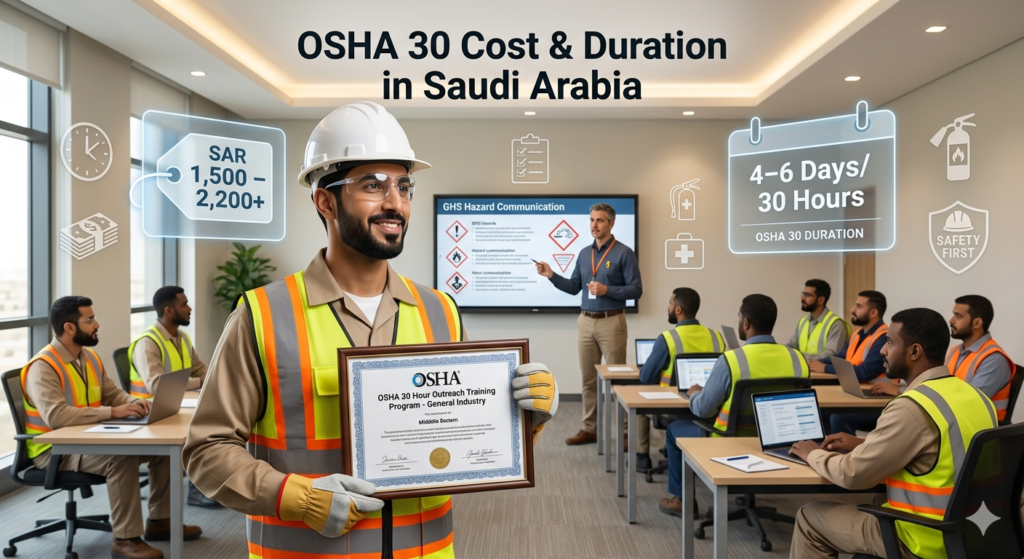
OSHA 30 typically costs between $150 and $300 USD, depending on the provider and delivery format. Online self-paced courses are usually at the lower end of this range. In-person courses are generally more expensive. The course requires 30 hours to complete, but you are not expected to finish it all at once. Most online providers allow you to log in and out at your own pace.
You can complete the course in as little as four to five days if you dedicate full days to it, or you can spread it over two to three weeks. Once you finish, your DOL card is mailed to you, usually within 7 to 14 business days. International delivery to Saudi Arabia can take two to four weeks, depending on the provider and shipping method.
EUTC Global ships DOL cards internationally and provides tracking for students in Saudi Arabia, UAE, and other GCC countries.
What happens if I take the wrong OSHA 30?
If you take the wrong OSHA 30, you’ll likely be identified during site induction or pre-mobilization checks. Your card won’t align with the safety requirements for your work scope, and you’ll either be sent home or asked to complete the correct course before you can begin. This can delay your mobilization by weeks and lead to lost earnings, especially if you’re a contractor or expatriate hired for a specific project.
Some employers are very strict about this. Aramco and NEOM contractors regularly audit training records and will not accept a General Industry card for construction work, or vice versa. If you are uncertain, consult your hiring manager or HR team before enrolling.
The good news is that you can always take the correct course later. However, getting it right the first time is both more economical and faster.
FAQ’s
Is OSHA 30 Construction harder than General Industry?
Neither course is objectively more difficult. Both require 30 hours and cover complex safety topics. Construction focuses more on physical hazards such as falls, scaffolding, and trenching. General Industry emphasizes process hazards like machine guarding, confined spaces, and chemical safety. The perceived difficulty depends on your background and which hazards you’re more familiar with.
Can I use a General Industry card on an Aramco or NEOM site?
No, if your scope of work involves construction activities. Aramco CSM and NEOM contractor requirements specify that training must correspond to the work scope. General Industry cards cover 29 CFR 1910, but construction sites operate under 29 CFR 1926. Using the incorrect card will likely result in rejection at site induction.
Does OSHA 30 expire?
OSHA 30 DOL cards do not have an official expiration date according to osha.gov, the official U.S. Department of Labor website. However, most Saudi Arabian employers, including Aramco and SABIC, request refresher training every three to five years. If your card is older than that, you may need to retake the course.
Is OSHA 30 accepted in Saudi Arabia?
Yes, OSHA 30 is widely accepted in Saudi Arabia by Aramco, SABIC, NEOM, Ma’aden, Red Sea Global, Royal Commission projects, and major EPC contractors. It is the most recognized safety training standard in the Kingdom, even though its origin is with the U.S. Department of Labor. It’s a functional requirement for supervisors and HSE roles.
Is OSHA 30 worth it for HSE jobs in KSA?
Yes, OSHA 30 is worthwhile if you’re seeking HSE supervisor, foreman, or safety officer roles in Saudi Arabia. Most job postings from Aramco, SABIC, NEOM, and Tier-1 contractors list OSHA 30 as a minimum qualification. Without it, you may not pass the initial screening for many high-paying roles in the Kingdom.
What is the difference between OSHA 10 and OSHA 30?
OSHA 10 is for entry-level workers and takes 10 hours to complete. OSHA 30 is for supervisors, foremen, and HSE professionals, requiring 30 hours. OSHA 30 covers more hazards in greater depth and is typically required for leadership positions. If you’re a supervisor or foreman, OSHA 30 is the appropriate choice.
Can I take OSHA 30 online from Saudi Arabia?
Yes, you can take OSHA 30 online from Saudi Arabia through OSHA-authorized Outreach Training providers. The course is self-paced and accessible from anywhere with an internet connection. Once you complete it, your DOL card will be mailed to your address in Saudi Arabia, typically within two to four weeks.
Does Aramco accept online OSHA 30 certificates?
Yes, Aramco accepts online OSHA 30 DOL cards as long as they are issued by an OSHA-authorized Outreach Training provider. The card must clearly display the DOL logo and your unique student ID. Aramco CSM does not differentiate between online and in-person training, provided the provider is authorized by the U.S. Department of Labor.
Conclusion
Deciding between OSHA 30 Construction and General Industry is straightforward once you understand the distinctions. If you work on jobsites, capital projects, or anything involving building structures, you need OSHA 30 Construction (29 CFR 1926). If you work in a plant, refinery, warehouse, or permanent facility, you need OSHA 30 General Industry (29 CFR 1910). For those who move between both environments, taking both courses is advisable.
Quick decision guide:
OSHA 30 Construction → roles at NEOM, Red Sea Project, Qiddiya, Aramco capital projects, and turnarounds requiring scaffolding and rigging.
OSHA 30 General Industry → workers at SABIC plants, Ma’aden facilities, Aramco refineries, Petro Rabigh, and in maintenance and operations roles.
Both courses → workers who transition between construction and plant work, or companies that manage both types of scopes.
Do not guess. The wrong card can delay your mobilization and cost you weeks of lost income. Always review your job description, consult your hiring manager, and choose the track that precisely matches your actual work scope.