


Contents
- 1 Rigger Level 1: Entry-Level Foundation and Basic Duties
- 2 Rigger Level 2: Independent Operations and Complex Lifting Tasks
- 3 Rigger Level 3: Supervision, Planning, and Critical Lift Management
- 4 Career Progression: Your Path from Level 1 to Level 3
- 5 Comparison Table: Rigger Levels at a Glance
- 6 Industry Demand and Future Outlook
- 7 Frequently Asked Questions
- 7.1 What certification is required to work as a rigger in Saudi Arabia?
- 7.2 How long does it take to become a Level 3 rigger?
- 7.3 Can riggers earn more than SAR 40.00 per hour in Saudi Arabia?
- 7.4 What’s the difference between a rigger and a crane operator?
- 7.5 Are there jobs for female riggers in Saudi Arabia?
- 8 Conclusion
If you’re planning to begin a rigging career or looking to advance from your current position, understanding the three certification levels is essential. Saudi Arabia’s construction, oil and gas, and industrial sectors rely heavily on skilled riggers to perform safe lifting operations. Each level comes with specific responsibilities, training requirements, and pay scales.
The rigging industry in KSA follows international safety standards while adapting to local regulations. Your certification level determines your role on site, whether you’re working on large construction projects in Riyadh, offshore platforms in the Arabian Gulf, or industrial facilities across the Kingdom.
This guide breaks down the differences between rigger levels, explains what you’ll do at each stage, and shows you how to progress from basic assistant work to supervisory positions.
TL;DR: Rigger Level 1 handles basic rigging tasks under supervision, Level 2 performs complex lifting operations independently, and Level 3 supervises teams and plans critical lifts. According to PayScale (2026), riggers in Saudi Arabia earn between SAR 14.90 to SAR 391.49 per hour, with the average at SAR 40.00 per hour.

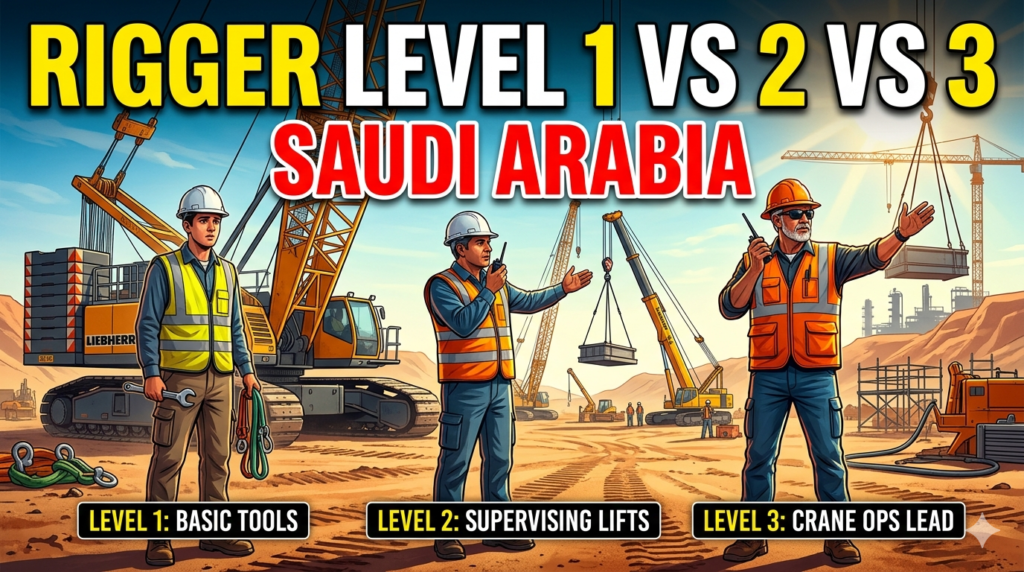
Rigger Level 1: Entry-Level Foundation and Basic Duties
Entry-level riggers with less than 1 year experience earn an average total compensation of SAR 135.00 per hour (PayScale, 2026). This makes it an attractive starting point for workers entering industrial sectors. Level 1 riggers assist experienced personnel while learning fundamental rigging principles and safety protocols.
At this stage, you’re building your foundation. Your main responsibilities include:
- Inspecting rigging equipment before and after use (slings, shackles, hooks, chains).
- Preparing the work area by clearing obstacles and setting up safety barriers.
- Assisting Level 2 and 3 riggers in attaching loads and positioning equipment.
- Passing hand signals to crane operators under supervision.
- Following lift plans created by senior riggers.
- Performing basic knots and hitches for securing loads.
- Understanding load weights and basic centers of gravity.
You won’t be planning lifts or working independently yet. Most of your day involves taking direction, learning proper techniques, and understanding safety procedures. Training typically covers OSHA standards, HSE requirements, and basic rigging mathematics.
Common work sites for Level 1 riggers include construction projects, warehouses, manufacturing plants, and maintenance facilities. You’ll spend time observing, assisting, and gradually taking on more responsibility as you demonstrate competence.
Our insight: Many companies in Saudi Arabia prefer hiring Level 1 riggers with NEBOSH or IOSH safety training certificates, even though these aren’t mandatory. This additional safety knowledge can help you stand out and accelerate your promotion to Level 2.
Rigger Level 2: Independent Operations and Complex Lifting Tasks
Early career riggers with 1-4 years of experience earn an average total compensation of SAR 25.00 per hour (PayScale, 2026). At Level 2, you’ve proven your competence and can perform most rigging operations without constant supervision.
Your expanded responsibilities include:
- Calculating load weights and selecting appropriate rigging gear.
- Interpreting lift plans and modifying them for site conditions.
- Communicating directly with crane operators using standard hand signals.
- Rigging complex loads including machinery, steel structures, and awkward shapes.
- Conducting pre-lift meetings with the lifting team.
- Identifying hazards and implementing control measures.
- Training and guiding Level 1 riggers during operations.
- Maintaining rigging equipment logs and inspection records.
You’re expected to work independently on routine lifts while consulting senior riggers for unusual or high-risk operations. Level 2 riggers often specialize in specific sectors. Some focus on offshore oil platforms, others on high-rise construction, and some on industrial plant maintenance.
According to recent job postings, 25 rigger positions (Levels 1, 2, and 3) were available in Riyadh, Saudi Arabia with a salary range of 1,600-2,500 SAR (Bureau of Emigration & Overseas Employment, 2025). This shows consistent demand across all certification levels.
Learn more about crane operator signals

Rigger Level 3: Supervision, Planning, and Critical Lift Management
The highest pay recorded for a rigger in Saudi Arabia is SAR 391.49 per hour (PayScale, 2026). This is typically achieved by experienced Level 3 riggers with specialized skills or supervisory roles. Level 3 represents the top of the rigging profession, combining technical expertise with leadership abilities.
At this level, your responsibilities expand significantly:
- Creating detailed lift plans for critical and complex operations.
- Conducting risk assessments and method statements (RAMS).
- Supervising rigging teams and allocating tasks.
- Approving rigging equipment selection and usage.
- Coordinating with project managers and safety officers.
- Performing technical calculations for specialized lifts.
- Investigating incidents and implementing corrective actions.
- Training and certifying Level 1 and Level 2 riggers.
- Ensuring compliance with local and international standards.
Level 3 riggers often hold additional certifications in advanced rigging techniques, crane operations, or HSE management. You are the go-to expert for challenging scenarios—installing large turbines, positioning bridge sections, or handling sensitive equipment in confined spaces.
The average salary range for a rigger is between SAR 84,477 and SAR 139,900 annually (ERI Economic Research Institute). Level 3 riggers typically earn at the higher end or exceed these figures when working for major oil and gas companies or large construction firms.
Our insight: Level 3 riggers in Saudi Arabia’s oil and gas sector often earn significantly more than construction-based riggers. This is due to the complexity of offshore operations and the higher safety requirements. Some experienced professionals report earnings exceeding SAR 200,000 annually when including allowances and overtime.
Career Progression: Your Path from Level 1 to Level 3
Moving through the rigging certification levels requires both time and demonstrated competence. Here’s what the typical progression looks like:
From Level 1 to Level 2:
- Minimum 1-2 years of practical experience.
- Complete intermediate rigging training (usually 5-7 days).
- Pass written and practical assessments.
- Demonstrate ability to work independently on routine lifts.
- Show consistent safety awareness and equipment knowledge.
From Level 2 to Level 3:
- Minimum 3-5 years of total rigging experience.
- Advanced training in lift planning and supervision (7-10 days).
- Pass comprehensive written, practical, and oral examinations.
- Prove leadership skills and team management ability.
- Complete specialized courses in critical lifts or specific equipment types.
Training providers in Saudi Arabia include international organizations like LEEA (Lifting Equipment Engineers Association), Aramco-approved centers, and specialized HSE training institutes. Many companies sponsor their riggers for certification upgrades when they demonstrate readiness.
Comparison Table: Rigger Levels at a Glance
| Aspect | Level 1 | Level 2 | Level 3 |
|---|---|---|---|
| Experience Required | 0-1 years | 1-4 years | 5+ years |
| Supervision Needed | Constant | Occasional | None |
| Planning Authority | None | Routine lifts | All lifts |
| Team Responsibility | Self only | Guides Level 1 | Supervises teams |
| Typical Hourly Rate | SAR 15-50 | SAR 25-100 | SAR 80-390 |
| Training Duration | 3-5 days | 5-7 days | 7-10 days |
| Risk Level Handled | Low | Medium | Critical |
Industry Demand and Future Outlook
Saudi Arabia’s Vision 2030 initiatives continue driving substantial infrastructure development. This creates sustained demand for qualified riggers. The NEOM project, Red Sea tourism developments, and ongoing oil and gas expansion ensure job security for certified professionals.
The average hourly pay for a rigger in Saudi Arabia is SAR 40.00 (PayScale, 2026), placing rigging among the better-compensated skilled trades in the Kingdom. Companies particularly seek riggers with:
- Multi-sector experience (construction, oil and gas, marine).
- Additional safety certifications (NEBOSH, IOSH).
- Crane operation knowledge.
- Bilingual capabilities (English and Arabic).
- Specialized equipment expertise.
The lowest pay recorded for a rigger in Saudi Arabia is SAR 14.90 per hour (PayScale, 2026). This typically represents entry-level positions in smaller companies or rural areas. However, experienced professionals working for major contractors or petrochemical facilities command premium rates.
Frequently Asked Questions
What certification is required to work as a rigger in Saudi Arabia?
You need an accredited rigging certification from organizations like LEEA, NCCCO, or Aramco-approved training centers. Most employers also require a valid medical certificate, safety training (HSE induction), and sometimes NEBOSH IGC. International certifications are recognized, but verification through Saudi authorities is necessary.
How long does it take to become a Level 3 rigger?
Typically 5-7 years from starting as a Level 1. This includes 1-2 years gaining experience at Level 1, 3-4 years working as Level 2, plus completing the required training courses and passing examinations. Some exceptionally skilled riggers advance faster in companies with accelerated development programs.
Can riggers earn more than SAR 40.00 per hour in Saudi Arabia?
Absolutely. The average hourly pay is SAR 40.00 (PayScale, 2026), but experienced Level 3 riggers in specialized roles earn significantly more. Offshore riggers, critical lift specialists, and those in supervisory positions often command SAR 100-200 per hour, with some reaching the recorded maximum of SAR 391.49 per hour.
What’s the difference between a rigger and a crane operator?
Riggers prepare loads, attach rigging equipment, signal crane operators, and ensure safe lifting operations. Crane operators control the crane itself. However, many experienced riggers also complete cross-training in crane operation. Some Level 3 riggers hold both certifications, increasing their employability and earning potential.
Are there jobs for female riggers in Saudi Arabia?
Yes, though less common than in Western countries. As Saudi Arabia continues modernizing its workforce under Vision 2030, more opportunities are opening for women in traditionally male-dominated fields. Some companies now hire female riggers, particularly in manufacturing facilities and logistics operations with appropriate facilities.
Conclusion
Understanding the differences between rigger certification levels helps you plan your career strategically. Whether you’re just starting out or looking to advance, Saudi Arabia offers strong opportunities for skilled rigging professionals across construction, oil and gas, and industrial sectors.
Key takeaways:
- Level 1 riggers assist experienced personnel and learn fundamental skills, earning entry-level wages.
- Level 2 riggers work independently on routine lifts with 1-4 years’ experience and moderate pay increases.
- Level 3 riggers supervise teams, plan critical lifts, and earn premium rates with 5+ years’ experience.
- Career progression requires both practical experience and formal training certifications.
- Salary ranges from SAR 14.90 to SAR 391.49 per hour, with averages around SAR 40.00.
- Industry demand remains strong due to Vision 2030 projects and ongoing infrastructure development.
- Specialization in sectors like oil and gas or offshore operations increases earning potential significantly.
Start with proper certification, gain hands-on experience, prioritize safety in every operation, and you’ll find rigging offers a stable, well-compensated career path in Saudi Arabia’s growing economy.