


Contents
- 1 1. What Are the Main Types of Fire Extinguishers?
- 2 2. When Should You Use a Water or Foam Extinguisher?
- 3 3. Is a CO2 Extinguisher the Right Choice for Electrical Fires?
- 4 4. What Makes Dry Powder Extinguishers Versatile — and Problematic?
- 5 5. Why Do Commercial Kitchens Need Wet Chemical Extinguishers?
- 6 6. Frequently Asked Questions
- 7 Ready to Train Your Team?
Reaching for the wrong fire extinguisher can turn a containable fire into a disaster. According to the National Fire Protection Association (NFPA), the majority of workplace fires that escalate beyond their starting point do so because the first responder either had no extinguisher or used the wrong type. For safety officers and facility managers, that’s a preventable failure — and it almost always comes down to training gaps, not equipment gaps.
This guide covers the five main types of fire extinguishers, the fire classes each one addresses, and the specific situations where using the wrong one creates more danger than it solves.
TL;DR: The five main fire extinguisher types, water, foam, CO2, dry powder, and wet chemical — each target specific fire classes. Using the wrong type can spread or intensify a fire. Match the extinguisher to the fire class before an emergency happens.
1. What Are the Main Types of Fire Extinguishers?
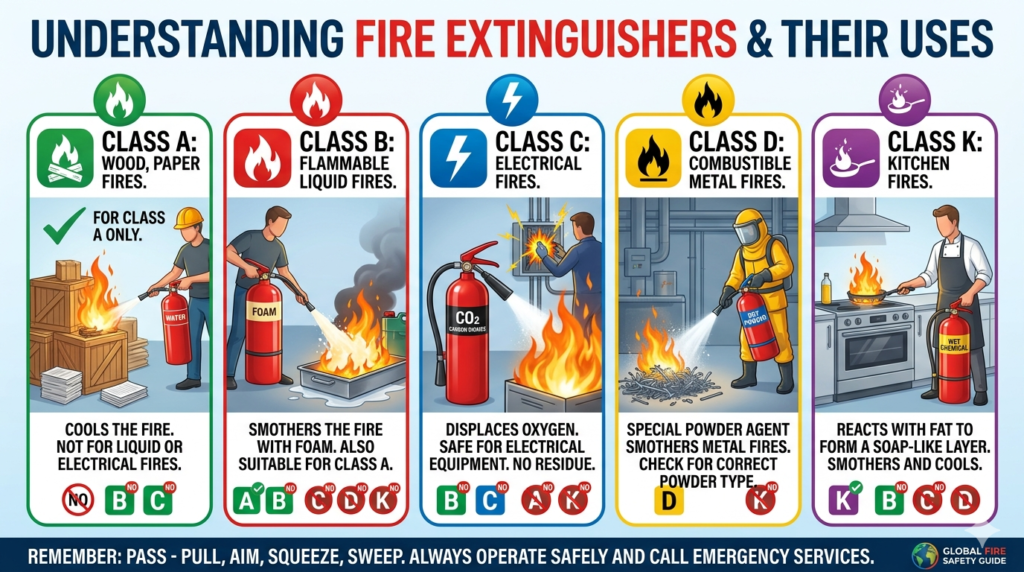
The five types facility managers need to know are water, foam, CO2, dry powder, and wet chemical. Each works through a different suppression mechanism — cooling, smothering, displacing oxygen, or interrupting the chemical chain reaction — and each is rated for specific fire classes by bodies like the NFPA and the Saudi Civil Defence authority.
Getting this wrong isn’t a minor mistake:
- Applying a water extinguisher to an electrical fire creates an electrocution risk
- Using dry powder on a cooking oil fire won’t suppress the fire — it can cause re-ignition within seconds
Fire Extinguisher Types at a Glance
| Extinguisher Type | Label Colour | Best Used For | Do NOT Use On |
|---|---|---|---|
| Water | Red | Class A (wood, paper, textiles) | Electrical fires, flammable liquids |
| Foam (AFFF) | Red / Cream | Class A & B (liquids, solvents) | Electrical fires, cooking oils |
| CO2 | Red / Black | Class B & C (electrical, liquids) | Class A materials (re-ignition risk) |
| Dry Powder (ABC) | Red / Blue | Class A, B & C (multi-purpose) | Enclosed spaces, cooking oil fires |
| Wet Chemical | Red / Yellow | Class F / Class K (cooking oils, fats) | Electrical fires, flammable solvents |
Understanding Fire Classes
Choosing the right extinguisher starts with identifying the fire class in your environment. For a full breakdown of what each class means and which fuel types are involved, see our detailed guide: Classes of Fire A B C D K — Which Extinguisher Stops Each?
| Fire Class | Fuel Type | Common Examples |
|---|---|---|
| Class A | Solid combustibles | Wood, paper, textiles, cardboard |
| Class B | Flammable liquids | Petrol, paint, solvents, diesel |
| Class C | Flammable gases | LPG, butane, propane |
| Class D | Combustible metals | Magnesium, titanium, sodium |
| Class F / K | Cooking oils & fats | Vegetable oil, animal fat |
| Electrical | Live electrical equipment | Panels, servers, machinery |
Saudi Arabia Note: Dry powder ABC extinguishers dominate most commercial and industrial facilities in the Kingdom. While practical for multi-hazard environments, they are the wrong tool in kitchens or server rooms. Saudi Civil Defence guidelines specifically mandate wet chemical and CO2 in those areas respectively.
According to NFPA 10 (Standard for Portable Fire Extinguishers), selecting the correct agent type for the occupancy hazard class is a fundamental requirement in every compliant fire safety plan.
2. When Should You Use a Water or Foam Extinguisher?
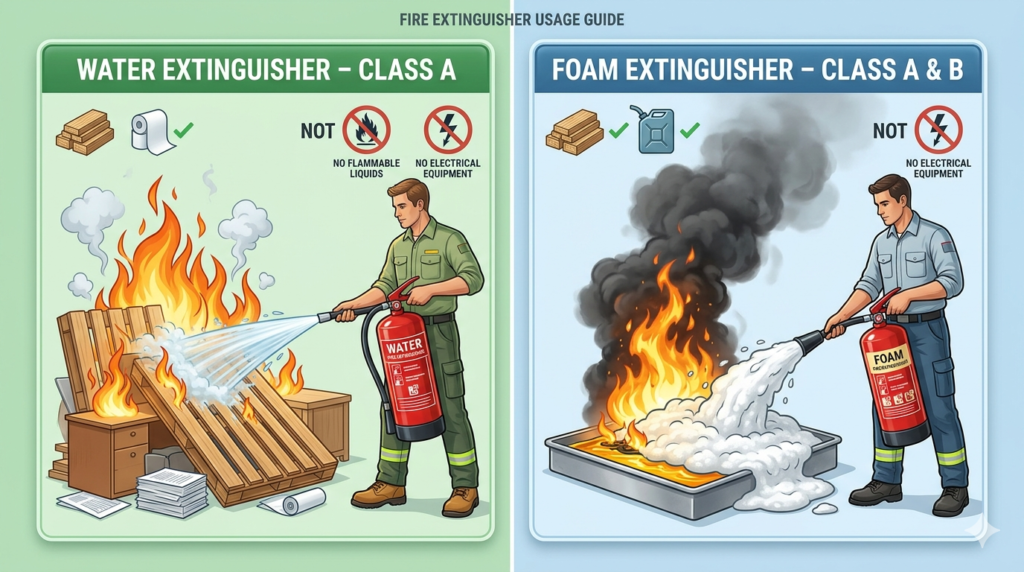
Water and foam extinguishers are the right choice for Class A fires — those involving ordinary combustibles like wood, paper, cardboard, and textiles. Foam extinguishers extend that coverage to Class B fires involving flammable liquids like petrol, paint, and solvents.
Water Extinguishers
- Label: Plain red
- Mechanism: Cools the burning material below its ignition point
- Best for: Open office environments, warehouses storing paper goods, general storage areas
- Limitation: Not safe near any live electrical equipment — including mist-type variants
Foam Extinguishers (AFFF)
- Label: Red with cream panel
- Mechanism: Creates a smothering layer over flammable liquids, cutting off oxygen supply
- Best for: Mixed environments where both solid materials and liquid chemicals are present — light manufacturing floors, for instance
- Limitation: Not rated for live electrical panels or cooking oil fires
Key Limitation for Both Types
Neither water nor foam extinguishers are safe near live electrical equipment. Even mist-type water extinguishers, which carry a higher safety margin than jet types, are not rated for live electrical panels.
Practical warning: Facilities that stock only water extinguishers in mixed-use areas create a real response gap. If a fire starts near a printer or electrical cabinet, grabbing the nearest extinguisher can make the situation significantly worse.
According to NFPA fire incident data, Class A fires account for the largest share of reported structure fires in commercial buildings — making water and foam extinguishers the baseline requirement for nearly every facility type.
3. Is a CO2 Extinguisher the Right Choice for Electrical Fires?
Yes — CO2 extinguishers are the standard and correct recommendation for electrical fires. They are among the most commonly specified types in server rooms, data centres, and office environments across Saudi Arabia. The UK’s Health and Safety Executive rates CO2 as safe for use on live electrical equipment up to 1,000 volts.
CO2 Extinguisher: Pros and Cons
| Pros | Cons |
|---|---|
| Leaves zero residue — safe for electronics | Dissipates quickly in open or ventilated spaces |
| Rated safe for live electrical equipment | Creates suffocation risk in confined spaces |
| Effective on Class B flammable liquids | Does not cool burning material — re-ignition risk on Class A |
| No secondary damage to sensitive equipment | Less effective outdoors or in large areas |
Where CO2 Extinguishers Are Mandatory
- Server rooms and data centres
- Electrical control panels
- Office IT environments
- Telecommunications facilities
Critical insight: CO2 extinguishers do not cool the burning material. Once the gas disperses, a Class A fire can re-ignite. They are not a standalone solution for mixed-material environments — always pair with appropriate backup coverage.
According to a fire safety analysis of Gulf commercial properties, CO2 extinguishers are the most specified type in IT and telecommunications facilities in Saudi Arabia and the UAE, aligning with international electrical fire suppression standards.
4. What Makes Dry Powder Extinguishers Versatile — and Problematic?
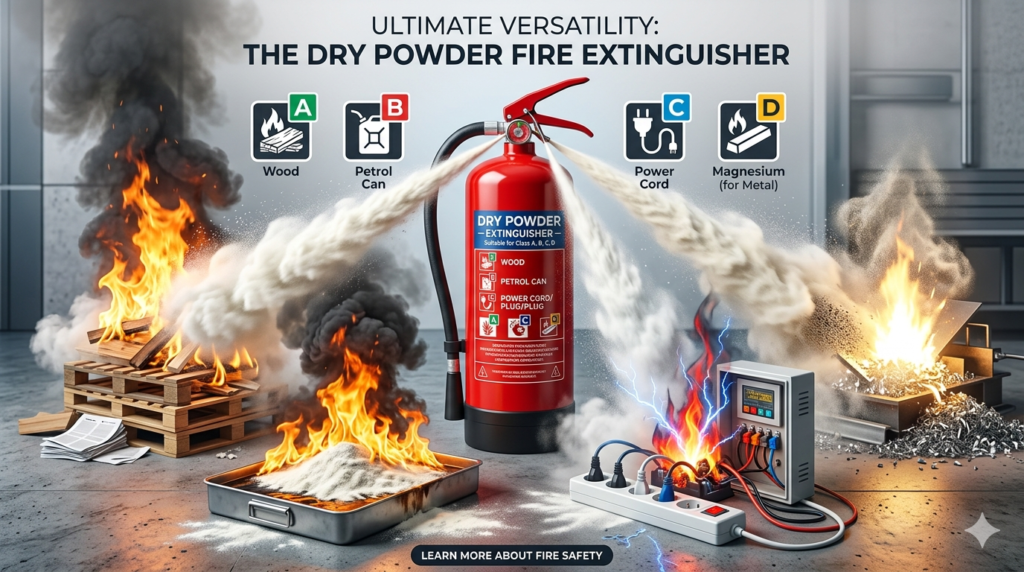
Dry powder ABC extinguishers handle the widest range of fire classes: A (solids), B (liquids), and C (gases). That versatility explains why they are the most widely installed type across Saudi industrial, construction, and commercial sites.
- Label: Red with blue panel
- Mechanism: Interrupts the chemical chain reaction of combustion
- Coverage: Class A, B, and C fires
Where Dry Powder Works Well
- Industrial warehouses and manufacturing floors
- Construction sites with multiple fuel types
- Petrol stations and vehicle workshops
- Multi-hazard commercial environments
Where Dry Powder Should NOT Be Used
| Environment | Reason to Avoid |
|---|---|
| Server rooms & IT environments | Fine residue permanently damages electronics |
| Electrical control rooms | Residue contaminates sensitive equipment |
| Commercial kitchens | Ineffective on Class F/K fires; re-ignition risk |
| Enclosed spaces with poor ventilation | Dense discharge cloud reduces visibility and causes respiratory irritation |
| Food preparation areas | Residue contaminates surfaces and equipment |
The Class D Variant — A Specialist Product
There is also a Class D dry powder formulated specifically for metal fires (magnesium, titanium, sodium). This is a specialist product for laboratories and manufacturing environments. It is chemically distinct from ABC powder and cannot substitute for it in standard hazard areas. Standard ABC units applied to a Class D metal fire can react violently — intensifying the fire rather than suppressing it.
According to NFPA 10, dry chemical extinguishers must be matched to the specific fire hazard classification of each area — a general-purpose ABC unit is not compliant in a Class D metal hazard environment.
5. Why Do Commercial Kitchens Need Wet Chemical Extinguishers?
Wet chemical extinguishers are the only type rated for Class F / Class K fires — those involving cooking oils and animal fats heated to ignition point.
Why this matters: A standard dry powder or CO2 extinguisher applied to a burning oil fire causes a violent steam explosion that spreads burning oil rather than suppressing the fire. Saudi Civil Defence regulations mandate wet chemical extinguishers in all commercial kitchen environments for precisely this reason.
How Wet Chemical Extinguishers Work
Wet chemical extinguishers work through two simultaneous mechanisms:
- Cooling — The agent rapidly cools the burning oil
- Saponification — The agent reacts chemically with the fat to form a soapy foam layer that seals the surface and prevents re-ignition
Correct Application Technique
- Stand back from the fire at the distance indicated on the unit
- Apply the agent using a slow, circular motion over the fire’s surface
- Do not aim directly into the burning oil — this causes dangerous splashing
- Apply at low pressure to avoid spreading burning liquid
Wet Chemical Extinguisher: Quick Reference
| Feature | Detail |
|---|---|
| Label colour | Red with yellow panel |
| Fire class | Class F / Class K (cooking oils and fats) |
| Mechanism | Cooling + saponification (foam seal) |
| Mandatory in | All commercial kitchens (Saudi Civil Defence requirement) |
| Do NOT use on | Electrical fires, flammable solvents |
According to the UK Fire and Rescue Service, cooking-related fires account for nearly 50% of all accidental dwelling fires — and the figure is proportionally significant in commercial settings where bulk cooking oils are used.
6. Frequently Asked Questions
What are the 4 main types of fire extinguishers?
The four most commonly referenced types are water, foam, CO2, and dry powder. A fifth — wet chemical — is essential in commercial kitchens but sometimes excluded from general lists. NFPA 10 classifies extinguishers by both agent type and fire class rating, so matching the type to your specific hazard is always the starting point.
What is a Class ABC fire extinguisher and when is it used?
A Class ABC extinguisher contains dry chemical powder rated for ordinary combustibles (A), flammable liquids (B), and electrical fires (C). It is the most versatile portable extinguisher available and the most widely installed type in mixed-use commercial and industrial facilities across Saudi Arabia and the wider Gulf region.
What are the three most common fire extinguisher types found in workplaces?
Dry powder ABC, CO2, and foam are the three most commonly installed types in commercial workplaces. Dry powder covers most multi-hazard areas, CO2 is standard in electrical and IT environments, and foam handles liquid fuel risks. Most facility compliance plans require a combination rather than relying on a single type.
What extinguisher should you use on an electrical fire?
CO2 extinguishers are the correct choice for electrical fires. They leave no residue and are rated safe for live electrical equipment. Water and foam extinguishers conduct electricity and create electrocution risk. Dry powder can be used if CO2 isn’t available but causes significant secondary damage to equipment.
What are the 7 types of fire extinguishers?
The seven types are water, water mist, foam, dry powder ABC, dry powder Class D for metal fires, CO2, and wet chemical. Water mist is increasingly common in healthcare environments because it is safe near patients and electrical equipment. Each type carries a specific colour-coded label under international standards.
Ready to Train Your Team?
Knowing the right extinguisher is only half the equation — your team needs to be confident using it under pressure. EUTC Global’s Fire Fighting Course is OSHA KSA and SGS/SAAC approved, covers hands-on extinguisher use across all fire classes, and is available on-site at your facility across Saudi Arabia. Trusted by 500+ organizations with a 4.9/5 rating.