


Contents
- 1 TL;DR
- 2 The Five Classes of Fire A B C D K: Quick Reference
- 3 What Makes Class B Fires the Biggest Risk in Oil and Gas?
- 4 Why Class C and Class D Fires Catch Workers Off Guard
- 5 Class K Fires: The Overlooked Hazard on Remote Sites
- 6 How to Match the Right Extinguisher to Each Fire Class
- 7 Frequently Asked Questions
- 8 Key Takeaways
Using the wrong extinguisher on the wrong fire doesn’t just fail to stop it — it can make things dramatically worse. Water on a Class B fuel fire spreads burning liquid across the floor. CO₂ on a Class D metal fire can trigger a violent reaction. Yet across oil rigs, construction sites, and petrochemical facilities throughout Saudi Arabia, workers still reach for the nearest extinguisher without checking the label.
TL;DR
There are five fire classes A, B, C, D, and K — each requiring a specific extinguisher type. Using the wrong agent (e.g., water on Class B) can spread the fire or cause electrocution. NFPA 10, adopted by Saudi Civil Defense, mandates extinguisher matching by fuel type across all industrial workplaces.
The Five Classes of Fire A B C D K: Quick Reference
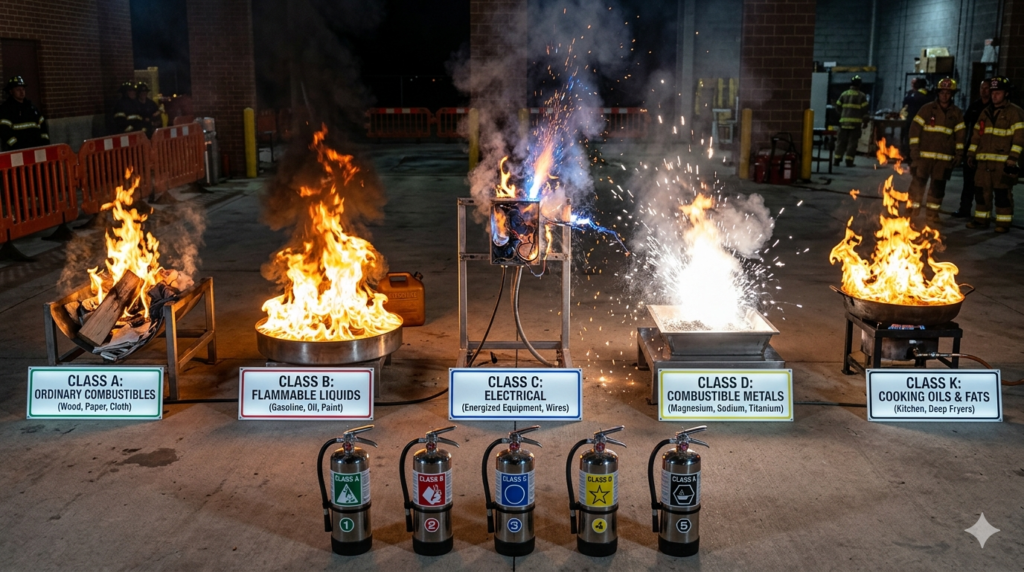
Each class in the A B C D K system is defined by its fuel source — and that determines which suppression agent will actually work.
| Class | Fuel Type | Saudi Workplace Example | Correct Extinguisher |
|---|---|---|---|
| Class A | Ordinary combustibles (wood, paper, cloth) | Site offices, scaffolding timber | Water, foam, ABC dry powder |
| Class B | Flammable liquids & gases | Diesel spills, LPG, crude oil | CO₂, dry powder (ABC/BC), foam |
| Class C | Energized electrical equipment | Control panels, transformers | CO₂, dry powder (non-conductive) |
| Class D | Combustible metals | Magnesium shavings, titanium parts | Dry sand, Class D powder only |
| Class K | Cooking oils & fats | Rig catering kitchens, site canteens | Wet chemical agent |
Worth noting
Most Saudi industrial sites stock ABC dry powder extinguishers as a catch-all. That covers Classes A, B, and C — but creates a false sense of security in areas where Class D metals are processed or Class K cooking equipment is present. Both require entirely different agents that ABC powder can’t handle.
What Makes Class B Fires the Biggest Risk in Oil and Gas?
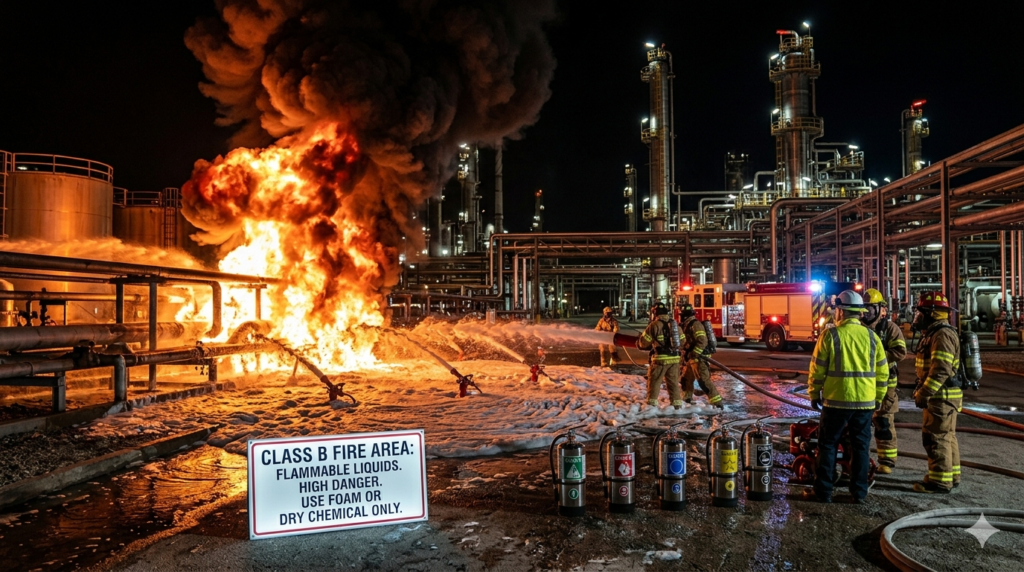
Class B fires — flammable liquids and gases — represent the most common and dangerous fire type in Saudi Arabia’s oil and gas sector. Diesel spills, LPG leaks, hydrocarbon vapors, and crude oil exposure are everyday realities on Aramco-affiliated sites, NEOM construction zones, and offshore platforms.
The core problem: water makes Class B fires worse. It doesn’t mix with most flammable liquids — it floats on top and splashes burning fuel across a wider area. That’s how a contained spill becomes a facility-wide emergency.
The correct agents are CO₂, BC or ABC dry powder, and aqueous film-forming foam (AFFF). The choice depends on the fire: foam works best on pooled liquid; dry powder or CO₂ is more effective on running gas fires. GPCA 2025 safety guidelines specifically reinforce Class B training for Gulf petrochemical workers given the density of hydrocarbon handling in the region.
Why Class C and Class D Fires Catch Workers Off Guard
Class C: Energized Electrical Fires
Class C fires involve live electrical equipment — control panels, junction boxes, motors, transformers. The danger isn’t just the fire: using a conductive agent (especially water) turns the worker into a path for electrical current. CO₂ and dry powder extinguishers are both non-conductive and appropriate. Once power is isolated, the fire may downgrade to Class A if ordinary combustibles are involved.
Recurring audit finding
Across Saudi industrial sites, workers spray water-based extinguishers on electrical panels during drills. This indicates a persistent training gap rather than a labeling failure — the problem isn’t access to correct equipment, it’s knowledge of when not to use what’s available.
Class D: Combustible Metal Fires
Class D fires are rare but extremely dangerous. Metals like magnesium, titanium, and sodium can ignite from welding sparks or grinding operations. Standard extinguishers — including ABC dry powder — can react violently with burning metals, intensifying the fire or causing steam explosions. The only safe approach is dry sand or a specialized Class D powder agent, applied gently to avoid scattering burning particles.
→ Related: What is basic fire fighting training
Class K Fires: The Overlooked Hazard on Remote Sites
Class K fires involve cooking oils and animal fats at high temperatures. Every oil rig, construction camp, and remote Vision 2030 project site has a catering facility — and those kitchens face real Class K risk.
The specific danger is auto-ignition. Cooking oil heated past its flash point doesn’t need an external ignition source. When it ignites, ABC dry powder scatters burning oil and spreads the fire across the kitchen. Wet chemical extinguishers are the correct choice — the agent reacts with burning fat through saponification, turning the oil surface into a soapy foam that cools and prevents re-ignition. Saudi Civil Defense audits increasingly flag missing Class K extinguishers in site catering areas as a compliance violation.
How to Match the Right Extinguisher to Each Fire Class
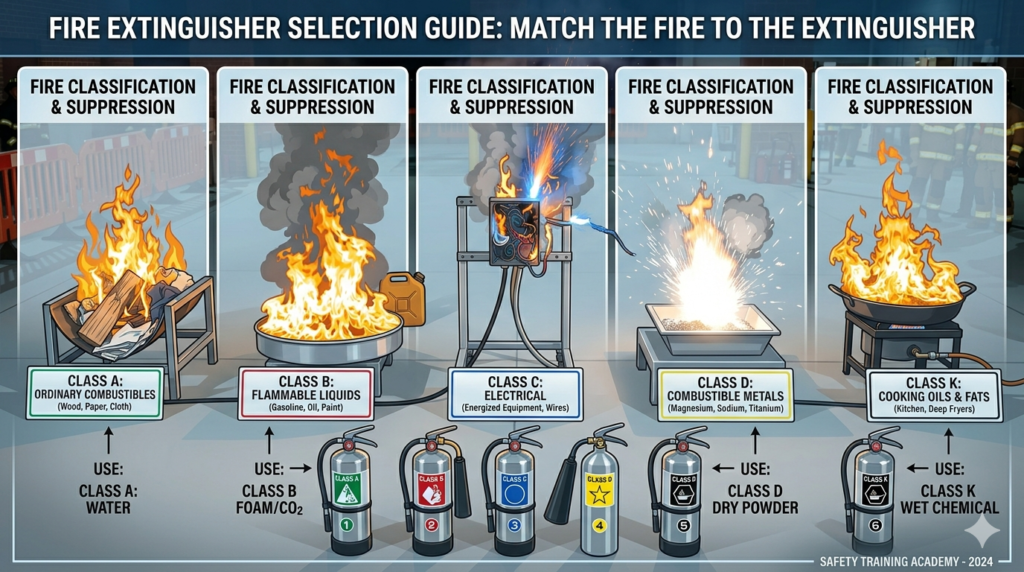
Matching extinguisher to fire class comes down to three things: reading the label, knowing your worksite hazards, and never assuming a multi-purpose unit covers every scenario.
ABC dry powder covers the majority of Class A, B, and C situations — but Class D and Class K require purpose-specific units. A single missing wet chemical extinguisher in a site kitchen, or a missing Class D unit near a welding bay, is both a compliance failure and a genuine life-safety gap.
Practical rule for supervisors
Walk every area of your site and list what’s burning if a fire starts there. Then check whether the extinguisher on the wall matches that fuel type. If it doesn’t, that’s a corrective action item before the next audit finds it first.
Frequently Asked Questions
What are the 5 classes of fire A B C D K?
A (ordinary combustibles), B (flammable liquids and gases), C (energized electrical equipment), D (combustible metals like magnesium), and K (cooking oils and fats). Each class requires a different suppression agent — using the wrong one can spread the fire or create additional hazards.
What causes Class B fires in oil and gas?
Diesel spills, LPG leaks, crude oil exposure, and hydrocarbon vapors. These are the most common serious fire type on Saudi industrial sites. GPCA 2025 guidelines specifically reinforce Class B training for Gulf petrochemical workers.
What are Class C fire examples in the workplace?
Live control panels, transformers, switchboards, and motors. Never use water on a Class C fire — it conducts electricity and risks electrocution. CO₂ or dry powder are the correct choices. Once power is isolated, the fire may reclassify as Class A.
How do you put out a Class D metal fire?
Use dry sand or a dedicated Class D powder agent only. Standard ABC extinguishers can react violently with burning metals. Class D fires are most common near welding, grinding, and metal fabrication operations.
What type of extinguisher is needed for Class K fires?
A wet chemical extinguisher. The agent reacts with burning cooking oil through saponification, forming a foam layer that suppresses and cools the fire. ABC dry powder will scatter burning oil and worsen the fire. Class K extinguishers are mandatory in site catering areas under Saudi Civil Defense compliance standards.
Key Takeaways
- Class A, B, C fires are the most common — ABC dry powder covers all three, but it’s not a universal solution
- Class B fires in oil and gas are the highest-consequence risk — water makes them spread; foam or CO₂ is required
- Class C fires require non-conductive agents — water on live electrical equipment is a fatal combination
- Class D and K fires need purpose-specific extinguishers that most sites don’t stock in sufficient quantities
- NFPA 10 and Saudi Civil Defense standards require extinguisher matching to specific hazard classes — not just general coverage
Practical next step: today, walk your worksite and verify every mounted extinguisher matches the hazard class in that area. Pay particular attention to welding bays, electrical rooms, and site catering facilities — the three most common compliance gaps found during Saudi Civil Defense inspections.