


Contents
- 1 Why Oil & Gas in Saudi Arabia Carries Unique Risk
- 2 The Top 10 Oil & Gas Hazards in Saudi Arabia — and How to Control Each One
- 2.1 1. Heat Stress — The Silent Killer in Desert Operations
- 2.2 2. H2S Exposure — Zero Margin for Error
- 2.3 3. Confined Space Entry — Where Incidents Escalate Fast
- 2.4 4. Fire and Explosion — Managing the Persistent Top Risk
- 2.5 5. Falls from Height — A Leading Cause of Fatalities
- 2.6 6. Heavy Equipment and Lifting Operations
- 2.7 7. Chemical Exposure in Refinery and Processing Environments
- 2.8 8. NORM Radiation — The Hazard Most Teams Underestimate
- 2.9 9. Ergonomic and Mechanical Strain
- 2.10 10. Remote Location Emergencies — When Response Time Works Against You
- 3 What’s Changing in Oil & Gas Safety for 2026
- 4 How to Prioritise Safety Controls on Your Site
- 5 Frequently Asked Questions
- 5.1 What are the major hazards in the oil and gas industry in Saudi Arabia?
- 5.2 How dangerous is oil and gas work in Saudi Arabia?
- 5.3 What H2S training is required for oil and gas work in Saudi Arabia?
- 5.4 What is the Permit-to-Work system in oil and gas KSA?
- 5.5 How can oil and gas sites in Saudi Arabia control heat stress?
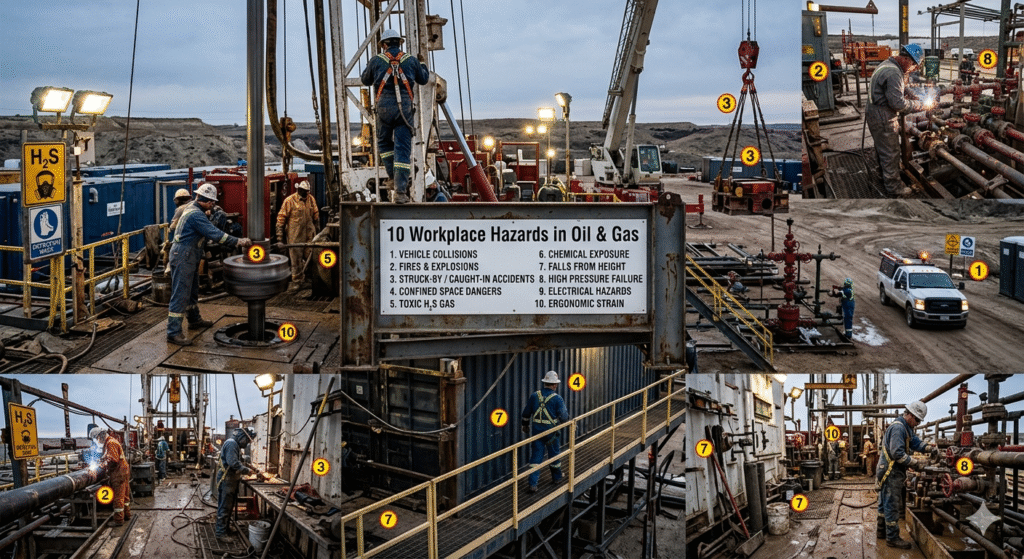
You’re walking onto a site in the Eastern Province. It’s 8 AM and already 42°C. Your crew is prepping for confined space entry while another team handles hot work nearby. A third group is running lifting operations, three high-risk activities, one location, dozens of variables that could go wrong.
This is a normal morning in oil and gas operations across Saudi Arabia.
The industry drives the Kingdom’s economy and is expanding rapidly under Vision 2030. But growth brings pressure, on timelines, crews, and safety systems that may not always keep up. Whether you’re an HSE officer at a refinery, a site supervisor managing a shutdown, or new to the sector, knowing exactly which hazards you face, and what actually controls them, can be the difference between a productive shift and a tragedy.
Here’s what every oil and gas professional needs to know heading into 2026.
Why Oil & Gas in Saudi Arabia Carries Unique Risk
Most industries deal with hazards. Oil and gas deals with several simultaneously, in conditions that amplify every single one.
You’re working with flammable hydrocarbons in temperatures that regularly exceed 50°C, across a workforce that may span 10+ nationalities, on sites that can be hours from the nearest hospital. Regulatory audits under Saudi Aramco HSE standards and MHRSD requirements carry zero tolerance for lapses — a single violation can halt operations and cost you a contract.
Saudi Arabia’s workplace safety market reached USD 504.6 million in 2024 and is projected to grow at a 19.1% CAGR through 2030, reflecting both the scale of projects like NEOM and the serious investment required to manage risk at that scale.
The Top 10 Oil & Gas Hazards in Saudi Arabia — and How to Control Each One
1. Heat Stress — The Silent Killer in Desert Operations
Temperatures above 50°C are not unusual on KSA oil fields. Heat exhaustion can set in within minutes for an unprotected worker, and heatstroke can be fatal.
Effective controls:
- Shift schedules that move heavy physical work to early morning or evening
- Mandatory hydration programs with electrolyte access — not just water
- Shaded rest areas within walking distance of the work zone
- Acclimatization periods for workers new to the site
A common mistake is treating heat stress as a seasonal concern. In the Eastern Province, it can affect outdoor workers year-round.
2. H2S Exposure — Zero Margin for Error
Hydrogen sulfide is colourless, fast-acting, and lethal at concentrations that are easy to miss without proper equipment. It’s present across drilling, processing, and pipeline work throughout KSA.
Effective controls:
- Continuous gas monitoring at all H2S-risk locations
- Personal H2S detectors for every worker in the zone
- Regular H2S training — not just at induction, but periodically refreshed
- Evacuation drills your team has actually practised, not just read about
H2S training programmes based in Al Khobar have become a critical site entry requirement for many Aramco-affiliated projects. Outdated certification is a gap worth closing before an audit finds it.
3. Confined Space Entry — Where Incidents Escalate Fast
Tanks, vessels, pipelines, and manholes are everywhere in oil and gas facilities. Hazards inside them — oxygen deficiency, toxic gases, engulfment — can incapacitate a worker in seconds.
Effective controls:
- A robust Permit-to-Work (PTW) system before any entry
- Atmospheric testing before and during entry — not just before
- Trained standby personnel and a written rescue plan
- Confined space training covering emergency retrieval, not just entry procedures
The most common failure point isn’t equipment — it’s schedule pressure causing teams to skip atmospheric testing or rush the PTW process.
4. Fire and Explosion — Managing the Persistent Top Risk
Hydrocarbons are flammable. Everyone knows this. But complacency is what keeps fire and explosion a persistent leading hazard across petrochemical and refinery sites.
Effective controls:
- Gas detection systems with automatic shutdown integration
- Strict hot work permit systems with physical area inspections before ignition
- Flame-resistant (FR) clothing as a non-negotiable PPE requirement
- Emergency shutdown procedures your team can execute under real pressure
Practical audit check: When did you last run an unannounced fire drill? Teams that only perform well when they know it’s coming are revealing a critical gap.
5. Falls from Height — A Leading Cause of Fatalities
Falls remain one of the leading causes of fatalities across oil and gas globally. On offshore platforms, during turnarounds, or on the major infrastructure projects currently underway across KSA, the exposure is constant.
Effective controls:
- Full harness systems with proper anchor points — inspected before every shift
- Fixed guardrails and barriers wherever feasible (engineering controls beat PPE every time)
- Pre-task Job Safety Analysis (JSA) for any work above 1.8 metres
- Toolbox talks specific to the day’s actual task — not generic safety lectures
6. Heavy Equipment and Lifting Operations
Cranes, forklifts, and heavy lifting are daily realities on oil and gas construction and maintenance sites. Crush injuries and struck-by incidents are among the most severe.
Effective controls:
- Lockout/Tagout (LOTO) procedures applied consistently — not only when supervisors are present
- Documented rigging inspections before every lift
- Certified, competent operators only — qualifications are non-negotiable here
- Enforced exclusion zones during lifts with a designated signaller
LOTO compliance in Saudi Arabia is under increasing regulatory scrutiny. Undocumented or unpractised energy isolation procedures are a liability on multiple levels.
7. Chemical Exposure in Refinery and Processing Environments
Acids, solvents, and process chemicals are standard in refinery operations. Skin contact, inhalation, and eye exposure can cause injuries ranging from chemical burns to long-term respiratory damage.
Effective controls:
- Site-specific chemical handling training — not just distributing Safety Data Sheets (SDS)
- Appropriate respiratory protection matched to the actual chemical — not a generic dust mask
- Emergency eyewash and shower stations that are regularly tested and accessible
- Spill response kits positioned where spills are most likely to occur
8. NORM Radiation — The Hazard Most Teams Underestimate
Naturally Occurring Radioactive Materials (NORM) are present in oil and gas production — in scale buildup, pipes, and produced water systems. Exposure is gradual, invisible, and easy to overlook without proper monitoring.
Effective controls:
- Personal dosimetry for workers in high-risk areas
- Clearly defined controlled zones around NORM-affected equipment
- Specialist PPE and disposal procedures for contaminated materials
- Baseline and periodic dose assessments throughout employment
This is one of the most underestimated hazards in KSA oil and gas operations — and it’s receiving increasing regulatory attention heading into 2026.
9. Ergonomic and Mechanical Strain
Repetitive manual handling, awkward working positions, and equipment vibration cause injuries that accumulate quietly — resulting in long-term health problems and productivity loss that rarely appear in incident statistics.
Effective controls:
- Ergonomic tools and mechanical assists where available
- Task rotation schedules to reduce repetitive strain
- Fatigue management policies, especially on long rotational shifts
- Supervisors trained to identify early signs of strain before they become injuries
10. Remote Location Emergencies — When Response Time Works Against You
Many KSA oil and gas sites are hours from the nearest medical facility. When something goes wrong, distance makes every element of emergency response harder.
Effective controls:
- On-site medical facilities with trained first responders — not just a first aid box
- Satellite communication for sites beyond cellular coverage
- Regular evacuation and emergency response drills with realistic scenarios
- IoT-enabled monitoring systems that alert remotely even without standard internet connectivity
What’s Changing in Oil & Gas Safety for 2026
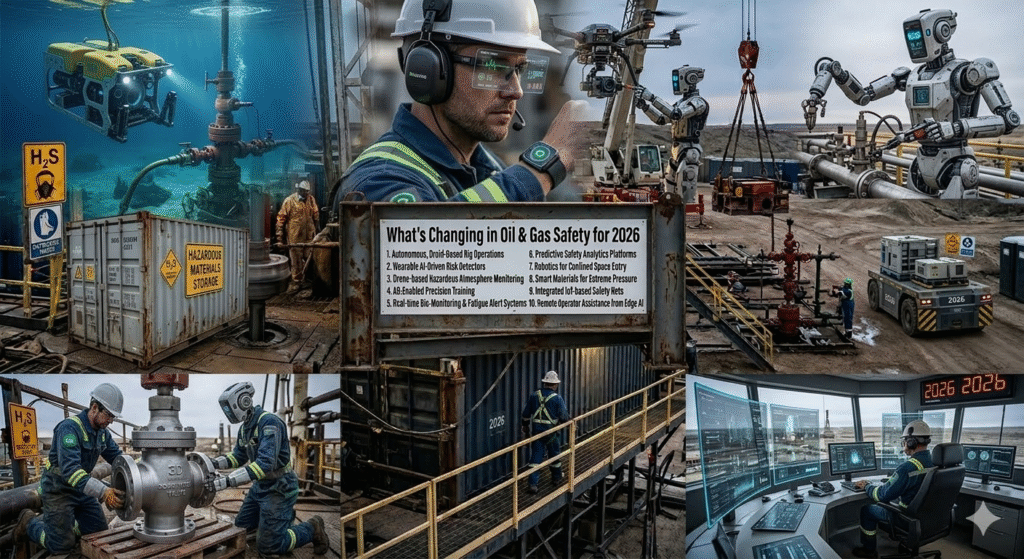
The regulatory environment is tightening. Saudi Aramco’s Safety Management System (SMS) requirements, MHRSD nationalization mandates, and ECRA oversight are pushing sites toward documented, fully auditable safety systems.
Technology expectations are shifting too. IoT-enabled gas sensors for real-time leak detection, VR and AR training for high-risk simulations, and digital Permit-to-Work platforms are moving from optional to expected — particularly on larger projects.
If your team is still managing hazards primarily through paper-based systems and infrequent training, the gap between your current approach and what regulators and clients expect is growing.
How to Prioritise Safety Controls on Your Site
Managing oil and gas hazards in Saudi Arabia isn’t about choosing which risks matter — all ten are active on most major sites simultaneously. The question is whether your controls are actually working, not just documented.
Start here:
- Audit your PTW and LOTO systems — are they followed consistently, or only when senior management is on site?
- Check H2S and confined space training records — when were they last refreshed?
- Review heat stress protocols — are they built into the actual work schedule, or only written in a policy?
- Test your remote emergency response — time it. The results may be surprising.
Frequently Asked Questions
What are the major hazards in the oil and gas industry in Saudi Arabia?
The major hazards include H2S toxic gas exposure, extreme heat stress, confined space entry, fire and explosion from flammable hydrocarbons, falls from height, heavy lifting and equipment incidents, chemical exposure, NORM radiation, ergonomic strain, and remote location emergencies. Each is amplified by KSA’s climate, site geography, and the scale of operations.
How dangerous is oil and gas work in Saudi Arabia?
It’s among the highest-risk working environments globally. The combination of extreme heat, hazardous materials, remote locations, and complex simultaneous operations demands active, well-resourced HSE management. Regulatory lapses can result in immediate site shutdowns and contract termination under Saudi Aramco and MHRSD standards.
What H2S training is required for oil and gas work in Saudi Arabia?
H2S awareness and emergency response training is mandatory on most Aramco-affiliated and major oil and gas sites in KSA. Training covers recognition, monitoring, respiratory protection, and emergency procedures. Programmes based in Al Khobar are widely recognised for site entry certification. A one-time induction certificate is not sufficient — refresher training is required periodically.
What is the Permit-to-Work system in oil and gas KSA?
The Permit-to-Work (PTW) system is a formal, documented process that authorises specific high-risk tasks — such as confined space entry, hot work, and working at height — after hazards have been identified and controls confirmed. When consistently enforced, it addresses the majority of equipment-related and task-related incident scenarios.
How can oil and gas sites in Saudi Arabia control heat stress?
Effective heat stress control combines shift scheduling (moving heavy work away from peak heat hours), mandatory hydration with electrolyte replacement, shaded rest areas, acclimatization programmes for new personnel, and supervisory monitoring for early warning signs. Heat stress management belongs in your daily site plan alongside every other operational hazard control.