


Contents
- 1 What Is Basic Firefighting Training?
- 2 What You’ll Learn: Core Curriculum Breakdown
- 3 How Long Does Firefighting Training Take?
- 4 Physical Fitness: The CPAT Test
- 5 Live Fire Training: Where It All Comes Together
- 6 Certification Requirements
- 7 Cost of Firefighting Training
- 8 Free Basic Firefighting Training Resources
- 9 Volunteer Firefighting: A Smart Starting Point
- 10 What Makes a Strong Firefighting Student?
- 11 Your Next Steps: How to Get Started
- 12 FAQ’s
Whether you’re responding to a job posting, attending a recruiter session, or simply feeling drawn to a more meaningful career — one question comes up every time: what actually happens in a firefighting training course?
This guide covers everything you need to know before enrolling — from curriculum and certification requirements to costs, physical prep, and free resources.
What Is Basic Firefighting Training?
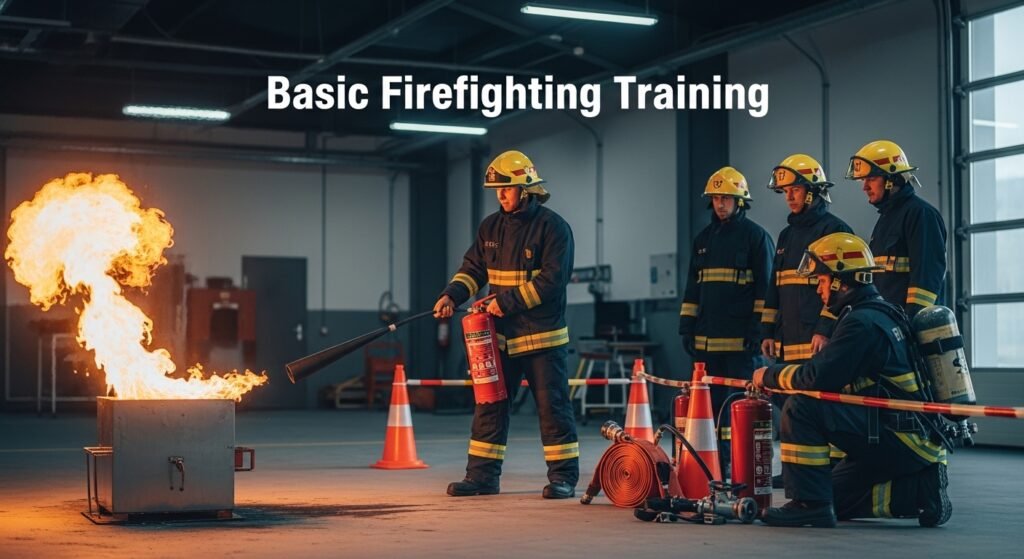
Basic firefighting training is a structured, hands-on program that teaches you how to safely suppress fires, rescue civilians, and operate effectively as part of a team.
Most U.S. programs follow the NFPA 1001 standard (National Fire Protection Association — Firefighter Professional Qualifications), which ensures a consistent national benchmark for skills and safety.
Course lengths vary by goal:
- 8–16 hours for workplace fire safety
- 32–40 hours for volunteer firefighter basics
- 200–250 hours for Firefighter I certification
- 400–428 hours for full fire academy (Firefighter I & II)
What You’ll Learn: Core Curriculum Breakdown
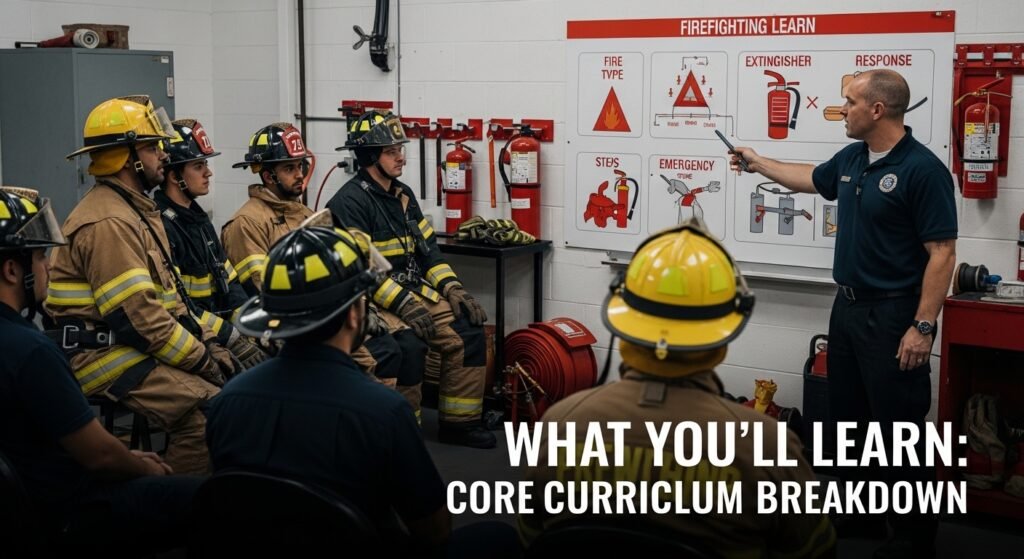
1. Fire Behavior and the Fire Tetrahedron
Every firefighting course starts here. You’ll study the fire tetrahedron — the four elements fire needs to survive:
- Heat
- Fuel
- Oxygen
- Chemical chain reaction
Understanding how fires grow, how flashover occurs, and how fires behave in enclosed spaces helps you make safer, faster decisions on scene.
2. Fire Extinguisher Types and Fire Classes
Not all fires are the same — and using the wrong extinguisher can make things worse. You’ll memorize all five fire classes:
| Class | Fire Type | Example |
|---|---|---|
| A | Ordinary combustibles | Wood, paper |
| B | Flammable liquids | Gasoline, oil |
| C | Electrical fires | Wiring, appliances |
| D | Combustible metals | Magnesium, titanium |
| K | Cooking oils/fats | Commercial kitchens |
3. SCBA Training for Firefighters
SCBA (Self-Contained Breathing Apparatus) is the air tank and mask system that keeps you breathing inside a burning structure.
Training covers:
- Donning and doffing quickly under pressure
- Pre-use equipment checks
- Breathing technique while physically exerting yourself
- Emergency procedures if the unit malfunctions
Many students are surprised by how different it feels to breathe through an SCBA while their heart rate is elevated. Programs build in repetitions until it becomes second nature.
4. Fire Suppression Techniques
This is the hands-on core of your training. You’ll learn:
- Hose handling and water application
- Interior attack strategies
- Ventilation methods (horizontal, vertical, positive pressure)
- Team coordination during active suppression
Some programs include wildland fire modules following NFPA 1051 — covering brush, forest, and open-terrain firefighting, which requires a separate skill set from structural respons
5. Hazmat Awareness
You won’t become a hazmat specialist in a basic course, but you will learn to:
- Identify hazardous material placards and labels
- Classify chemical and toxic threats
- Establish a safe perimeter
- Know when — and how — to call for specialized backup
6. Search, Rescue, and Basic EMS
Firefighters respond to more than fires. Your course covers:
- Primary and secondary search techniques in smoke-filled buildings
- Removing unconscious victims safely
- Basic emergency medical response (since most departments respond to EMS calls)
How Long Does Firefighting Training Take?
| Program Type | Approximate Hours | Typical Duration |
|---|---|---|
| Workplace fire safety | 8–16 hrs | 1–2 days |
| Volunteer firefighter basic | 32–40 hrs | 2–3 weekends |
| Firefighter I certification | 200–250 hrs | 10–14 weeks |
| Full fire academy (FF I & II) | 400–428 hrs | 4–6 months |
| Career recruit academy | Up to 1,500 hrs | Up to 9 months |
Physical Fitness: The CPAT Test
Firefighting is physically demanding — and your training will reflect that. Most career academies require you to pass the CPAT (Candidate Physical Ability Test) before or during enrollment.
The CPAT includes 8 events wearing a weighted vest:
- Stair climb
- Hose drag
- Equipment carry
- Ladder raise and extension
- Forcible entry
- Search
- Rescue (dummy drag)
- Ceiling breach and pull
Start preparing at least 3 months before your course. Focus on:
- Cardiovascular endurance (running, rowing, stair climbing)
- Grip strength
- Functional movement (carries, squats, pulls)
Failing the CPAT is one of the most common reasons applicants don’t advance — don’t wait to start training.
Live Fire Training: Where It All Comes Together
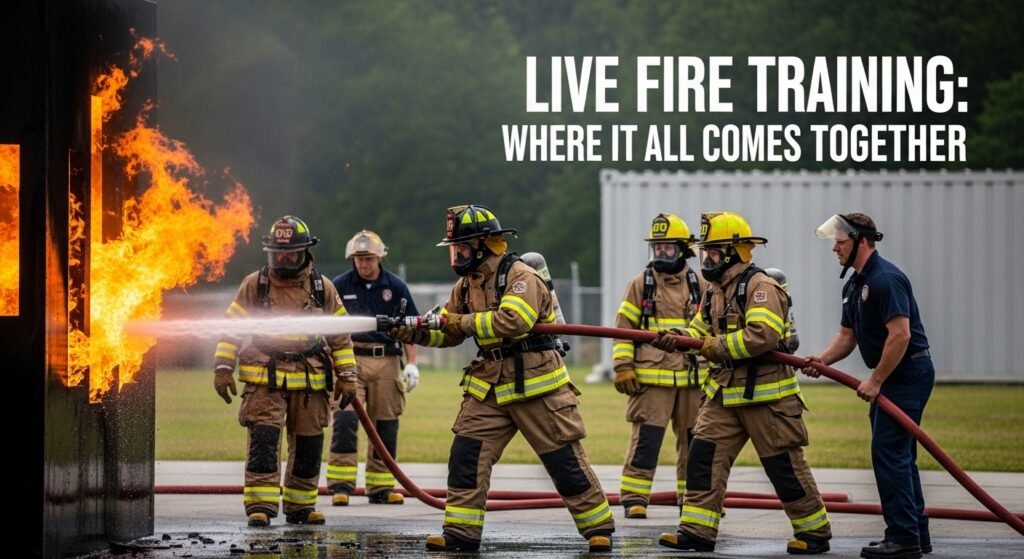
Near the end of your program, you’ll enter a live burn structure — a controlled building where instructors set real fires for you to suppress.
What to expect:
- Real heat, real smoke, real pressure
- Application of everything you’ve practiced
- Team coordination under stress
- Some programs run 24-hour exercises to test endurance
Most graduates describe live fire training as the defining moment of their course. It’s where theory becomes instinct.
Certification Requirements
After completing your course, you’ll sit for:
- A written exam (most programs require 80%+ to pass)
- A hands-on skills assessment
Successful completion earns you a Firefighter I or Firefighter II certification, issued by your state fire authority.
Before enrolling, most academies require:
- Valid CPR certification (AHA recommended)
- Medical clearance / physical exam
- ICS-100 completion (free online through FEMA)
- CPAT results (within past 12 months)
Note: Full certification requires in-person skills testing. Online-only programs cover theory but cannot replace the hands-on component.
Cost of Firefighting Training
| Program | Estimated Cost |
|---|---|
| Free online (NFA, NWCG) | $0 |
| Community college fire academy | $300–$800 |
| Private fire academy | $1,500–$2,000+ |
| Gear and textbooks (e.g., IFSTA Essentials) | $150–$400 |
Ways to reduce cost:
- Apply to departments that sponsor recruits in exchange for a service commitment
- Complete free prerequisites (ICS-100, S-130) before enrolling to reduce paid hours
- Check community college programs — often the most affordable accredited option
Free Basic Firefighting Training Resources
You don’t need to spend money to get started. Several legitimate free options exist:
- National Fire Academy (NFA) — Free online courses in fire behavior, safety fundamentals, and ICS
- NWCG S-130/S-190 — Free wildland fire courses recognized as prerequisites nationwide
- FEMA ICS-100 — Free Incident Command System basics, required by most academies
These don’t replace a full certification — but they build your knowledge base, reduce prep time in paid programs, and some count as formal prerequisites.
Volunteer Firefighting: A Smart Starting Point
If a full academy feels out of reach right now, consider the volunteer firefighter route:
- 32–40 hours of training, usually on evenings and weekends
- Fully NFPA-aligned curriculum
- Real calls, real experience, real community impact
- A low-pressure way to test whether a career path is right for you
Many career firefighters started as volunteers — it’s not a lesser path, it’s often the smarter one.
What Makes a Strong Firefighting Student?
Instructors aren’t looking for superheroes. They’re looking for people they’d trust in a burning building. That means students who:
- Show up consistently and take every drill seriously
- Ask questions rather than guessing
- Support teammates instead of competing against them
- Prepare physically before the course starts
- Study the material between sessions
Your Next Steps: How to Get Started
- Complete ICS-100 (free, online, takes a few hours) — most academies require it
- Get CPR certified — book a class this week
- Begin CPAT prep — 3 months minimum before your start date
- Contact your local volunteer fire department — ask about their next basic course
- Research your state fire academy — look up Firefighter I programs near you
FAQ’s
What are the basics of firefighting?
The basics include understanding fire behavior, correctly using fire extinguishers by class, operating SCBA equipment, applying suppression techniques, and working as a coordinated team. Most courses also cover search and rescue, hazmat awareness, and basic EMS response — all aligned with NFPA 1001.
How long does it take to become a certified firefighter?
A volunteer basic course takes 32–40 hours. Firefighter I certification requires 200–250 hours (10–14 weeks). A full fire academy covering Firefighter I and II runs 400–428 hours. Career recruit academies can extend up to 9 months with EMS and physical training included.
What does 5-5-5 mean to a firefighter?
The 5-5-5 bell signal is a traditional firefighter funeral toll — three rounds of five slow bell strikes — used to honor a firefighter who has died in the line of duty. It signifies the end of their last shift and is one of the most respected traditions in fire service.
Is free firefighting training available online?
Yes. The National Fire Academy and NWCG both offer free accredited online courses. FEMA’s ICS-100 is also free and required by most academies. These are legitimate starting points, but full certification always requires in-person hands-on testing.