


Contents
- 1 What Is CPR, Really?
- 2 What Is BLS (Basic Life Support)?
- 3 CPR vs BLS: Side-by-Side Comparison
- 4 The Real Difference in Practice
- 5 Does BLS Include CPR and AED?
- 6 Is BLS the Same as CPR and First Aid?
- 7 Who Needs What? A Profession-by-Profession Guide
- 8 CPR vs BLS vs ACLS: Understanding the Progression
- 9 Cost, Duration, and Validity: What to Expect
- 10 A Note on Online CPR Certification
- 11 Career Impact: Does Your Certification Choice Matter for Hiring?
- 12 Should You Take BLS or CPR First?
- 13 Key Takeaways: CPR vs BLS
- 14 FAQ’s
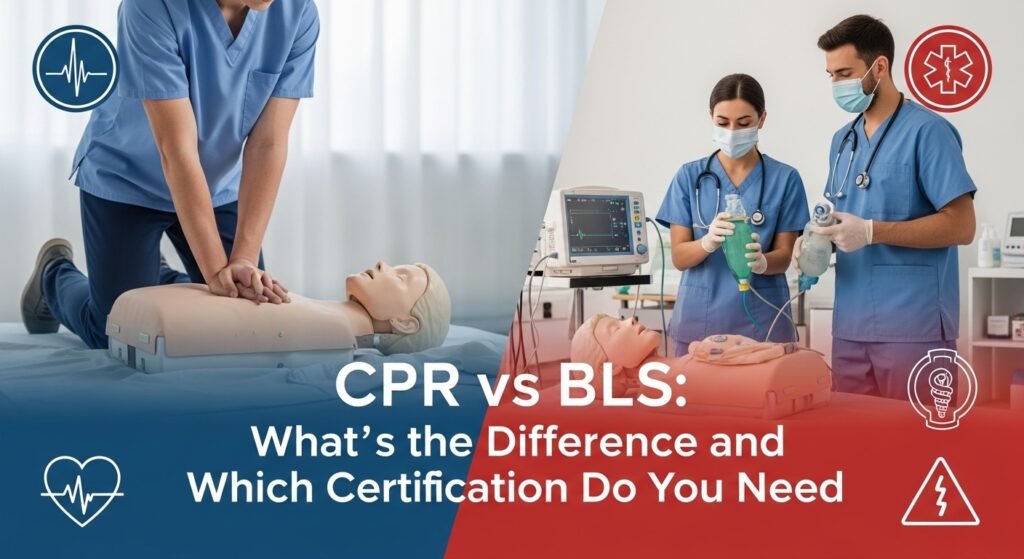
You’re applying for a nursing position, and the job posting says “BLS certification required.” But you already have a CPR certificate sitting in your drawer. Are they the same thing? Can you just submit that?
This is one of the most common points of confusion in healthcare and workplace safety training. Getting it wrong can delay your hiring, block your clinical placement, or leave you underprepared in an actual emergency.
The short answer: CPR and BLS are related but not the same. One is designed for the general public. The other is built for healthcare professionals who need to perform under pressure, in teams, with clinical tools.
This guide breaks down exactly what each certification covers, who needs which one, what they cost, how long they’re valid, and how to choose the right path for your career or workplace.
What Is CPR, Really?
CPR (cardiopulmonary resuscitation) is a physical technique that uses chest compressions and rescue breathing to keep blood and oxygen moving in someone whose heart has stopped beating.
Most people learn CPR in a few hours. The typical CPR certification course covers:
- Recognizing cardiac and respiratory arrest
- Chest compressions — rate, depth, and hand placement
- Rescue breathing and mouth-to-mouth technique
- Using an AED (Automated External Defibrillator)
- Basic choking response for adults, children, and infants
In Canada, CPR Level C with AED is the most common standard for workplaces, schools, and general community settings. It’s valid for 3 years and can often be completed through blended online and in-person formats.
CPR is designed for lay responders — a teacher, a security guard, a parent — someone who happens to be nearby when a person collapses, without clinical training.
What Is BLS (Basic Life Support)?
BLS (Basic Life Support) is CPR’s more advanced, clinically focused equivalent. It was developed specifically for healthcare providers — nurses, doctors, paramedics, dentists, and respiratory therapists — who respond to emergencies in structured medical settings.
A BLS provider course typically covers:
- High-performance CPR with correct technique and quality monitoring
- Pulse checks — not taught in standard CPR
- Bag-valve-mask (BVM) ventilation — a manual device used to breathe for a patient
- Multi-rescuer team coordination and role assignment
- Team dynamics and communication during resuscitation
- Adult, child, and infant CPR including 2-rescuer techniques
- AED use in a clinical context
- Recognition of special situations: opioid overdose, drowning, trauma
BLS is offered through the Heart & Stroke Foundation and the Canadian Red Cross. As of 2025, it is the standardized requirement across Ontario, Nova Scotia, and most Canadian provinces for clinical placements and healthcare employment.
Important: BLS must be completed in person. There is no fully online BLS option. BLS certification is valid for 1 year, with annual renewal required.
CPR vs BLS: Side-by-Side Comparison
Here is a clear breakdown of how the two certifications compare across the areas that matter most.
| Feature | CPR (Level C + AED) | BLS (Basic Life Support) |
|---|---|---|
| Target audience | General public, non-clinical workers | Healthcare professionals, clinical staff |
| Chest compressions | Yes | Yes (high-performance focus) |
| Rescue breathing | Basic | Advanced (BVM included) |
| AED use | Yes | Yes |
| Pulse check | No | Yes |
| Bag-valve-mask (BVM) | No | Yes |
| 2-rescuer technique | Rarely | Yes |
| Team dynamics training | No | Yes |
| Online option | Blended formats available | In-person only |
| Certification validity | 3 years | 1 year |
| Typical course duration | 4-8 hours | 4-7 hours |
| Average cost | $50-$100 CAD | $80-$150 CAD |
| Required for clinical roles | Generally not accepted | Mandatory |
| WSIB workplace compliance | Yes (non-clinical) | Yes (clinical/high-risk) |
The Real Difference in Practice
Consider a patient who goes into cardiac arrest in a hospital hallway. Within seconds, two nurses and a respiratory therapist respond. One nurse starts chest compressions. The second takes over the airway with a BVM. The therapist calls for the crash cart and manages team communication. That coordinated response — role assignments, BVM use, synchronized handoffs — is exactly what BLS trains for.
Now imagine the same cardiac arrest in a shopping mall food court. A nearby teacher calls 911, directs a bystander to grab the wall-mounted AED, and begins compressions. That’s CPR doing its job. No BVM. No pulse checks. Just immediate action that keeps the person alive until advanced help arrives.
Both are life-saving skills. They simply serve different people in different situations.
Does BLS Include CPR and AED?
Yes — completely. BLS builds on top of CPR rather than replacing it. If you hold a BLS certification, you have covered everything in a CPR Level C course plus the clinical additions. So if someone asks whether you know CPR, the answer is absolutely yes.
The reverse is not true. A CPR certificate does not mean you have completed BLS. For clinical jobs and hospital placements, this distinction is critical.
Is BLS the Same as CPR and First Aid?
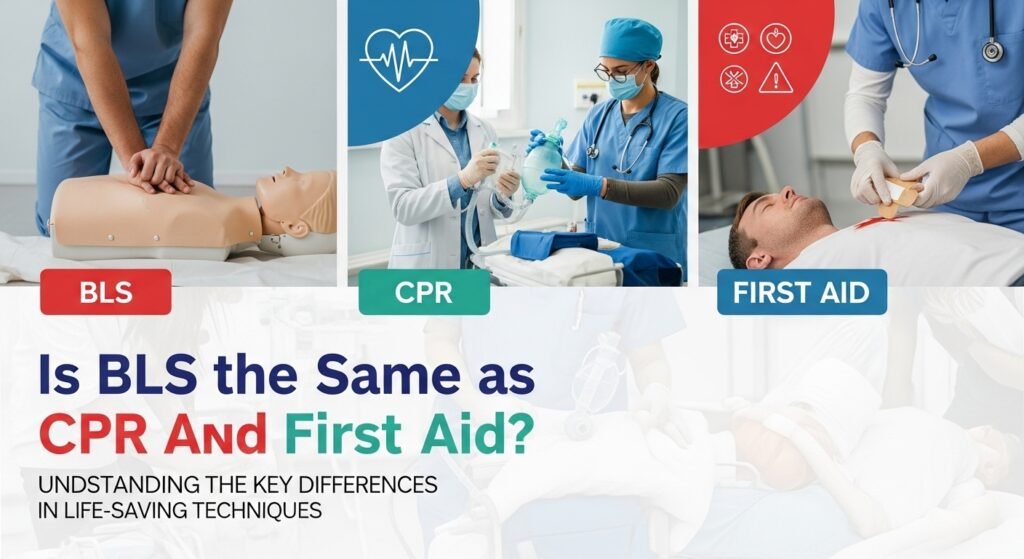
No. BLS focuses specifically on cardiac and respiratory emergencies — it does not cover wound care, fractures, burns, anaphylaxis management, or the broader first aid content required for workplace First Aid Attendant designations.
If your workplace requires both first aid and CPR/BLS, you will likely need separate certifications or a combined course that covers both areas.
Who Needs What? A Profession-by-Profession Guide
Healthcare Professionals — You Need BLS
If you work in a clinical environment, BLS is non-negotiable:
- Nurses and nursing students: BLS required for clinical placements at virtually all Ontario and Nova Scotia hospitals. Mohawk College and Ontario Tech mandate it before students enter a clinical setting.
- Doctors and medical students: BLS is a prerequisite for clinical rotations and the entry point before advancing to ACLS.
- EMTs and paramedics: BLS is foundational and required by most provincial licensing bodies.
- Dentists: The Royal College of Dental Surgeons of Ontario (RCDSO) mandates BLS for any dentist administering sedation.
- Pharmacists, physiotherapists, respiratory therapists: Required for patient safety compliance in clinical environments.
- Hospital and clinic support staff: BLS is increasingly expected at skilled nursing facilities and acute care settings.
Non-Clinical Workplaces — CPR Level C Is Your Standard
- Corporate offices, safety officers: CPR Level C with AED meets WSIB compliance requirements for most non-clinical workplaces.
- Construction and industrial workers: CPR Level C is the baseline. High-risk worksites may require additional first aid certification.
- Fitness professionals: CPR Level C is typically required for certification bodies. BLS is a strong differentiator but not usually mandated.
First Responders and Public Safety
- Firefighters and paramedics: BLS is standard — these are team-based responders using multi-rescuer protocols.
- Police officers and security personnel: CPR Level C is typically required, though some departments require BLS by jurisdiction.
- Lifeguards: CPR is central and integrated within NLS (National Lifeguard Service) training.
Education and Childcare
- Teachers and school staff: CPR Level C (including infant CPR) is the standard requirement.
- Childcare providers: CPR Level C including infant and child protocols is required for provincial licensing.
Students Entering Healthcare
If you are a student in nursing, paramedicine, dentistry, or any allied health field, get your BLS before your placement begins. Most clinical programs will send you home without it.
CPR vs BLS vs ACLS: Understanding the Progression
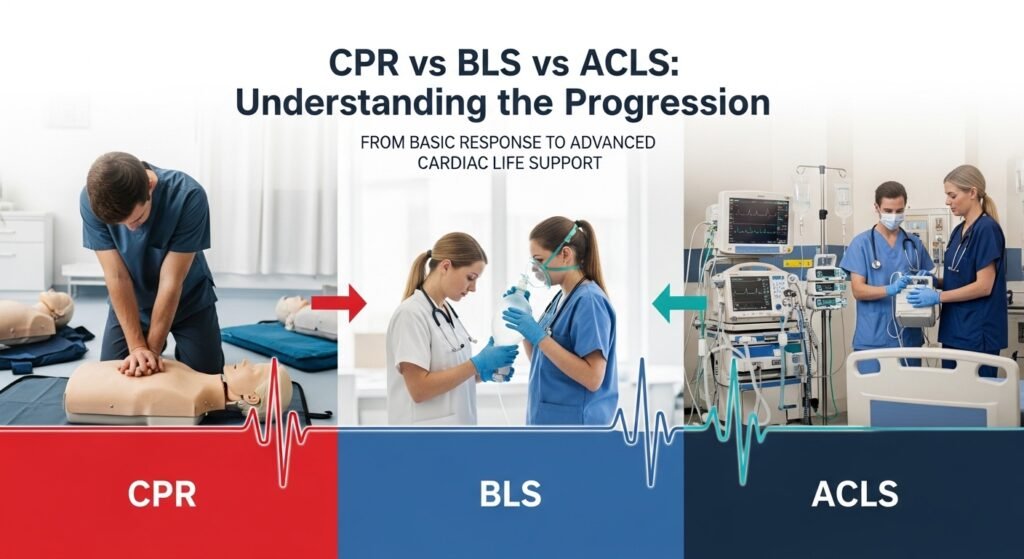
CPR, BLS, and ACLS form a progression, not a competition:
- CPR — Foundation. For anyone. Keeps someone alive with basic techniques.
- BLS — For healthcare providers. Expands CPR with clinical tools and team-based response.
- ACLS (Advanced Cardiovascular Life Support) — For experienced clinicians. Adds pharmacology, advanced airway management, cardiac rhythm interpretation, and complex team leadership.
You cannot take ACLS without a valid BLS certification. BLS is the gateway.
Cost, Duration, and Validity: What to Expect
CPR Level C + AED
- Duration: 4-8 hours (blended options may reduce in-person time)
- Cost: Approximately $50-$100 CAD
- Validity: 3 years
- Format: Online theory + in-person skills, or fully in-person
- Renewal: Recertification course every 3 years
BLS Provider Course
- Duration: 4-7 hours
- Cost: Approximately $80-$150 CAD
- Validity: 1 year
- Format: In-person only — no fully online option
- Renewal: Annual — every 12 months without exception
The annual renewal requirement for BLS is a real operational consideration. Hospitals, clinics, and healthcare programs track expiry dates and require staff to renew before the card lapses. Some employers cover the cost; others require staff to self-fund.
Not sure what BLS training will cost for your team or clinic? Get BLS Training Quote to find the right course and pricing for your team.
A Note on Online CPR Certification
You have probably seen ads for “online CPR certification” promising completion in an hour for $20. Be careful. Legitimate blended CPR courses include online theory with mandatory in-person skills testing. A purely online certificate with no hands-on component is generally not accepted by employers, WSIB, or clinical programs.
For BLS, there is no recognized online-only option. When searching for “CPR certification near me” or “BLS certification near me,” look for courses offered through the Heart & Stroke Foundation or Canadian Red Cross.
Career Impact: Does Your Certification Choice Matter for Hiring?
Yes — significantly. For clinical roles, submitting a CPR Level C when BLS is required will typically result in your application being flagged or your start date being delayed. Hiring managers and clinical educators check certification type and expiry date.
BLS demonstrates that you understand clinical emergency response, can work in a team under pressure, and meet the professional standard expected in patient-facing environments. Keeping your BLS current is less about career advancement and more about staying qualified for the role you already hold.
Should You Take BLS or CPR First?
Entering a healthcare career? Start with BLS — there is no benefit to taking CPR first and upgrading later. You will cover equivalent content and more in a single course.
Uncertain about your career path? CPR Level C is a practical and affordable starting point. You can transition to BLS when your direction becomes clear.
Currently working in a clinical role with only CPR? Check your employer’s requirements now. An expired or incorrect certification can affect your ability to practice.
Key Takeaways: CPR vs BLS
- CPR is for everyone. Accessible, broadly valid, and handles the most common emergency a non-clinician might face.
- BLS is for healthcare professionals. It includes CPR plus BVM, pulse checks, and team coordination — critical in hospital and clinic settings.
- BLS is not a substitute for first aid, and CPR is not a substitute for BLS in clinical environments.
- Renewal timelines matter: CPR every 3 years, BLS every year.
- For clinical placements and healthcare hiring, BLS is the expected standard — not optional.
Your next step: check your current certification, verify its expiry date, and compare it against your role or target job description. Book the appropriate course through Heart & Stroke or Canadian Red Cross if there is a gap.
Emergencies don’t wait for paperwork to be sorted. Neither should you.Ready to book your course or need group pricing? Get BLS Training Quote to find the right course and pricing for your team.
FAQ’s
What is the difference between CPR certified and BLS certified?
CPR certification teaches basic life-saving skills — chest compressions, rescue breathing, and AED use — designed for the general public. BLS includes all of those skills plus clinical additions like pulse assessment, BVM ventilation, two-rescuer techniques, and team coordination protocols. BLS is required for clinical employment and placements. Holding a CPR certificate does not satisfy a BLS requirement, but holding a BLS certificate demonstrates CPR competency.
Should I take BLS or CPR first?
If you are entering a healthcare profession — nursing, medicine, paramedicine, dentistry, or any allied health field — go straight to BLS. There is no advantage to taking CPR first and upgrading later. If you are in a non-clinical role or unsure of your career path, CPR Level C is a practical and affordable starting point.
What are the 5 steps of BLS?
While BLS does not follow a rigid 5-step script, the core sequence is: (1) Recognize the emergency — check for responsiveness and absent or abnormal breathing; (2) Activate the emergency response system and call for an AED; (3) Start high-quality CPR with correct rate and depth; (4) Manage the airway using BVM ventilation with a second rescuer; and (5) Defibrillate — use the AED as soon as it arrives, then resume CPR. In team settings, BLS emphasizes role assignment, clear communication, and rotating rescuers to maintain compression quality.
What does BLS not include?
BLS does not cover the broader scope of first aid. It generally does not include wound care, fracture management, burn treatment, or the full first aid curriculum required for workplace First Aid Attendant designations. BLS also does not include advanced pharmacology or cardiac rhythm interpretation — those are covered in ACLS, which is the next level up for experienced clinicians.