


Contents
- 1 Why Fire Safety Training Matters in Saudi Arabia
- 2 Types of Fire Safety Training Available in Saudi Arabia
- 3 Top Fire Safety Training Providers in Saudi Arabia
- 4 Most Popular Fire Safety and HSE Courses Explained
- 5 What Makes Good Fire Safety Training?
- 6 Career Opportunities After Fire Safety Training in Saudi Arabia
- 7 Safety Officer Salary in Saudi Arabia {#salary}
- 8 Online Safety Courses in Saudi Arabia — Are They Worth It?
- 9 How to Choose the Right Safety Course for Your Situation
- 10 Practical Tips for Freshers and Expatriates {#tips}
- 11 Your Path to a Fire Safety Career in Saudi Arabia
- 12 Frequently Asked Questions
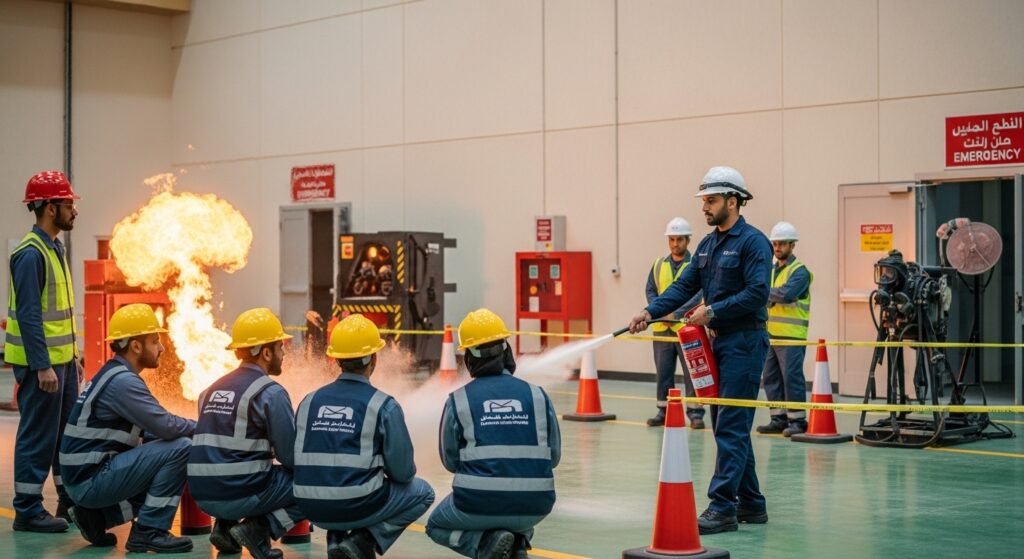
You’re working on a large construction site in Riyadh. There’s welding happening on one floor, flammable materials stored on another, and hundreds of workers going about their day. Then something goes wrong. A spark catches. Within minutes, what started as a small flame becomes a serious emergency.
Who steps in? The trained safety officer.
Fire safety is not a checkbox exercise in Saudi Arabia — it’s a legal requirement, a professional responsibility, and a career-defining skill. With Vision 2030 driving massive growth in infrastructure, construction, oil and gas, and hospitality, the demand for qualified professionals holding a safety officer course in Saudi Arabia has never been higher.
This guide covers everything you need to know: the top fire safety training courses, leading providers, career prospects, salary expectations, and practical advice for both freshers and expatriates.
Why Fire Safety Training Matters in Saudi Arabia
Saudi Arabia operates in one of the world’s most hazardous industrial environments. The oil and gas sector accounts for a significant share of workplace incidents, and fire-related risks are among the most common and most devastating.
According to the Saudi Civil Defense Authority, thousands of fire incidents are recorded annually across commercial, industrial, and residential settings. Workplaces involving chemical storage, heavy machinery, and confined spaces carry a particularly high risk of fire and explosion.
Beyond the human cost, businesses face regulatory consequences. Saudi labor law and the General Organization for Social Insurance (GOSI) set out clear employer obligations regarding workplace safety. Companies failing to meet fire safety standards risk penalties, project shutdowns, and serious reputational damage.
This is precisely why trained fire safety professionals are in demand — and why the right safety course in Saudi Arabia can open doors that were previously closed to you.
Types of Fire Safety Training Available in Saudi Arabia
Before choosing a course, it helps to understand what’s available. Fire safety training in Saudi Arabia generally falls into four categories:
1. Internationally Accredited Certifications
These globally recognized qualifications carry significant weight with multinational employers and major Saudi contractors:
- NEBOSH Fire Safety and Risk Management — the most sought-after qualification for fire safety specialists
- NEBOSH IGC (International General Certificate) — a broader HSE qualification including fire safety modules
- OSHA Certificate Saudi Arabia — OSHA 10-hour and 30-hour programs, widely accepted on US-linked projects
- NEBOSH IDIP — Diploma-level qualification for senior HSE professionals
2. Local Saudi Safety Certifications
Training centers in the Kingdom offer locally developed programs aligned with Saudi Civil Defense and SASO (Saudi Standards, Metrology and Quality Organization) requirements. These are particularly useful for professionals working in Saudi-owned firms or government-linked projects.
3. Short Courses and Awareness Programs
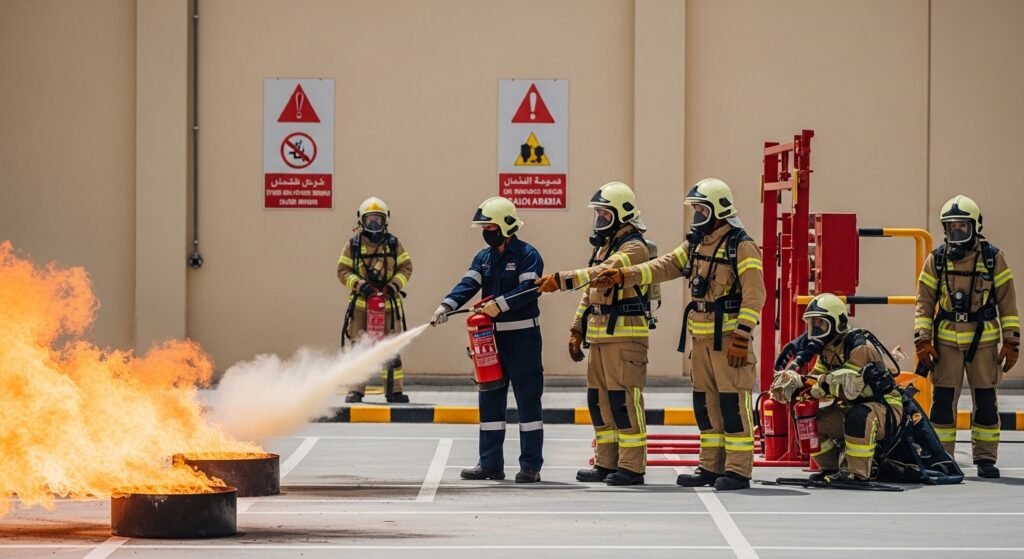
Typically 1–5 day programs covering fire warden duties, evacuation planning, fire extinguisher operation, and emergency response. Ideal for non-safety staff or professionals adding a specific skill.
4. Online Safety Courses in Saudi Arabia
The growth of online learning has made internationally recognized qualifications more accessible than ever. NEBOSH online courses and platform-based programs allow working professionals to study around their schedules. More on this below.
Top Fire Safety Training Providers in Saudi Arabia
Here are the leading organizations offering quality fire safety and HSE training across the Kingdom.
Arabian Safety Training Center
One of the most recognized names for safety training in Saudi Arabia, Arabian Safety Training Center offers courses from fire safety fundamentals to advanced HSE certifications. They serve professionals in Riyadh, Jeddah, and Dammam, with programs tailored to Saudi industrial requirements. Corporate training packages are also available.
NEBOSH-Accredited Learning Partners
Several NEBOSH-approved learning partners operate in Saudi Arabia, offering classroom and online delivery of:
- NEBOSH IGC (International General Certificate)
- NEBOSH Fire Safety and Risk Management
- NEBOSH PSM (Process Safety Management — critical for oil and gas)
- NEBOSH IDIP
Providers like NIST and similar centers have strong track records for NEBOSH delivery in the region. Always verify accreditation status directly on the NEBOSH official website before enrolling.
TSQC — Total Safety Courses
TSQC offers a broad portfolio of safety training solutions, including fire safety, emergency response, and HSE management, catering to both individual professionals and corporate clients.
OSHA-Authorized Training Organizations
For professionals targeting US-linked companies, oil refineries, or international contractors, OSHA-authorized centers provide the OSHA Certificate Saudi Arabia programs, including OSHA 10 and OSHA 30 certifications.
Most Popular Fire Safety and HSE Courses Explained
NEBOSH Fire Safety and Risk Management
This is the gold-standard qualification for fire safety specialists. It covers:
- Principles of fire and explosion
- Fire risk assessment techniques
- Fire prevention and protection systems
- Emergency planning and evacuation procedures
- Legal and regulatory frameworks
Duration: 4–6 weeks (varies by study mode)
Delivery: Classroom or online
Best for: Safety officers, fire wardens, facility managers, and anyone responsible for fire risk
The qualification is globally recognized and highly valued by Saudi employers in construction, oil and gas, manufacturing, and facilities management.
NEBOSH IGC — International General Certificate
The NEBOSH IGC is the most popular entry point into professional safety careers worldwide — and Saudi Arabia is no exception.
It provides a solid foundation across workplace health and safety, including fire safety, hazard identification, risk assessment, and workplace inspections. Many employers in Saudi Arabia list NEBOSH IGC as a minimum requirement for HSE officer roles.
Duration: 10–12 weeks
Delivery: Classroom or online
Best for: Safety officers at all levels, HSE supervisors, professionals transitioning into safety
NEBOSH PSM — Process Safety Management
For professionals in Saudi Arabia’s oil, gas, and petrochemical sectors, NEBOSH PSM is highly relevant. It focuses on managing fire, explosion, and toxic release hazards in process environments.
Best for: HSE professionals, engineers, and process safety specialists in energy industries
OSHA Certificate Saudi Arabia
OSHA certifications are widely valued on international construction and industrial projects. The OSHA 30-hour course is widely recognized and can be completed in a few days.
Duration: 10 or 30 hours
Delivery: Classroom or online
Best for: Supervisors, safety officers, and construction professionals
NEBOSH IDIP — International Diploma
For those targeting senior HSE management roles, the NEBOSH IDIP is the advanced qualification. It takes longer to complete but positions you as a senior-level professional.
Duration: 12–18 months
Delivery: Classroom or online
Best for: Experienced HSE professionals targeting management positions
What Makes Good Fire Safety Training?
Not all courses are equal. Quality fire safety training should include:
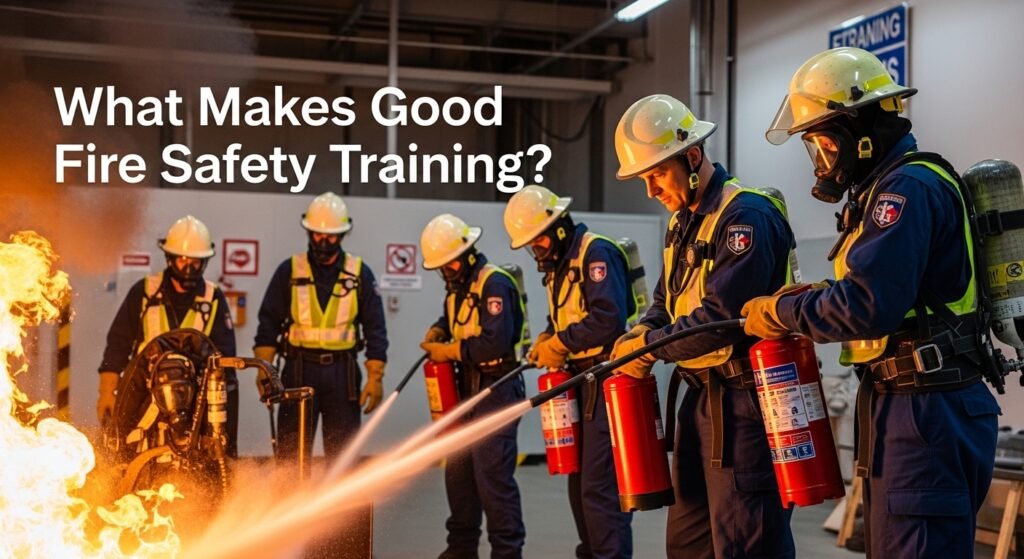
Practical, Hands-On Components: Look for live fire extinguisher drills, evacuation simulations, and real-scenario risk assessments. Purely lecture-based courses are a red flag.
Scenario-Based Learning: Real workplace case studies and incident investigations deliver lasting learning.
Recognized Accreditation: Always verify your course is accredited. For NEBOSH, check the official accreditation list. For OSHA, confirm trainers are OSHA-authorized. Unaccredited courses may not be accepted by serious employers.
Rigorous Assessment: Courses with meaningful assessments — like NEBOSH’s written exams and practical components — ensure you actually understand the material. This rigor is why employers trust them.
Career Opportunities After Fire Safety Training in Saudi Arabia
Safety Officer Jobs in Saudi Arabia
Safety officers conduct fire risk assessments, develop emergency procedures, train staff, perform safety inspections, and liaise with Civil Defense authorities. Safety officer jobs in Saudi Arabia span construction, oil and gas, manufacturing, healthcare, hospitality, and government sectors.
HSE Officer Jobs in Saudi Arabia
HSE officer jobs in Saudi Arabia typically require recognized qualifications like NEBOSH IGC and involve broader health, safety, and environmental responsibilities — a step up from basic safety officer roles.
Safety Officer Jobs in Saudi Arabia for Freshers
Fresh graduates can break into the field. Many employers hire into junior safety roles — especially candidates holding a recognized certification like NEBOSH IGC or an OSHA certificate. Starting positions include Safety Assistant, Junior HSE Officer, Fire Warden Coordinator, and Site Safety Inspector.
Safety Jobs in Saudi Arabia for Expatriates
Saudi Arabia has a large expatriate workforce, and safety roles are open to international professionals. Safety jobs in Saudi Arabia for expatriates are particularly common in construction, oil and gas, mining, utilities, hospitality, and facilities management. Internationally recognized certifications transfer directly.
Safety Officer Salary in Saudi Arabia {#salary}
Salary ranges based on available market data:
| Experience Level | Monthly Salary (SAR) | Annual Salary (SAR) |
|---|---|---|
| Entry-level (< 1 year) | ~3,750 | ~45,000 |
| Average | ~5,533 | ~51,000+ |
| Experienced (12+ years) | 5,885+ | 70,000+ |
| Senior (oil & gas / int’l contractor) | Up to 10,000 | Up to 120,000 |
Key insight: Holding a NEBOSH qualification consistently positions professionals at the higher end of these salary ranges. Oil and gas companies and major international contractors typically pay the most.
Online Safety Courses in Saudi Arabia — Are They Worth It?
For many professionals, online safety courses in Saudi Arabia are the most practical option. Long hours on project sites don’t leave room for evening classes. Online NEBOSH courses let you study at your own pace without extended time off work.
What to check before enrolling:
- Accreditation — confirm the provider is officially approved by NEBOSH, OSHA, or the relevant body
- Tutor support — good online programs include qualified tutor access, not just video content
- Assessment format — understand how exams are conducted (online-proctored or exam center)
- Study community — learning with peers improves completion rates and outcomes
A legitimate NEBOSH online course from an accredited provider carries exactly the same recognition as one completed in a classroom. Employers look at the certificate, not the delivery method.
How to Choose the Right Safety Course for Your Situation
Complete beginner? Start with NEBOSH IGC or OSHA 30-hour. Both are accessible, widely recognized in Saudi Arabia, and provide a strong foundation.
Focused specifically on fire safety? NEBOSH Fire Safety and Risk Management is purpose-built for this and what employers in fire-risk industries look for.
Working in oil, gas, or petrochemicals? Consider NEBOSH PSM alongside or after your IGC. Process safety is a specialized, high-value skill set in Saudi Arabia.
Aiming for senior HSE roles? Work toward NEBOSH IDIP. It requires commitment but opens doors to HSE Manager and Director-level positions.
Course Fees Comparison
| Course | Estimated Fee (SAR) |
|---|---|
| Short fire safety awareness courses | 500–2,000 |
| OSHA 10/30 certifications | 1,500–4,000 |
| NEBOSH IGC | 4,000–10,000 |
| NEBOSH Fire Safety and Risk Management | 5,000–12,000 |
| NEBOSH IDIP | 15,000–25,000+ |
Online delivery is often cheaper than classroom training. Many Saudi employers fund professional certifications — always ask your HR department before paying yourself.
Practical Tips for Freshers and Expatriates {#tips}
Get certified before you job-hunt. Even an OSHA 10-hour or basic NEBOSH qualification changes how employers view your application.
Join professional networks. The Saudi Chapter of IOSH and LinkedIn safety professional groups in the Gulf region are valuable for making connections and hearing about opportunities.
Understand local regulations. Knowledge of SASO and Saudi Civil Defense requirements demonstrates local awareness that impresses employers.
Learn basic Arabic safety terms. For expatriates, even a working knowledge of safety-related Arabic can set you apart with mixed-nationality teams.
Plan realistically. A NEBOSH IGC typically takes 3–4 months to complete. Build this into your work schedule so you’re not rushing your studies.
Your Path to a Fire Safety Career in Saudi Arabia
Fire safety is one of the most important and fastest-growing professional specializations in Saudi Arabia. Whether you’re a fresh graduate, an experienced professional wanting to specialize, or an expatriate building a career in the Kingdom, the pathway is clear:
- Beginners: NEBOSH IGC or OSHA 30 — accessible and widely recognized
- Fire safety specialists: NEBOSH Fire Safety and Risk Management
- Oil and gas professionals: Add NEBOSH PSM to your credentials
- Senior ambitions: Work toward NEBOSH IDIP
- Online learners: Choose an accredited provider with tutor support included
- Expatriates: International certificates transfer well; supplement with Saudi-specific regulatory knowledge
Research accredited providers in Riyadh, Jeddah, Dammam, or online — compare fees and delivery modes, and commit to starting. Every qualified safety officer started exactly where you are now.
Frequently Asked Questions
Which safety course is best for Saudi Arabia?
The NEBOSH International General Certificate (IGC) is widely considered the best starting point for safety professionals in Saudi Arabia. It’s recognized across all major industries — construction, oil and gas, manufacturing, and facilities management. For fire safety specialists, the NEBOSH Fire Safety and Risk Management certificate is the most targeted qualification. For US-linked projects or construction roles, the OSHA 30-hour certificate is also highly valued.
What is the salary of a safety officer in Saudi Arabia?
Entry-level safety officer salaries start at around SAR 3,750 per month (approximately SAR 45,000 annually). The average sits around SAR 5,533 monthly. Experienced professionals and those working in oil and gas or with international contractors can earn up to SAR 10,000 per month. Holding a NEBOSH qualification consistently positions professionals at the higher end of the salary range.
How do I get a NEBOSH certificate in Saudi Arabia?
Enroll with an officially accredited NEBOSH learning partner in Saudi Arabia. Providers in Riyadh, Jeddah, and Dammam offer classroom delivery; online options are available through accredited providers worldwide. Always verify provider accreditation on the NEBOSH official website before enrolling. NEBOSH IGC is the most popular starting point, with course fees typically ranging from SAR 4,000 to SAR 10,000.
What is the difference between a safety officer and an HSE officer in Saudi Arabia?
A safety officer focuses primarily on ensuring workplace safety compliance, conducting inspections, and managing fire and emergency procedures. An HSE officer covers a broader scope — Health, Safety, and Environment — typically requiring higher qualifications like NEBOSH IGC and carrying more strategic responsibilities. HSE officer roles generally command higher salaries and are more common in larger organizations.