



Picture this: you’ve just spotted a safety officer vacancy in Dubai or Riyadh that pays well, comes with benefits, and looks like everything you’ve been working toward. Then you scroll down to the requirements. “OSHA certification preferred.” Sound familiar?
If you’ve been job hunting in the Gulf, you’ve seen this phrase more times than you can count. And there’s a good reason employers keep asking for it.
The Gulf Cooperation Council (GCC) countries — Saudi Arabia, UAE, Qatar, Kuwait, Oman, and Bahrain — are in the middle of massive construction booms, oil and gas expansions, and infrastructure megaprojects. All of that activity means workplaces with serious safety risks. And serious safety risks mean employers need qualified people who know what they’re doing.
That’s exactly where OSHA certification career Gulf opportunities come in. This article breaks down what OSHA certification actually means for your career, how it translates to real salaries, and how you can use it to stand out in one of the most competitive job markets in the world.
What Is OSHA Certification and Why Do Gulf Employers Care?
OSHA stands for the Occupational Safety and Health Administration. It’s a U.S. federal agency, but its training programs — particularly the 10-hour and 30-hour outreach courses — have become globally recognized benchmarks for workplace safety knowledge.
When a Gulf employer asks for OSHA certification, they’re not necessarily expecting you to know U.S. labor law. They want to know that you understand:
- Hazard identification
- Risk assessment
- Safety compliance
- Emergency procedures
OSHA training provides exactly that foundation.
The 10-hour course covers basic safety awareness and is great for entry-level roles. The 30-hour course goes deeper into management-level safety practices and is typically what’s required for HSE officer and engineer positions. Some advanced roles also mention OSHA 100 certification, which refers to more specialized safety training programs.
The Numbers Don’t Lie: OSHA Job Demand in the Gulf
Here’s a concrete way to understand the demand.
According to data from Naukrigulf, there were over 1,721 OSHA-related job vacancies listed in early 2026, with the majority concentrated in the UAE, particularly Abu Dhabi and Dubai. Saudi Arabia followed closely, with roles ranging from safety officers on construction sites to HSE engineers in oil and gas facilities.
These aren’t just entry-level listings either. Many roles require:
- Four to eight years of experience
- A bachelor’s degree
- OSHA certification
- Additional certifications like NEBOSH or IOSH
The point is — the demand is very real and growing.
LinkedIn data also reflects this trend. HSE-related roles consistently rank among the most actively searched jobs in the Gulf, and candidates with certifications listed on their profiles receive significantly more recruiter outreach than those without.
Salary Ranges by GCC Country: What Can You Actually Earn?
One of the most common questions people ask is:
“What’s the HSE officer salary in Saudi Arabia compared to other Gulf countries?”
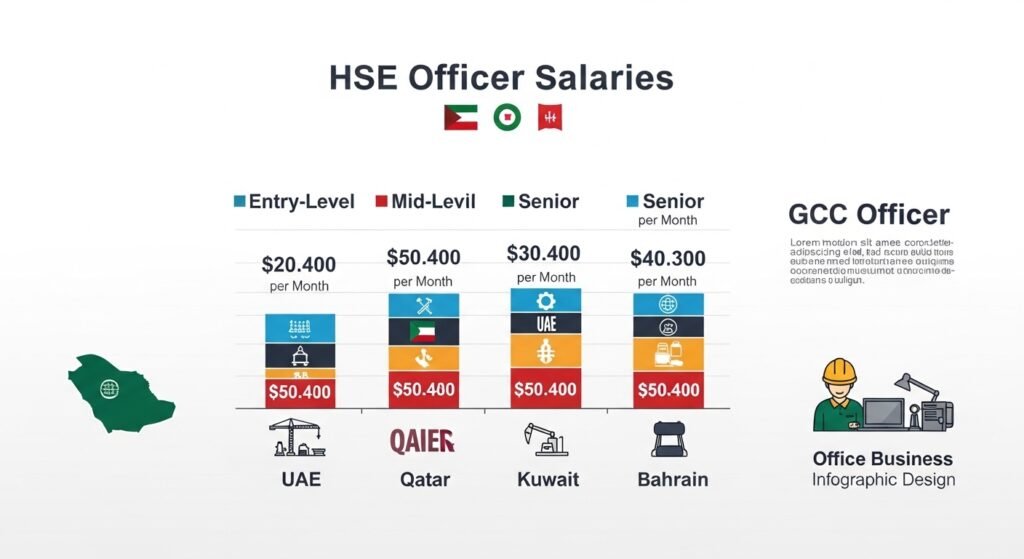
Here’s a realistic overview based on current market data:
| Country | Entry-Level HSE Officer | Mid-Level HSE Engineer | Senior HSE Manager |
|---|---|---|---|
| Saudi Arabia (KSA) | $800 – $1,500/month | $2,000 – $3,500/month | $4,500 – $7,000/month |
| UAE | $1,000 – $1,800/month | $2,500 – $4,000/month | $5,000 – $8,000/month |
| Qatar | $1,200 – $2,000/month | $3,000 – $4,500/month | $5,500 – $9,000/month |
| Oman | $700 – $1,200/month | $1,500 – $2,800/month | $3,500 – $6,000/month |
| Kuwait | $900 – $1,500/month | $2,000 – $3,200/month | $4,000 – $6,500/month |
| Bahrain | $700 – $1,200/month | $1,500 – $2,500/month | $3,000 – $5,500/month |
These figures are approximate and vary based on:
- Sector
- Company size
- Nationality
- Experience
Oil and gas roles typically sit at the higher end. Construction and manufacturing fall somewhere in the middle.
The key takeaway: OSHA certification alone won’t guarantee the top salary. But it consistently opens the door to roles that pay significantly more than non-certified positions.
Your Career Path: From Certification to Senior Roles
Think of OSHA certification as a starting point, not a destination.
Here’s how a typical career progression looks for safety professionals in the Gulf:
Stage 1 — Entry Level (0–2 years)
Complete OSHA 10 or OSHA 30. Apply for junior safety officer roles, site safety inspectors, or HSE coordinator positions. Focus on construction or manufacturing to build hands-on experience.
Stage 2 — Mid Level (3–5 years)
Add NEBOSH IGC (International General Certificate) to your credentials. Target HSE engineer or lead safety officer roles in oil and gas or large infrastructure projects. Your OSHA foundation becomes valuable context here.
Stage 3 — Senior Level (6+ years)
Pursue advanced certifications like NEBOSH Diploma or IOSH Managing Safely. Move into HSE manager, regional safety director, or consulting roles. At this level, Gulf salaries become genuinely competitive on a global scale.
The combination of OSHA + NEBOSH is consistently mentioned in Gulf job listings as the preferred certification stack. If budget allows, working toward both gives you a meaningful edge.
Real Voices: What Certified Professionals Say
Ahmed R., Safety Officer in Riyadh:
“I completed my OSHA 30-hour online and added it to my resume alongside my diploma. Within three months, I got an interview for a site safety role with a major contractor in KSA. The hiring manager specifically said the OSHA certification stood out.”
Maria S., HSE Engineer in Abu Dhabi:
“I was changing careers from general engineering. OSHA 30 gave me the vocabulary and confidence to speak about safety systems in interviews. It wasn’t the only thing that got me the job, but it definitely helped me get in the room.”
James O., Fresh Graduate, Doha:
“I couldn’t afford NEBOSH straight away. I started with OSHA 10 online, then moved to OSHA 30. I got an entry-level role in construction safety in Qatar within six months. Now I’m saving toward my NEBOSH.”
These aren’t extraordinary stories. They’re fairly typical experiences for people who approach certification strategically rather than randomly collecting qualifications.
How Much Does OSHA Certification Cost?
Cost is a real concern for many candidates, especially those transitioning careers or just starting out.
Here’s the practical breakdown:
- OSHA 10-hour course: Generally ranges from $30 to $100 USD online. Physical wallet cards are often shipped within a couple of days.
- OSHA 30-hour course: Typically $150 to $250 USD online.
- Free OSHA training: OSHA.gov offers some free resources and introductory content. Certain non-profit organizations also provide subsidized access, particularly for construction workers.
It’s worth noting that “free OSHA certification” as a fully accredited credential doesn’t really exist — but free learning materials can help you prepare. If you’re serious about using OSHA for Gulf job applications, invest in the proper accredited course. The cost is low relative to the salary increase it can support.
Important: What OSHA Certification Won’t Do
It’s worth being honest here. 🎯
OSHA certification on its own will not land you a senior role in a major oil and gas company. Gulf employers, especially in KSA and UAE, have become more selective. They want certifications plus real site experience plus familiarity with local safety regulations.
A few honest limitations to keep in mind:
- OSHA alone isn’t enough for senior roles. NEBOSH or equivalent is typically expected at engineer and manager levels.
- Gulf experience matters. Recruiters often prefer candidates who have already worked in the region or understand local conditions like extreme heat risks and multicultural team dynamics.
- Local regulation alignment is essential. Saudi Arabia and other GCC countries have their own HSE compliance frameworks. Understanding how OSHA principles apply alongside local rules gives you a real advantage in interviews.
None of this means OSHA isn’t valuable. It absolutely is. Just use it as part of a broader career strategy, not a standalone solution.

Practical Steps to Get Started This Week
You don’t need months of preparation to begin.
Here’s a simple action plan:
- Choose your course level. Entry level? Start with OSHA 10. Targeting engineer roles? Go straight to OSHA 30.
- Select an accredited provider. Look for OSHA-authorized outreach training programs. OSHA.com and similar platforms offer recognized online courses.
- Update your LinkedIn profile. Add the certification under licenses and certifications. Use relevant keywords like “HSE officer,” “safety compliance,” and your target country.
- Search active job listings. Naukrigulf, LinkedIn, and Bayt.com are the primary Gulf job platforms. Filter by “OSHA” to see what’s currently open.
- Plan your next certification. Once you’re earning, look into NEBOSH IGC as your next step.
The barrier to entry is genuinely low. The question is whether you take that first step.
Bringing It All Together
OSHA certification career Gulf opportunities are not hype. The vacancy numbers, salary data, and employer requirements all point in the same direction — safety professionals with recognized credentials are in consistent demand across the GCC region in 2026 and beyond.
Whether you’re a fresh graduate looking for your first role, a professional changing careers, or an experienced safety officer wanting to move into the Gulf market, OSHA training provides a credible, affordable, and practical foundation to build from.
Start with OSHA 10 or 30. Pair it with real-world experience and local knowledge. Work toward NEBOSH as your career progresses. And keep your LinkedIn profile updated — because the Gulf market moves fast, and opportunities go to candidates who are ready.
FAQ’s
How OSHA Certification Boosts Your Career in the Gulf Region?
Yes, OSHA certification is recognized by Gulf employers and is listed as a requirement or preference in over 1,700 job vacancies across the GCC. However, it works best when combined with relevant experience and complementary certifications like NEBOSH. Entry-level roles in construction and manufacturing are the most accessible starting points for OSHA-certified candidates without Gulf experience.
Which is better for Gulf jobs — NEBOSH or OSHA?
Both are valued, but they serve different purposes. OSHA is more accessible and affordable, making it ideal for entry-level candidates. NEBOSH, particularly the International General Certificate (IGC), is more widely recognized for mid-to-senior level HSE engineer and manager roles in the Gulf. Many successful safety professionals hold both. If you’re just starting out, OSHA 30 is a practical and cost-effective first step.
What does OSHA certification cost for Gulf job seekers?
Online OSHA 10-hour courses typically cost between $30 and $100 USD. The OSHA 30-hour course, which is more relevant for Gulf HSE roles, generally ranges from $150 to $250 USD. Some free learning resources exist through OSHA’s official website, but a properly accredited course is recommended for job applications. Given the salary ranges in the Gulf, the investment pays for itself quickly.
What OSHA certifications are most useful for Gulf careers?
The OSHA 30-hour General Industry or Construction course is the most relevant for Gulf job seekers, as it covers the depth of safety knowledge employers expect. OSHA 10 works well for entry-level or support roles. Some senior positions reference OSHA 100 or advanced safety programs, which typically require more experience and specialized focus areas like process safety or environmental management.
How do I find OSHA certified jobs in KSA and other GCC countries?
The most effective platforms for finding OSHA certified jobs in Saudi Arabia and the wider GCC are Naukrigulf, LinkedIn, and Bayt.com. Search using terms like “HSE officer,” “safety engineer,” and “OSHA certified” along with your target country. Setting up job alerts helps you respond quickly to new listings. Keeping your LinkedIn profile updated with your certifications also increases recruiter visibility significantly.