


Contents
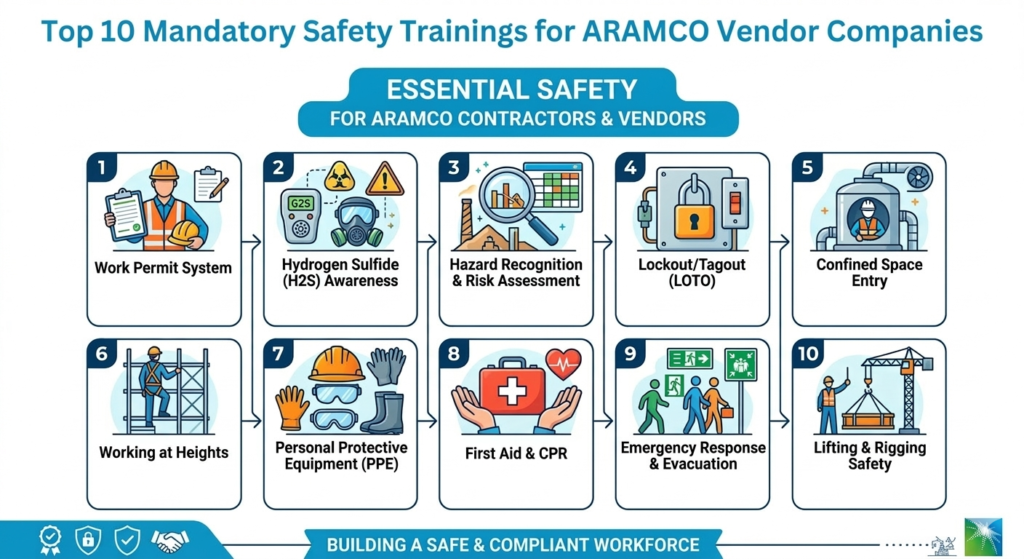
If your company supplies to Saudi Aramco, your workforce must meet strict HSE certification requirements before they can step on site. That’s not a suggestion — it’s a condition of doing business.
Whether you’re a small contractor in Al Khobar or a mid-size service firm looking to grow your Aramco book of work, your team’s safety credentials are reviewed before any access is granted. Missing a certification doesn’t just delay a project — it can cost you the contract entirely.
Why ARAMCO Enforces Such Strict Vendor HSE Requirements
Saudi Aramco operates in one of the most hazardous industrial environments in the world. Oil and gas worksites carry real risks — fires, toxic gases, heavy equipment failures, and confined space incidents are not theoretical concerns. They happen.
To manage those risks, Aramco holds its vendors to the same standards it holds its own workforce. Their Contractor Workforce Qualification Assurance Program (CWQAP) requires that technicians working on Aramco sites be evaluated and certified through Aramco-authorized training institutes.
Beyond safety, there’s a business case here too. Vendors who maintain proper HSE documentation — training records, risk assessments, incident logs — move through the vendor registration process faster. Companies with ISO 45001-aligned programs and clean training records consistently see stronger bid outcomes and smoother onboarding.
The message is simple: certified teams get access. Uncertified teams don’t.
The 10 Most Required HSE Training Certifications for ARAMCO Vendors
1. H2S Awareness Hydrogen sulfide is odorless at high concentrations and lethal within seconds. Any worker entering oil and gas facilities in the Eastern Province must understand H2S risks, detection methods, and emergency response. This is non-negotiable on virtually every Aramco site.
2. SCBA (Self-Contained Breathing Apparatus) Knowing H2S exists isn’t enough — workers must be trained to use their breathing equipment correctly under pressure. SCBA training covers donning, doffing, seal checks, and emergency protocols. Aramco’s CSAR standards specify oxygen concentration thresholds (20–23.5%) that SCBA users must be able to identify and respond to.
3. PTW (Permit to Work) The Permit to Work system is Aramco’s primary tool for controlling hazardous work activities. Anyone involved in issuing, approving, or executing permits must understand the system. Errors in PTW procedures are among the most common audit findings at contractor sites.
4. Confined Space Entry Storage tanks, vessels, pipelines, and manholes — confined spaces are everywhere on Aramco facilities. Entry without proper training is a serious compliance violation. Training covers atmospheric testing, isolation procedures, rescue planning, and entry/exit protocols.
5. Fire Watch Aramco requires a designated fire watcher within 3 meters (10 feet) during welding or cutting operations, equipped with a fire extinguisher — and maintained for 30 minutes after work stops. Workers in this role need formal training to understand their responsibilities, not just a job-site briefing.
6. First Aid & Basic Life Support (BLS) Medical emergencies don’t wait for an ambulance. Aramco expects vendor teams — especially supervisors and safety officers — to have certified first aid and BLS training. This directly impacts emergency response capability on site and is a common requirement in vendor prequalification documents.
7. Working at Heights Falls remain one of the leading causes of fatalities in oil and gas construction globally. This training covers fall hazard identification, harness inspection, ladder safety, and rescue procedures. Aramco’s scaffolding and elevated work requirements under CSAR make this one of the most frequently checked certifications during site audits.
8. Rigging & Lifting Crane and lifting operations involve some of the highest mechanical energy on any worksite. Training ensures workers understand load calculations, sling inspection, lifting plan requirements, and communication protocols. An error here can be catastrophic — for people and equipment alike.
9. HAZCOM (Hazard Communication) Workers handling chemicals on Aramco sites must understand Safety Data Sheets (SDS), labeling systems, and proper handling procedures. Particularly relevant for vendor companies supplying maintenance, cleaning, or chemical services, and ties directly into Aramco’s material control requirements.
10. Defensive Driving Vehicle incidents are one of the most frequent causes of contractor fatalities across the GCC oil and gas sector. Aramco mandates defensive driving certification for anyone operating vehicles on or between its facilities — covering journey management, fatigue awareness, and emergency response, not just road rules.
How to Manage Training Records for ARAMCO Audits
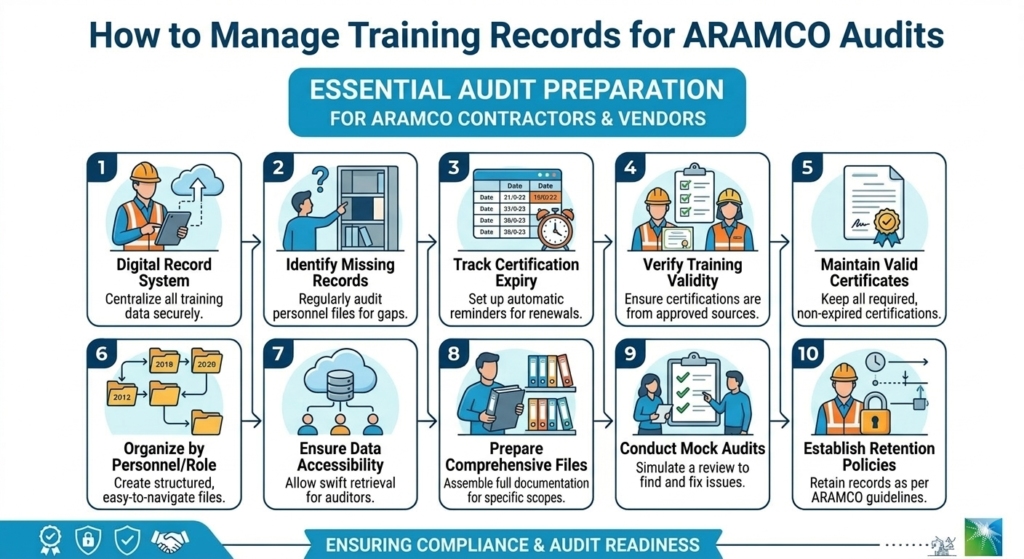
Certification alone isn’t the finish line. Aramco auditors want to see organized, up-to-date training records — and gaps in documentation can be just as problematic as gaps in training.
Your HSE management system should include:
- Individual training matrices showing each worker’s certifications, issue dates, and expiry dates
- Copies of original certificates from accredited training providers
- Refresher tracking — most certifications require renewal every 1–3 years
- Evidence of gap analysis — how your current workforce stacks up against site access requirements
A common mistake among mid-size vendors in Al Khobar and Dammam is treating training as a one-time event rather than an ongoing compliance program. Aramco’s vendor evaluations look at trends, renewals, and whether your HSE system is actually functioning. Using a simple spreadsheet or HSE management platform to track certifications by employee, by site, and by renewal date can save significant stress when an audit arrives.
How EUTC Supports ARAMCO Vendor Companies
Coordinating HSE training across a vendor workforce — especially under time and budget pressure — is a real operational challenge. EUTC (Eastern Union Training Center) offers structured corporate training packages specifically designed for companies supplying to Saudi Aramco and other major operators in the Eastern Province.
Their programs cover the full scope of Oil & Gas and Construction HSE trainings required for Aramco site access, including all 10 certifications outlined above, with:
- Group sessions scheduled around your project timelines
- Certification documentation provided in audit-ready formats
- Training delivered by instructors with direct industry experience in KSA
Getting training organized early — not at the last minute — is the difference between being ready and being turned away at the gate.
Frequently Asked Questions
What HSE standards does Aramco require from vendor companies?
Aramco’s HSE standards for vendors are governed by its Construction Safety and Administrative Requirements (CSAR) and the CWQAP. Vendors must maintain documented HSE policies, risk assessments, incident reporting systems, and employee training records. Alignment with ISO 45001 is strongly recommended and increasingly expected during vendor prequalification reviews.
Is ARAMCO vendor HSE training available online?
Some preparatory and awareness-level resources are available online through the supplier portal. However, certifications requiring practical demonstration — such as SCBA, confined space entry, and rigging — must be completed through Aramco-authorized training institutes with in-person components. Online-only options are generally not accepted for site access.
How do I become an Aramco-approved safety officer?
You typically need a recognized HSE qualification (such as NEBOSH or IOSH), relevant certifications in the mandatory CWQAP areas, and documented field experience. Approval is determined through the contractor company’s prequalification process rather than an individual application.
Which certifications should my team prioritize first?
For first-time Aramco site mobilization, prioritize H2S Awareness, PTW, and Confined Space Entry — the most commonly required across all facility types. Follow with SCBA, Fire Watch, and First Aid/BLS. Working at Heights, Rigging & Lifting, HAZCOM, and Defensive Driving complete the standard set. Exact requirements depend on your scope of work and facility type.
How does my company get Aramco vendor certification?
Through the supplier registration and prequalification process on the Aramco supplier portal. You’ll need to submit HSE documentation including your safety management system, training records, and relevant ISO certifications. Individual worker certifications must come from Aramco-authorized training providers.